
Tsujimoto Market: Our Guarantees
Description
DHC Fucoidan — Mekabu Seaweed Extract, 60 Tablets / 30 Days
Overview
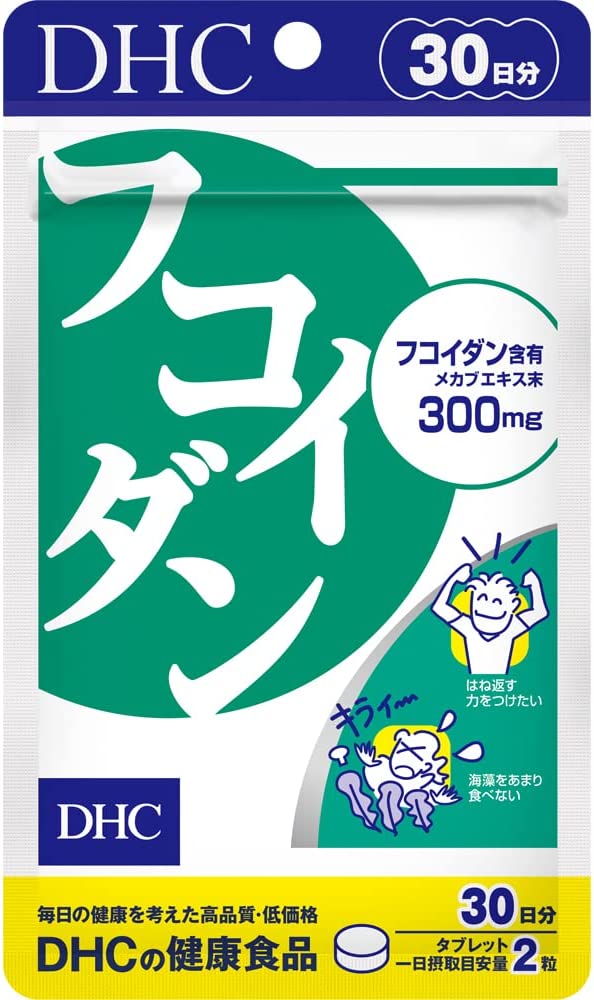
DHC sells this in Japan as フコイダン 30日分, item 2299. It is a food supplement built on mekabu — the frilled base of the wakame plant — concentrated until the extract's fucoidan content reaches 80%, which is the figure DHC prints on the panel.
DHC's stated amount is two tablets a day, and the pack holds sixty. That is what makes it thirty days. This page previously said three a day, which would have emptied the pack in twenty and taken you past the daily amount DHC asks buyers to observe; the figures below are now DHC's own throughout. Compare our other Japanese supplements, or the Orihiro fucoidan capsule, which delivers the same 300 mg a day in a different carrier.
Key Benefits
- ✓ 300 mg of mekabu extract per daily 2 tablets, with the extract standardised at 80% fucoidan
- ✓ Sixty tablets in the pack — a full thirty days at DHC's own stated amount, with nothing to ration
- ✓ Small oblong tablet, about 9.0 × 5.3 mm, swallowed whole with no seaweed taste
- ✓ Mekabu extract powder produced in Japan; the full ingredient list and panel are printed below
- ✓ Declared by DHC as メカブエキス末含有食品 — a food, with no medicine or quasi-drug status claimed
- ✓ Japanese-market pack (JAN 4511413603697), dispatched from our Kobe warehouse with tracking
Product Details
| Brand | DHC |
|---|---|
| Product name (Japan) | フコイダン 30日分 — DHC item 2299 |
| Legal name | メカブエキス末含有食品 — food containing mekabu extract powder |
| Product type | Food supplement (健康食品). Not a medicine and not a quasi-drug |
| Format | Tablet, approx. 9.0 mm long × 5.3 mm thick |
| Net content | 19.8 g — 330 mg × 60 tablets |
| Daily amount (DHC) | 2 tablets — one pack is 30 days |
| Key component | Mekabu extract powder 300 mg per 2 tablets, fucoidan 80% |
| Country of origin | Japan; mekabu extract powder produced domestically |
| JAN | 4511413603697 |
Who Is This For?
- Someone who wants a measured, repeatable amount of fucoidan rather than guessing at it from meals
- People who eat seaweed rarely or not at all, and would rather not start with a taste they dislike
- Anyone who prefers a small swallowed tablet to a capsule, a powder or a drink
- Buyers comparing fucoidan products on the figure that matters — extract milligrams and declared purity
- Not for you if: you are allergic to seaweed or iodine, manage a thyroid condition without medical advice, are vegan (the coating contains shellac), or take blood-thinning medication without speaking to your doctor first
How to Use
- Take two tablets a day. This is DHC's stated daily amount and the figure the 60-tablet pack is built on.
- Swallow them whole with water or lukewarm water. DHC asks that the tablets not be chewed.
- Pick one time of day and keep to it — with a meal or away from one, whichever you will remember.
- Do not go above two a day. DHC's first caution is to observe the stated daily amount.
- Close the pack firmly after opening and finish it reasonably promptly.
Frequency: Two tablets daily. One 60-tablet pack is a 30-day course at that amount.
Ingredients and Nutrition Panel
Ingredients, in DHC's declared order: mekabu extract powder (produced in Japan), reduced maltose syrup, starch / cellulose, sucrose fatty acid esters, shellac.
The last of those is worth naming plainly: shellac is a resin secreted by the lac insect. It is the tablet's coating, it is why this product is not vegan, and it is not mentioned on most listings of this item.
Panel, per 2 tablets (660 mg) — DHC's published figures:
| Energy | 2.5 kcal |
|---|---|
| Protein | 0.01 g |
| Fat | 0.05 g |
| Carbohydrate | 0.50 g |
| Salt equivalent | 0.016 g |
| Mekabu extract powder | 300 mg (fucoidan 80%) |
Cautions
- This is a food supplement, not a medicine. It is not intended to diagnose, treat, cure or prevent any disease.
- Observe the stated daily amount of two tablets. This is DHC's own first instruction.
- Stop taking it if you feel any change in your condition.
- DHC asks that anyone taking medication, under medical care, or pregnant consult a doctor before use.
- Mekabu is seaweed and therefore a source of iodine. If you have a thyroid condition or are watching your iodine intake, speak to your doctor first; do not use it if you are allergic to seaweed or iodine.
- Fucoidan is a sulfated polysaccharide. If you take anticoagulant or antiplatelet medication, ask your doctor before adding it.
- The coating contains shellac, which is insect-derived. This product is not suitable for a vegan diet.
- Check the ingredient list above if you have any food allergy, and do not take the product if it contains something you react to.
- Colour can vary slightly between batches. DHC notes this is natural material with no colour adjustment and does not affect content or quality.
- Store away from direct sunlight, heat and humidity. Close the pack firmly after opening and keep it out of reach of children.
Package Contents
- 1 × DHC Fucoidan 30日分 — 60 tablets, net 19.8 g
- Japanese-market retail pack with the maker's printed panel and cautions
- A 30-day course at DHC's stated two tablets a day
Shipping & Store Notes
- Ships directly from Japan
- Processing time: 2–6 business days
- Tracking number provided after dispatch
- Import duties and taxes may apply depending on destination country
- Opened supplements cannot be returned for hygiene and safety reasons
Authenticity Guarantee
Every product at Tsujimoto Market is sourced directly from Japan and verified for authenticity. We never sell fakes or grey-market goods. Each order is carefully packed in Kobe, Japan and dispatched with full tracking.
FAQ
How many tablets a day, and how long does one pack last?
Two a day. The pack holds sixty tablets, which is thirty days at that amount, and DHC prints both figures on the box. Until today this page said three a day — that would have finished the pack in twenty days and taken you past the amount DHC asks buyers to keep to. If you have been following the old instruction, nothing is wrong, but the pack will run out early.
How much fucoidan does two tablets actually give me?
DHC declares 300 mg of mekabu extract powder per two tablets, and states the extract is concentrated and purified to a fucoidan content of 80% or more; the panel prints 80%. DHC does not publish a separate milligram figure for fucoidan itself, so we do not invent one.
How does this compare with the Orihiro fucoidan you also sell?
The daily dose is the same number: 300 mg of mekabu extract at 80% fucoidan. The carriers are not. DHC's is a shellac-coated tablet, two a day, sixty to a pack. Orihiro's is a gelatin hard capsule, three a day, ninety to a bottle, and Orihiro states it uses high-molecular-weight fucoidan. Choose on format, diet and price rather than on the extract figure.
Is it suitable for a vegan or a halal diet?
Not vegan — the coating contains shellac, which comes from the lac insect. There is no gelatin and no other animal-derived ingredient. Rulings on insect secretions differ between schools of Islamic jurisprudence, so if you follow a particular ruling, check it against the shellac before buying rather than after.
Is there anyone who should not take it?
Seaweed carries iodine, so anyone with a thyroid condition, anyone watching iodine intake, and anyone allergic to seaweed or iodine should speak to a doctor first or avoid it. DHC also asks that people on medication, under medical care or pregnant consult a doctor. Add to that anyone on anticoagulant or antiplatelet medication, since fucoidan is a sulfated polysaccharide.