
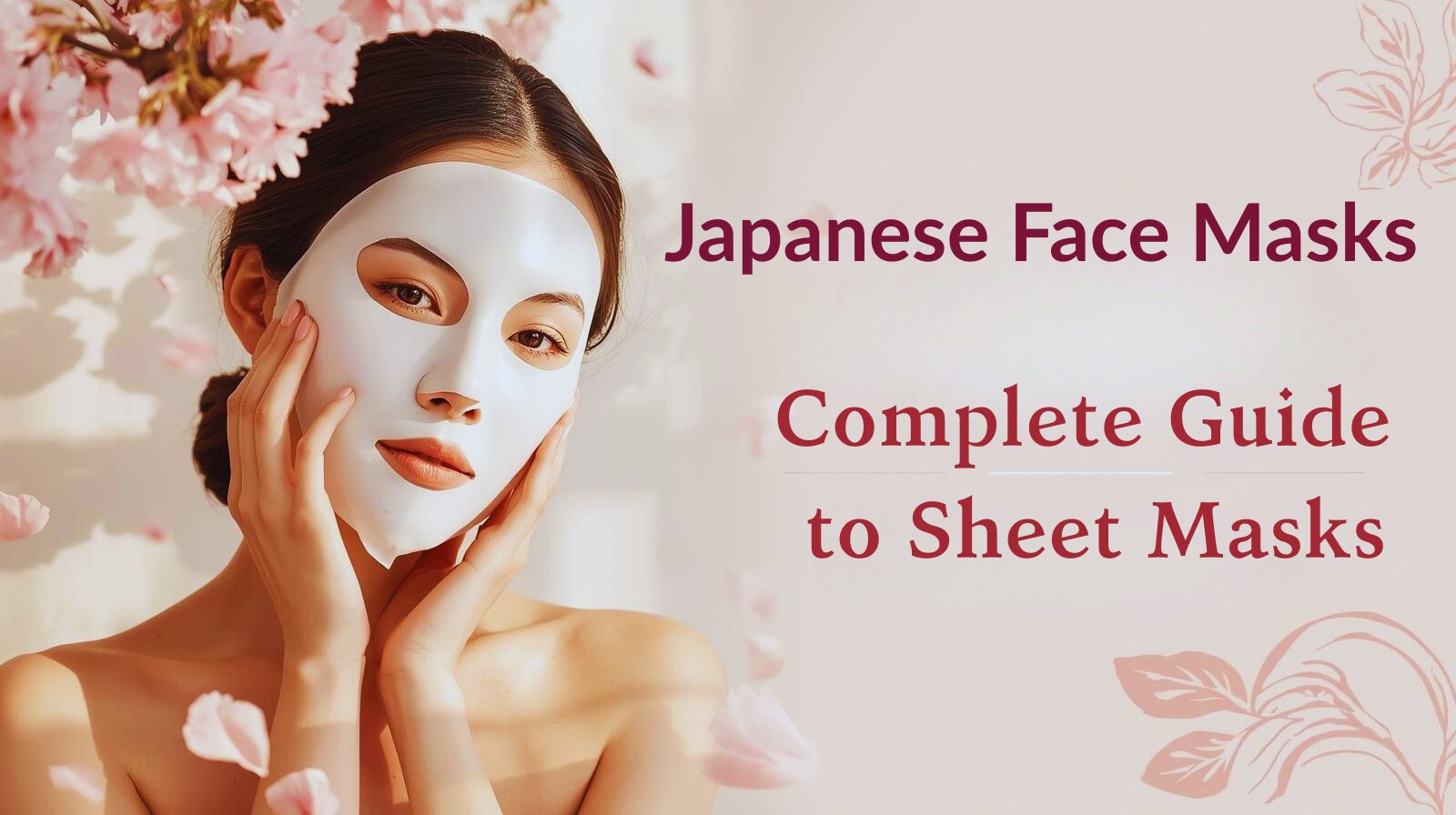
I live in Japan, and masking is not a weekly treat here — it is a daily habit. Walk into any drugstore in Kobe, where I shop and pack your orders, and you will find an entire aisle of face masks: thin daily sheets sold in packs of thirty, clay packs from Okinawa, overnight gels, fermented sake-kasu masks. This guide is my honest shortlist, and I want to be clear up front about one thing: every mask below is a product I actually stock and can ship to you.
Below you will find masks grouped the way I actually use them — everyday sheets, vitamin C and brightening sheets, clay and wash-off masks, rice and fermented masks, overnight masks, and a small salon-grade section for when you want to treat your skin. Wherever a mask contains something worth flagging, such as placenta or a human-derived ingredient, I say so plainly.
What makes Japanese face masks different
Masking is a daily step, not a monthly ritual
The biggest difference is frequency. In much of the world a sheet mask is an occasional indulgence. In Japan, brands like LuLuLun built an entire category around masks gentle enough to use every single day, morning and night. That changes how the products are designed: thinner sheets, lighter essences, and value packs of seven, thirty, even fifty sheets so the cost per use stays low.
The sheet and the essence do the work together
Japanese sheets tend to fit the face closely — many are 3D-cut to hug the curve of the nose and jaw — and they are soaked in an essence rather than a heavy serum. The idea is not to drown your skin in actives but to press hydration in evenly and consistently. A good daily sheet can replace your toner step entirely.
Masks go far beyond sheets
What surprises newcomers is how much of the Japanese mask aisle is not sheets at all: mineral clay packs that draw out pores, wash-off rice masks for texture, leave-on overnight gels, and fermented masks built on sake brewing by-products. I have kept all of those categories in this guide because they are where some of my most interesting products live.
Everyday sheet masks — the ones I reach for most
If you are new to Japanese masking, start here. These are the affordable, gentle, use-them-often sheets that make up the core of the habit.
LuLuLun Pure — the mask that started the daily habit
LuLuLun Pure is Japan's everyday workhorse, and it is the one I recommend first. It is gentle enough for twice-a-day use and formulated around blueberry leaf extract, wakame seaweed and polyglutamic acid for steady hydration. One sheet replaces your toner step. Try the LuLuLun Pure 7-sheet pack if you want to see what daily masking feels like without committing to a big box.
LuLuLun White — the same habit, with a brightening lean
If dullness is your concern, LuLuLun White is the same daily-sheet concept tuned toward a brighter-looking finish. It is a comfortable everyday sheet rather than a treatment mask — think of it as your morning glow step.
Saborino Morning — 60 seconds and you are done
Some mornings there is no time. Saborino Morning Face Mask is Japan's original 60-second all-in-one: in one minute it cleanses, tones, moisturises and preps skin as a makeup base. The formula pairs sodium hyaluronate, soluble collagen and a vitamin C derivative (ascorbyl glucoside) with cooling grapefruit and peppermint. A pack of 32 makes it a genuine daily-driver.
Kose Clear Turn — the drugstore classic in a value pack
Kose Clear Turn is the drugstore staple every Japanese household knows. The 50-sheet Clear Turn box is an anti-aging, antioxidant daily sheet, and the large count makes it my pick for anyone who wants to mask every day without thinking about cost. It lists retinol among its actives, so it is best used in the evening — see the pregnancy note in the FAQ.
Kracie Hadabisei 3D — the sheet that actually fits
If you have ever fought a sheet mask that slid off your chin, Kracie Hadabisei 3D Moisturising Mask is the answer. Its 3D-cut sheet hugs the face contours and holds a thick gel-serum rich in hyaluronic acid with a touch of lemon extract. It feels more like a treatment than a basic daily sheet.
Hada Labo Gokujyun 3D — hydration, concentrated
Hada Labo is my default name for anything hydration-related. The Gokujyun 3D Perfect Sheet Mask belongs to the higher-concentration Koi-Gokujyun line and is soaked in an essence built on four types of hyaluronic acid. If your skin is thirsty, this is the everyday sheet I would hand you.
Vitamin C and brightening sheets
When the goal is glow and an even tone rather than pure hydration, these are the sheets I reach for.
Rohto Melano CC Vitamin C Sheet
From Rohto's much-loved Melano CC family, the Melano CC Vitamin C Sheet Mask is a daily vitamin C sheet in a generous 28-count box — an easy, low-commitment way to add a brightening step to your routine.
Rohto Melano CC+ AZmask — vitamin C meets azelaic acid
The newer premium tier, Melano CC+ AZmask, pairs pure vitamin C with pure azelaic acid in a serum-soaked mask aimed at the look of pores. It is the one I suggest when someone wants to target both tone and texture.
Quality 1st Derma Laser Super VC100
An award-winner and a Don Quijote best-seller, Quality 1st Derma Laser Super VC100 builds its serum around four forms of vitamin C plus niacinamide for a fast, visible glow. If you want a "big event tomorrow" mask, this is it.
Clay and wash-off masks
I recommend the strong clay masks from the Okinawan brand Ryu Spa, built around mineral-rich sea clay and deep sea water.
Ryu Spa Resort Kucha Pack — deep cleansing from Okinawa
The Ryu Spa Resort Kucha Pack is a deep-cleansing mask made with Okinawan kucha sea mud and seaweed extracts. It is the one I use when my skin feels congested and needs a proper reset. A 120 g tub lasts a long time.
Ryu Spa Kumi Clay Pack — for pores and excess oil
If oiliness and visible pores are your main concern, the Ryu Spa Kumi Clay Pack combines Okinawan sea silt with bentonite to lift out sebum, dirt and dead skin — without that tight, stripped feeling cheaper clays leave behind.
Ryu Spa Refining Kucha Pack — clay plus charcoal
The Ryu Spa Refining Kucha Pack adds charcoal to the Okinawan sea clay for a more purifying, refining cleanse. Between the three, this is my pick for combination skin that gets shiny by midday.
Rice and fermented masks
This is where Japanese skincare heritage really shows — masks built on rice and on the by-products of sake brewing.
Keana Nadeshiko — the rice sheet-mask classic for pores
By Ishizawa Lab, Keana Nadeshiko Rice Mask is a tissue sheet mask made with 100% Japanese rice-derived ingredients — it refines the look of pores, firms and brightens. A drugstore cult favourite: 10 sheets, worn like an ordinary sheet mask with no rinsing.
Amenity Bijofu CEL-24 Fermented Mask — sake-kasu on a sheet
For fermented skincare in sheet form, Amenity Bijofu CEL-24 Fermented Mask is a dense tissue sheet built around sake-kasu (sake lees) extract, fermented rice and underground Nahari River water. It is a lovely bridge between the daily-sheet habit and traditional fermented ingredients.
Overnight and sleeping masks
Overnight masks do their work while you sleep — apply as the last step, no rinsing. These are my go-tos when skin needs recovery.
AXXZIA AGTHEORY Perfect Gel Mask
The AXXZIA AGTHEORY Perfect Gel Mask is a leave-on overnight gel that delivers all-night hydration; its gel matrix carries the brand's Toka Mix botanical complex into the stratum corneum as you sleep. A little goes a long way from the 50 g jar.
Saborino Mega Shot V Night — the 5-in-1 night sheet
From the same house as the morning classic, the Saborino Mega Shot V Night Shiratama is the upgraded 2025/2026 overnight sheet — a 5-in-1 night step in a 32-count box for people who want a sheet, not a jar, before bed.
Ryu Spa Resort Mozuku Sleeping Pack
Rounding out Okinawa's contribution, the Ryu Spa Resort Mozuku Sleeping Pack is an overnight leave-on mask built around mozuku seaweed extract and deep sea water — a marine-led way to wake up with softer skin.
Salon-grade and premium masks
Finally, a small section for the treat-yourself end of my shelf. These are professional-leaning masks with more concentrated formulas — and I want to be straightforward about what is in them, because a couple contain ingredients that not everyone will want.
Spa Treatment HAS Bio Mask R
Spa Treatment HAS Bio Mask R is a professional-grade anti-aging sheet the brand positions around its HAS complex, which it describes as a stem-cell extract adapted to human fat cells. That is a human-derived ingredient, so I flag it openly here — please decide whether it fits your preferences before buying. I describe it as the brand positions it, without medical promises.
Make.iN EXOSOME + Glutathione
Make.iN EXOSOME + Glutathione is a 30-sheet mask built around exosomes, glutathione, NMN and ceramides — one of the most "next-generation" formulas I carry. As with any exosome product, I flag the ingredient openly so you can make an informed choice.
La Mente CPla Mask
La Mente CPla Mask is a luxurious sheet that delivers close to a full serum bottle per sheet, combining a vitamin C derivative with three types of placenta and EGF. Important: the placenta here is animal-derived, so this mask is not suitable if you avoid such ingredients.
Ultra Collagen Pack
The Ultra Collagen Pack by Beauty Act is a professional anti-aging and brightening mask built on hydrolysed nano-collagen, which the brand says is milled small enough to sink in more easily. It is a nice option when you want a richer, spa-style treatment at home.
Elixcell Revita Face Mask
Elixcell Revita Face Mask is a high-potency anti-aging sheet mask the brand positions as professional-grade — with astaxanthin and collagen, made to support skin renewal and protect the hydro-lipid barrier against UV, free radicals and pollution. A good pick when you want concentrated care in sheet form.
How to get the most from a Japanese face mask (FAQ)
How often should I use a face mask?
It depends on the type. Daily sheets like LuLuLun Pure, Saborino and Kose Clear Turn are designed for everyday use, once or twice a day. Clay and wash-off masks are better one to three times a week. Overnight masks can be used as often as your skin enjoys them, in place of your night cream.
What is the difference between sheet, clay and overnight masks?
Sheets press hydration and actives into the skin in 5–15 minutes and are your everyday step. Clay masks draw out oil and clear pores, so they are a weekly deep-clean. Overnight masks seal in moisture while you sleep and act as a recovery treatment. Many people use all three across a week.
Does a mask replace my moisturiser?
A daily sheet can replace your toner and give a hydration boost, but for most skin you will still want a moisturiser to seal it in — especially at night. Overnight masks are the exception: they are designed to be the final, sealing step themselves.
Are any of these masks not suitable during pregnancy?
Two masks in this guide list retinol among their actives — Kose Clear Turn (50-sheet) and Make.iN CICA × RETI. If you are pregnant or breastfeeding, it is worth checking with your doctor before using retinol products, and choosing one of the many retinol-free sheets here instead.
How should I store my masks?
Keep them out of direct sunlight and reseal the pack tightly so the sheets do not dry out. Many people in Japan keep a few sheets in the fridge in summer — a cold mask on a hot day is one of the small pleasures of the habit.
My bottom line
If you only take one thing from this guide, let it be the daily-mask habit: a gentle sheet like LuLuLun Pure, used consistently, does more for most skin than an occasional expensive treatment. From there, add a clay pack for weekly deep-cleaning, an overnight mask for recovery, and a vitamin C sheet when you want glow. Everything I have described is on my shelf here in Japan and ready to ship.
You can browse every mask in one place in the Japanese Face Masks collection. If you are not sure where to start, message me — I am always happy to help you build a routine that fits your skin.
— Natalia Tsujimoto, sourcing and shipping Japanese skincare from Kobe, Japan.