
Updated May 2026 — sourced and tested in Kobe, Japan by Natalia Tsujimoto.
If you've ever lived through a gout attack — or watched a parent live through one — you know that the polite categories of "anti-inflammatory" and "lifestyle change" don't quite cover what's happening at 3 a.m. with a swollen toe joint. So when customers in Russia and the Middle East started asking me about anserine, I realised the article I'd written wasn't doing them any favours. Most people don't search for anserine because they want to feel sharper at work — they search because their doctor said the words "high uric acid" or "hyperuricemia", and they want to know what Japan does about it.
This is the article I should have written first. Anserine is, in Japan, primarily marketed as a purine and uric acid management supplement — a daily, low-key support taken alongside diet changes, hydration, and (for diagnosed cases) medication prescribed by a doctor. The fatigue and brain-fog research is real but secondary. Let me explain both, in that order.
What anserine actually is
Anserine is a small, naturally-occurring peptide built from two amino acids — beta-alanine and a methylated histidine. Together with carnosine, it belongs to the imidazole dipeptide family (Japanese: イミダゾールジペプチド). You already have anserine in your body, mostly in skeletal muscle and the brain. You also eat it routinely — salmon, tuna and bonito are particularly rich sources (and migratory birds like chicken breast carry it too). DHC's anserine is extracted specifically from fish protein, which is part of why Japanese researchers got interested in concentrating it in supplement form — these are foods Japanese people already eat in volume.
The reason Japanese supplement formulators usually pick anserine over carnosine is practical: anserine resists an enzyme called carnosinase that rapidly breaks down carnosine in human blood. So a single oral dose of anserine stays in circulation longer, which makes it the more useful target for daily supplementation.
The uric acid story — why anserine matters for gout
Uric acid is the end product of purine metabolism. When your body breaks down purines — from food (meat, seafood, alcohol, especially beer) or from internal cell turnover — uric acid is what's left. In healthy ranges it's actually a useful antioxidant. The problem starts when blood levels rise above roughly 7 mg/dL. At that point urate can crystallise in joints, kidneys and soft tissue, producing the inflammation that we call gout.
Why does anserine come up in this conversation? Two reasons.
Mechanism — what Japanese research has shown
Japanese research on imidazole dipeptides — including anserine — has explored their role in maintaining healthy uric acid levels in adults whose values are on the higher end of normal. The proposed mechanisms are twofold: anserine appears to influence how the kidneys excrete uric acid, and it provides antioxidant capacity that helps neutralise some of the oxidative stress associated with elevated urate.
Importantly, the studies are framed around maintaining healthy uric acid levels in people who are not yet diagnosed with gout — which is exactly the niche Japan's supplement regulation allows. Anserine is not a treatment for diagnosed hyperuricemia or active gout. It is a daily nudge in the right direction for people whose lab numbers are creeping up.
Why Japanese anserine supplements have a credibility advantage
Japan has a regulated category called 機能性表示食品 (Foods with Function Claims), where manufacturers may submit research dossiers to the Consumer Affairs Agency and, if accepted, claim specific structured benefits on the label. Whether or not a particular DHC product carries this status, the broader regulatory environment in Japan around food-based supplements is more conservative than what's typical in cross-border online pharmacies. That's part of why Japanese anserine has a credibility floor that's hard to find elsewhere.
Who anserine is for — and who it's NOT for
It may be worth trying if:
- Your annual blood work has shown uric acid creeping toward 6.5–7 mg/dL but your doctor hasn't yet prescribed allopurinol or febuxostat
- You have a family history of gout and want a daily lifestyle-grade support
- You eat a moderate-to-high purine diet (beer, red meat, anchovies, sardines, organ meat) and are looking for something that pairs with diet adjustments rather than replacing them
- You've already changed your diet and hydration and want one more low-risk lever to pull
It is NOT a substitute if:
- You've already had a gout attack — see a rheumatologist; prescription urate-lowering therapy (ULT) is the standard of care
- You have kidney disease or are on dialysis — discuss with your doctor before any supplement
- You are on allopurinol, febuxostat, or any uricosuric — combinations should be supervised
- You're pregnant or breastfeeding — not enough research
This article is not medical advice. If your uric acid is high, the priority is a rheumatologist or internist, not a Japanese supplement.
DHC Anserine — what's actually in the bottle
The most accessible product in this category is DHC Anserine, a 30-day supply of capsules from one of Japan's largest mail-order supplement brands. Why I stock this one specifically:
- Standardised anserine content per daily serving — you can compare it directly to research dosages
- Regulated Japanese food-supplement market — Japan's conservative regulatory framework for supplements gives a credibility floor not found in many cross-border markets
- Capsule format — anserine in raw extract has a meaty taste; capsules avoid that
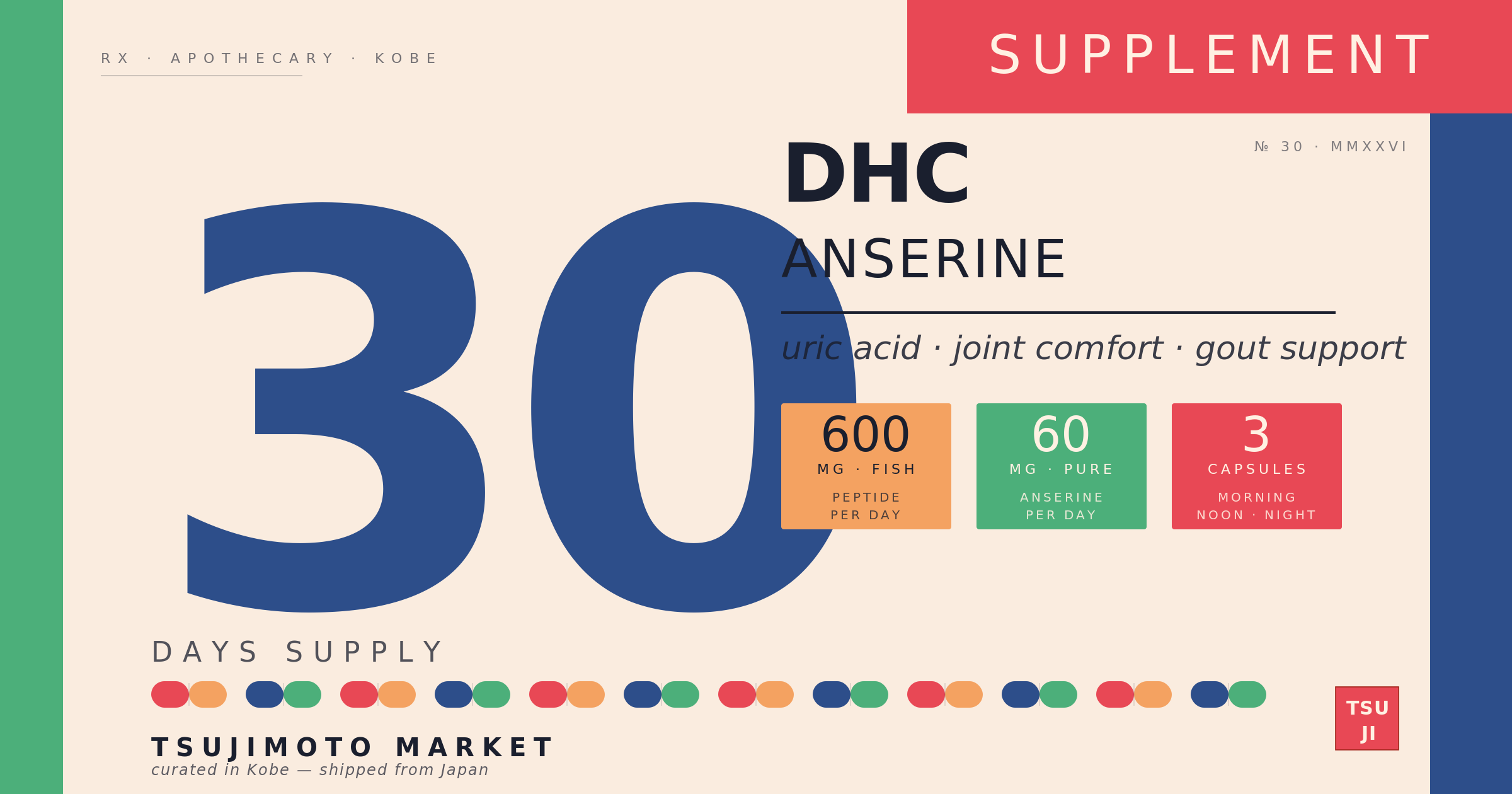
- Specific composition — 90 capsules per pack (a 30-day supply at 3 capsules per day), delivering 600 mg of fish peptide including 60 mg of anserine per daily dose. The supporting amino acids (alanine and histidine) are the components of anserine itself
- 30-day course — a reasonable trial length to see whether your next blood test shows movement
- DHC's distribution scale — fresh stock, fast turnover, no risk of getting an old bottle from a forgotten warehouse
The packaging is the same plain white DHC look you may have seen on their collagen or CoQ10 line — that's brand identity, not a quality issue.
How to take DHC Anserine
Daily dose
DHC's instructions: 3 capsules per day, divided across morning, afternoon and evening, with water or warm tea. The 90-capsule pack lasts 30 days. Don't stack multiple anserine products from different brands in the same day; it doesn't accelerate the effect and may overshoot the studied dose range.
Trial length
Plan a 3-month trial minimum if you want to see meaningful change. Uric acid moves slowly. A single 30-day pack will tell you whether you tolerate it; three packs will tell you whether your numbers are responding.
💡 90-day pack saves 10%. Add 3 packs of DHC Anserine to your cart and the 10% bundle discount is applied automatically at checkout — no coupon needed. The three-pack window is also the right diagnostic length to see whether your uric acid is responding.
Pair with — not replace
- Hydration: 2–2.5 L of water daily is the single most underrated uric acid lever
- Diet: reduce beer (the biggest dietary purine load), high-fructose drinks, organ meats, and fish like sardines and anchovies
- Cherry intake: some evidence supports tart cherry as adjunctive — fits naturally with anserine
- Weight management: reducing visceral fat reduces urate independently
Anserine works best as part of this stack, not as the only intervention.
The secondary story — fatigue, brain fog and exercise recovery
Even though uric acid is the primary reason most of my customers ask about anserine, it's worth mentioning the other research stream. Japanese studies have explored anserine's potential role in:
- Subjective mental fatigue recovery — particularly in older adults experiencing the kind of "afternoon flat-line" that's culturally a national topic of conversation in Japan
- Memory tasks in older adults with mild age-related decline (not dementia)
- Antioxidant balance during and after exercise — useful for endurance athletes
These are smaller signals than the uric acid story, but they do exist, and they explain why some users notice subjective benefits beyond their lab numbers.
What the research does not show — and what no honest Japanese label claims — is that anserine cures, prevents or treats Alzheimer's disease, dementia, gout disease itself, or any other diagnosed condition. If a website tells you it "reverses aging" or "cures gout," close that website.
FAQ
Will anserine lower my uric acid?
It may help maintain healthy levels in people whose readings are on the high end of normal — that's the regulated Japanese claim. It's not a urate-lowering therapy in the medical sense. Allopurinol and febuxostat are. Use anserine as a lifestyle-grade nudge, not a replacement for prescription care.
Is it halal?
DHC's anserine is extracted from fish protein (not chicken), which simplifies the halal question for many readers — fish-derived peptides are generally considered halal. However, DHC has not specifically certified this product as halal, and the supplement contains other ingredients in the capsule shell and processing aids. Please verify with your local religious authority and contact me if you need a copy of the manufacturer's source documentation.
Can I take it with allopurinol or febuxostat?
Don't combine without your doctor's approval. Both are urate-lowering medications and stacking lifestyle supplements may push you below the therapeutic window or interact in ways the studies haven't measured.
How long until I notice anything?
Uric acid is sluggish — give it 8–12 weeks of daily intake plus diet/hydration changes. Subjective fatigue effects, if any, tend to show up earlier (2–4 weeks). If your next blood panel shows nothing changed at three months, anserine isn't your lever — that's useful information.
Is it safe long-term?
Japanese studies haven't surfaced significant safety issues at the studied dosages, but very long-term human data (5+ years) is limited. Cycle on and off if you want to be cautious — for example, take it for 3 months, off for 1 month, then re-evaluate with blood work.
Why isn't anserine sold widely in Western pharmacies?
Mostly because the supplement category in the EU and US treats imidazole dipeptides as a niche, with no regulated structured claims framework comparable to Japan's 機能性表示食品. The science is the same; the regulation isn't. That's why Japanese-sourced anserine is more credible than what shows up in unregulated cross-border online stores.
Where to start
If your last blood test showed uric acid drifting toward the upper end of normal, and you've already started on hydration and diet, DHC Anserine is the most credible, regulator-reviewed entry point. Plan a 3-month trial, stack it with the lifestyle changes, and re-test your uric acid afterwards. Whatever the result, you'll know more than you did before.
For the broader Japanese supplements landscape — collagen, NMN, CoQ10, placenta — see the Japanese Vitamins & Supplements collection. Everything ships from our Kobe warehouse with tracking, usually within 2–6 business days.
— Natalia Tsujimoto, Kobe