
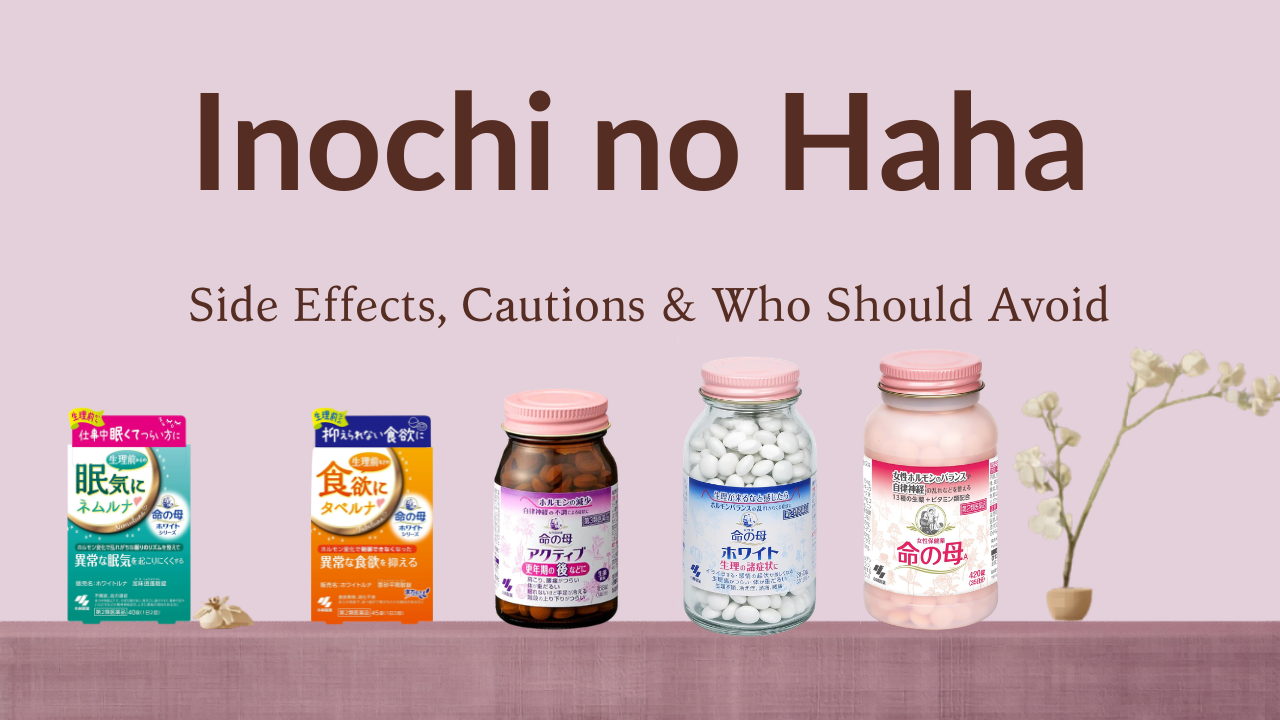
Updated 2026-05-14 by Natalia Tsujimoto, Kobe, Japan.
I have been recommending Kobayashi Pharmaceutical's Inochi no Haha range from Kobe since 2015, and the question I am asked most often after "does it actually work?" is "does Inochi no Haha have side effects?" The honest answer is: Inochi no Haha is classified in Japan as a Class 2 OTC medicine, not a herbal tea — so yes, it has cautions, contraindications and groups of women who should avoid it. Kobayashi prints them on every box. I have read every Tsujimoto Market listing in this article one more time before writing it, and below I gather what is actually on the label, by product.
This article is the safety companion to my full Inochi no Haha Complete Guide: instead of explaining what each tablet does, here I focus on cautions, who is not a candidate, and the warnings I think every international buyer should read before ordering. It follows the same pattern I used for the DHC Bulgarian Rose Side Effects article — focused, label-honest, no medical claims I cannot substantiate.
What "Inochi no Haha" actually is — a brief framing
Inochi no Haha (命の母, "Mother of Life") is a Japanese women's-health range manufactured by Kobayashi Pharmaceutical. The flagship product, Inochi no Haha A, has been in continuous use in Japan since 1950. Two facts matter for the side-effects discussion:
- It is a Class 2 OTC medicine in Japan — not a "supplement" in the loose Western sense. A Japanese pharmacy is required to display the package insert and a registered seller must be available.
- The formula is multi-herb Kampo plus vitamins and minerals. Each variant is built around a classical herbal prescription (Kamishoyosan, Koshaheisan, Kyuki Kyogaito, Shimotsu-to) rather than a single isolated active. That is why the cautions read differently from a single-ingredient supplement label.
"Multi-herb" does not mean "no contraindications". It means the package insert is longer than usual, and it deserves to be read.
Inochi no Haha A — cautions on the box
Inochi no Haha A is the flagship menopause/hormonal-balance formula. It contains 13 traditional Kampo herbal ingredients plus 11 vitamins, minerals and taurine. Two pack sizes are available on Tsujimoto Market: Inochi no Haha A — 35-day supply and Inochi no Haha A — 70-day supply.
Reading directly from the storefront product information:
- Pregnancy: not suitable for pregnant women without prior medical consultation. The 70-day pack states more strictly: not intended for use during pregnancy or breastfeeding.
- Breastfeeding: do not take while breastfeeding; or avoid breastfeeding while taking this medicine.
- Age: not suitable for children under 15.
- Men: the 70-day pack explicitly notes the product is for adult women only — not intended for use by men.
- Pre-existing conditions: consult a doctor before use if you are under medical care, have had allergic reactions to medicines, have a weak constitution, have a sensitive digestive system prone to diarrhoea, have a liver condition, or have a history of oestrogen-sensitive conditions.
- Prescription medications: consult a doctor if you are already taking other prescription medication.
- Stop and consult a medical professional if: you experience skin rash, redness, or any unusual reaction.
- If symptoms don't improve after 4 weeks (or worsen): consult a healthcare professional. Do not exceed the recommended dose.
The "history of oestrogen-sensitive conditions" caution is the one I underline most often for international customers. If you have a personal or family history of certain hormone-sensitive cancers, or if you are on hormonal therapy, this is a conversation for your doctor — not a self-decision.
Inochi no Haha Active — postmenopause variant
Inochi no Haha Active is the postmenopause-focused variant — 10 Kampo botanicals plus vitamins and minerals, designed for women who have already passed through menopause but still feel chills, stiff shoulders, back pain, heaviness in the legs, stress, poor sleep or fatigue. It is a Designated Quasi-Drug / Class-2 OTC in Japan, with these cautions on the storefront:
- Read the enclosed leaflet carefully — Kobayashi prints product-specific dosage and warnings.
- Not recommended for children, pregnant women, or nursing women.
- Do not combine with other Kampo formulas containing similar herbs without consulting a doctor or pharmacist. Stacking Kampo formulas can overlap active herbs without you realising.
- Discontinue if any unusual reaction, rash, or digestive discomfort occurs.
"Do not combine with other Kampo" is worth taking seriously. Several of the Inochi no Haha variants overlap on herbs like Kamishoyosan — using two of them together is not the same as doubling efficacy.
Inochi no Haha Meguribi a — skin + menopause Kampo
Inochi no Haha Meguribi a combines Kamishoyosan and Shimotsu-to into a 12-herb formula for women dealing with skin issues (eczema, dry skin, age spots) alongside menopause symptoms. It is a Class 2 OTC Kampo medicine.
The label cautions here are specific and worth listing in full:
- Consult your doctor or pharmacist before use if you are taking other medications.
- Not for use by anyone under 15 years of age.
- Do not use if you are pregnant or think you may be pregnant — consult a doctor or pharmacist first.
- Stop use and consult a doctor immediately if you experience any adverse reaction such as rash, digestive upset, or unusual symptoms.
- Contains aluminium silicate — avoid if you have kidney disease unless directed by a physician.
- Contains lactose — caution for those with lactose intolerance.
- Avoid use if you have a tendency toward gastrointestinal disorders — this formula is specified for women without gastrointestinal complications.
- If symptoms do not improve or worsen, stop and consult a healthcare professional.
The aluminium silicate / kidney note is one to read twice. It is an excipient (binder) that appears in several Kampo tablet formats. If you have known kidney disease, take this to your physician before ordering.
Inochi no Haha White Series — three formulas, three different cautions
The Inochi no Haha White Series is built for younger women (16–40) and PMS-related symptoms during the menstrual cycle. There are three single-symptom Kampo formulas here, each with its own cautions.
White Series Chirac — for heavy menstrual bleeding
Inochi no Haha White Series Chirac is based on the classical formula Kyuki Kyogaito (芎帰膠艾湯), traditionally used in East Asian medicine for excess bleeding and blood deficiency. It is taken at the onset of menstruation (3-day supply pack at standard dosage). Cautions:
- Class 2 OTC Kampo — consult a doctor or pharmacist before use if taking other medications.
- Not for under-15s.
- Do not use if pregnant or possibly pregnant.
- Stop if rash, digestive upset or unusual symptoms appear.
- Contains aluminium silicate — avoid if you have kidney disease unless directed by a physician.
- Contains lactose.
- Specifically designed for women with cold-sensitivity who do not have gastrointestinal disorders.
- Important medical-evaluation flag: stop use immediately and consult a doctor if you experience unusual bleeding outside menstruation, or severe menstrual pain — these may indicate a condition that requires medical evaluation.
I underline that last bullet for every customer who buys Chirac. Heavy bleeding has multiple possible causes — Kobayashi's own label tells you that some of them are not what this OTC tablet is designed for.
White Series Nemuluna — for PMS-related excessive daytime sleepiness
Inochi no Haha White Series Nemuluna is based on Kamishoyosan (加味逍遙散) and is specifically positioned for "premenstrual hypersomnia" — daytime sleepiness during the days before menstruation. It is started at symptom onset, not used continuously throughout the month. Cautions:
- Class 2 OTC Kampo — consult if taking other medications.
- Not for under-15s.
- Do not use if pregnant or possibly pregnant.
- Contains aluminium silicate — avoid if you have kidney disease unless directed by a physician.
- Contains lactose.
- If excessive sleepiness is severe or accompanied by other neurological symptoms, consult a doctor before using OTC medicines.
- This product is not a sleep aid and not a daily supplement — it addresses PMS-specific sleep-cycle dysregulation. Using it for general insomnia is the wrong framing.
White Series Tabeluna — for PMS-related appetite increase
Inochi no Haha White Series Tabeluna uses Koshaheisan (香砂平胃散) for pre-menstrual abnormal appetite increase. Cautions:
- Class 2 OTC Kampo — consult if taking other medications.
- Not for under-15s.
- Do not use if pregnant or possibly pregnant.
- Contains aluminium silicate — avoid if you have kidney disease unless directed by a physician.
- Contains lactose.
- Kobayashi's own framing: this is not a diet pill or an appetite suppressant — it addresses PMS-specific hormonal appetite dysregulation. Not recommended for those with below-average constitution or those who do not experience an overeating tendency.
I have had to redirect more than one customer who was hoping Tabeluna would be a general appetite tool. It is not. The brand says so on the box.
Inochi no Haha White — the 30-day complex
The simpler Inochi no Haha White 30-day complex (360 tablets) is positioned by Kobayashi for women aged 16–40 during the menstrual cycle, using 11 plant ingredients with no hormones and no synthetic substances. The storefront lists the following contraindications:
- Pregnancy.
- Breastfeeding.
- Individual intolerance to product components.
The storefront uses careful language about side effects that I want to quote precisely rather than rephrase: it states the product "does not have side effects or unwanted effects in inflammatory diseases and menstrual cycle disorders." That is a narrow brand statement — please read it as exactly what it says, not as a blanket claim that the product has no side effects in any context. If you have a known medical condition, the contraindication list above and a chat with your doctor still apply.
Cross-cutting cautions across the whole Inochi no Haha range
If you only read one section of this article, read this one. Pulled together from across the Tsujimoto Market storefront and the manufacturer label cautions:
- Pregnancy: not appropriate without medical consultation, and several variants are stricter than that. If you are pregnant, planning a pregnancy, or unsure — speak to your doctor first.
- Breastfeeding: Inochi no Haha A specifically says do not take while breastfeeding.
- Children: not intended for under-15s.
- Men: the 70-day Inochi no Haha A label specifically states the product is for adult women only.
- Kidney disease: the Meguribi a, Chirac, Nemuluna and Tabeluna formulas contain aluminium silicate. Avoid them in the context of known kidney disease unless your physician directs otherwise.
- Lactose intolerance: the same Meguribi and White Series tablets contain lactose. Read the label carefully if you have a lactose intolerance.
- Oestrogen-sensitive conditions: Inochi no Haha A explicitly flags this — consult a doctor first.
- Sensitive digestive system / weak constitution: flagged for Inochi no Haha A and for the gastrointestinal-disorder caution on Meguribi a.
- Combining Kampo formulas: do not stack Inochi no Haha Active (or any Kampo formula) with another Kampo product without a pharmacist's input — the overlapping herbs can be the same.
- Adverse reactions: stop immediately at rash, redness, digestive upset, or unusual symptoms and consult a medical professional.
- No improvement after 4 weeks of Inochi no Haha A: consult a healthcare professional rather than increasing the dose.
None of this is meant to talk you out of the range. After eleven years of curating Kobayashi products from Kobe, I am one of Inochi no Haha's strongest advocates for the right candidate. The point of this article is to make sure you are that right candidate before you order — and to give you the language to discuss it with your doctor.
FAQ
Does Inochi no Haha have side effects?
Yes, like any Class 2 OTC medicine. Kobayashi's labels across the range list possible adverse reactions including skin rash, redness, and digestive upset, and instruct users to stop and consult a medical professional immediately if these occur. Specific formulas (Meguribi a, the White Series) add cautions for kidney disease (due to aluminium silicate) and lactose intolerance.
Can I take Inochi no Haha during pregnancy?
No, not without medical consultation. Inochi no Haha A says it is not suitable for pregnant women without prior medical consultation; the 70-day pack and Inochi no Haha Active are stricter — not intended for use during pregnancy or breastfeeding. The White Series tablets explicitly say "do not use if you are pregnant or think you may be pregnant — consult a doctor or pharmacist first."
Is Inochi no Haha safe with kidney disease?
Several formulas — Meguribi a, White Series Chirac, Nemuluna and Tabeluna — contain aluminium silicate as an excipient and explicitly state to avoid use in kidney disease unless directed by a physician. Take this to your doctor before ordering.
Can men take Inochi no Haha?
The Inochi no Haha A 70-day pack states the product is for adult women only and is not intended for use by men. The range is built for women's hormonal-balance support.
Can I combine Inochi no Haha with another Kampo medicine?
Inochi no Haha Active explicitly says "do not combine with other Kampo formulas containing similar herbs without consulting a doctor or pharmacist." Several formulas in the range share underlying Kampo prescriptions (Kamishoyosan in particular), so combining them is not the same as doubling efficacy.
What should I do if I get a rash after starting Inochi no Haha?
Stop immediately and consult a medical professional. Across the range, the manufacturer's instruction is the same: skin rash, redness, digestive upset, or any unusual reaction is a stop-and-see-a-doctor signal.
Is Inochi no Haha a hormone replacement?
No. Kobayashi positions Inochi no Haha as Kampo herbal medicine plus vitamins and minerals, supporting hormonal balance — not as hormone replacement therapy. If you are on HRT or considering it, your doctor is the right person to advise on combining or switching approaches.
Final word from Kobe
Inochi no Haha works best when it is matched to the right woman. The cautions above are not a warning sticker designed to scare you off — they are how Kobayashi tells you whether this formula is for your body. Read the label that comes in the box. Talk to your doctor if any of the kidney, pregnancy, oestrogen-sensitive or prescription-medication flags apply to you. And if you want my full taste of which variant suits which life stage, that lives in the Inochi no Haha Complete Guide. The wider Japanese Kampo collection is always stocked from Japan.