
Tsujimoto Market: Our Guarantees
Description
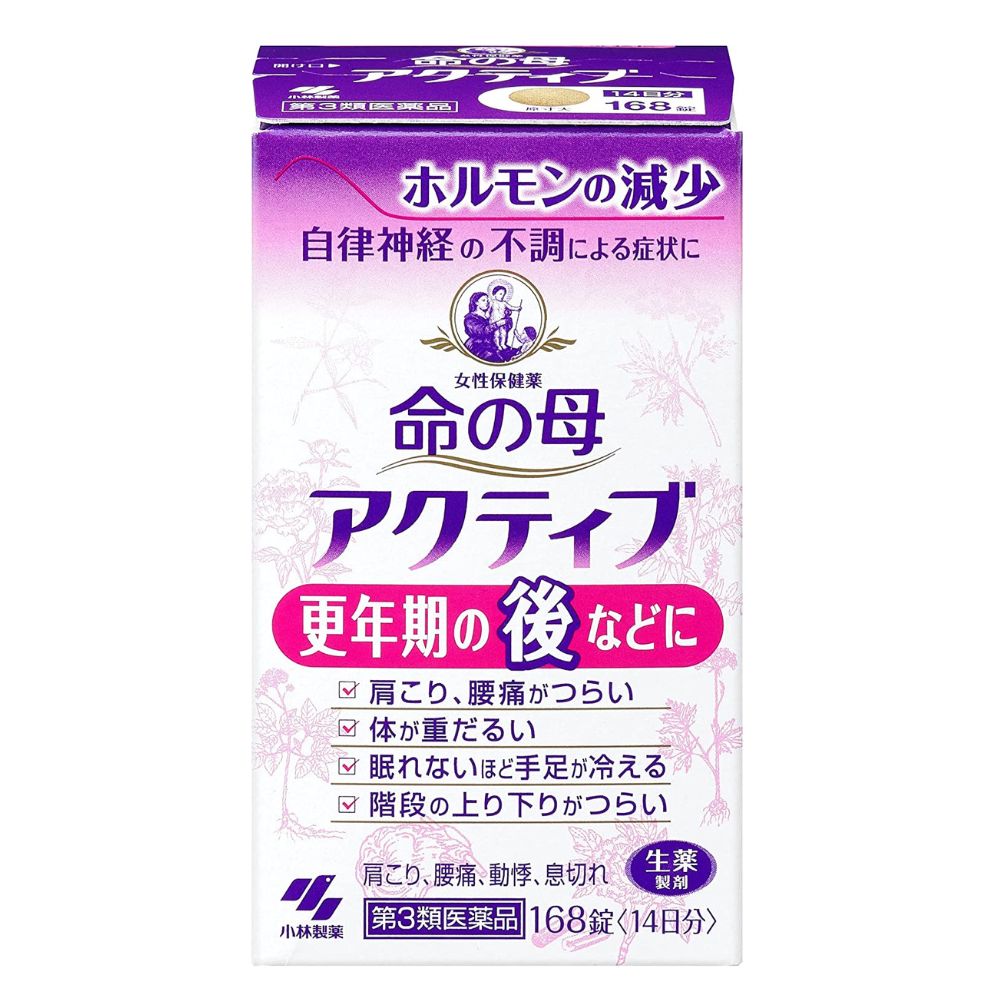
Inochi no Haha Active (命の母 アクティブ) — 168 Tablets, Japanese Class 3 OTC Herbal Medicine
Overview
Inochi no Haha Active is a Japanese herbal medicine (生薬 preparation) from Kobayashi Pharmaceutical, licensed in Japan as a 第3類医薬品 — a Class 3 over-the-counter medicine under the sales name 女性保健薬 命の母アクティブ. It is intended for women who are past the menopause transition itself but still carry the symptoms that came with it.
The formula is ten crude-drug powders and nothing else. It is not a supplement and it is not a quasi-drug: it is a licensed medicine with approved indications, a fixed dose and an age limit, and it should be treated as one. Browse the rest of our Japanese Kampo and herbal medicines or the wider Japanese health products range.
Key Benefits
- ✓ Licensed Japanese medicine, not a supplement — 第3類医薬品, with approved indications printed on the pack
- ✓ Ten crude-drug powders — toki, shakuyaku, senkyu, botanpi, kanzo, goshitsu, ninjin, keihi, byakujutsu and bukuryo, at declared milligram quantities
- ✓ Approved for post-menopausal and menstrual complaints — including cold sensitivity, stiff shoulders, lower-back pain, headache, hot flushes, dizziness, palpitations and swelling
- ✓ 14 days in a pack — 168 tablets at the licensed dose of 12 a day, so a pack is a complete two-week course rather than an open-ended bottle
- ✓ Full quantitative panel on this page — every herb with its milligram figure, and every excipient named
- ✓ Sourced in Japan and dispatched from Kobe with tracking
Product Details
| Brand | Inochi no Haha (命の母), Kobayashi Pharmaceutical |
|---|---|
| Product name (JP) | 命の母 アクティブ |
| Sales name (JP) | 女性保健薬 命の母アクティブ |
| Regulatory class | 第3類医薬品 — Class 3 OTC medicine (Japan) |
| Product type | Crude-drug (生薬) tablet preparation |
| Format | Tablet |
| Net content | 168 tablets — 14 days at the licensed dose |
| Daily dose | 12 tablets — 4 tablets three times a day, after meals |
| Age restriction | 15 years and over |
| Distributor | Kobayashi Pharmaceutical Co., Ltd., Doshomachi, Chuo-ku, Osaka |
| Country of origin | Japan |
| Quasi-drug status | No — this is a medicine (医薬品), a separate legal category from a quasi-drug |
Who Is This For?
- Women who have come through the menopause transition and still have the cold hands and feet, stiff shoulders, low-back ache and heaviness that came with it
- Anyone who wants a preparation with an approved indication and a declared quantitative formula rather than an unquantified botanical blend
- People who prefer a fixed two-week course they can judge, rather than an indefinite daily habit
- Not for anyone under 15, for whom the Japanese licence does not permit use
- Not a hormone product, and not a substitute for one — if you are being treated for anything, ask your doctor before adding it
How to Use
- Take 4 tablets with water or warm water.
- Repeat three times a day, after meals — breakfast, lunch and dinner.
- Close the cap firmly every single time. The tablets absorb moisture readily and this is in the official instructions, not a nicety.
- Throw away the padding inside the bottle when you first open it — it is transit protection only.
- If a month of use brings no change, stop and speak to a doctor or pharmacist rather than continuing.
Frequency: 12 tablets a day, in three doses of 4, after meals. Do not exceed the stated dose. Not for under-15s.
Full Ingredients
Declared composition per daily dose of 12 tablets. The active substances are ten crude-drug powders (末), not concentrated extracts:
- Toki (Angelica acutiloba root) — 300 mg
- Shakuyaku (Paeonia lactiflora root) — 300 mg
- Senkyu (Cnidium officinale rhizome) — 200 mg
- Botanpi (Paeonia suffruticosa root bark) — 300 mg
- Kanzo (Glycyrrhiza / licorice root) — 300 mg
- Goshitsu (Achyranthes root) — 300 mg
- Ninjin (Panax ginseng root) — 200 mg
- Keihi (Cinnamon bark) — 200 mg
- Byakujutsu (Atractylodes rhizome) — 100 mg
- Bukuryo (Poria sclerotium) — 100 mg
Excipients: silicon dioxide, carmellose calcium (CMC-Ca), magnesium stearate, hydroxypropyl cellulose, D-sorbitol.
There are no vitamins, no minerals, no taurine and no lecithin in this preparation. If you are looking for the vitamin-and-mineral member of the range, that is a different product in the same family.
Cautions
- Read the enclosed Japanese package insert before use, and keep it. It is the legal document for this medicine; this page is a summary of it, not a replacement.
- Japanese licensing: not to be taken by anyone under 15 years of age.
- Contains licorice root (甘草 kanzo). If you already take another licorice-containing preparation, or you intend to take this one for a prolonged period, speak to a doctor or pharmacist first.
- Contains Panax ginseng (ninjin). Worth knowing if you avoid stimulant-type botanicals or take medication that interacts with ginseng.
- Tell a doctor or pharmacist before use if you are already under medical treatment, or if you have previously had an allergic reaction to any medicine.
- Stop taking it and seek advice if a rash, redness or itching appears, or if you develop nausea or loss of appetite.
- If your symptoms do not improve after a reasonable period of use, stop and consult a professional instead of continuing.
- Store in a cool place away from direct sunlight and humidity. Keep out of reach of children. Do not transfer to another container. Do not handle the tablets with wet hands.
- This page is not medical advice. If you are under a doctor's care, pregnant, or think you may be pregnant, ask a healthcare professional before taking it.
Package Contents
1 × Inochi no Haha Active, 168 tablets, in a glass bottle with a steel cap, boxed, with the Japanese package insert enclosed.
Shipping & Store Notes
- Ships directly from Japan
- Processing time: 2–6 business days
- Tracking number provided after dispatch
- Import duties and taxes may apply depending on destination country
- Japanese over-the-counter medicines are restricted or prohibited imports in many countries — please check your destination's rules before ordering
- Medicines cannot be returned once the pouch or seal is opened, for safety reasons
Authenticity Guarantee
Every product at Tsujimoto Market is sourced directly from Japan and verified for authenticity. We never sell fakes or grey-market goods. Each order is carefully packed in Kobe, Japan and dispatched with full tracking.
FAQ
Is this a supplement or a medicine?
A medicine. It is licensed in Japan as a 第3類医薬品 — a Class 3 over-the-counter medicine — with approved indications, a fixed dose and a minimum age of 15. It is not a supplement and it is not a quasi-drug, which is a third and separate category.
Does it contain vitamins, calcium or taurine?
No. The declared composition is ten crude-drug powders and five excipients — silicon dioxide, carmellose calcium, magnesium stearate, hydroxypropyl cellulose and D-sorbitol. Nothing else. Other products in the Inochi no Haha family do contain vitamins and minerals; this one does not, and the two should not be confused when you compare them.
How long does one bottle last?
Fourteen days. The licensed dose is 12 tablets a day, taken as 4 tablets after each of three meals, and the bottle holds 168 — exactly two weeks with nothing left over.
Why do the tablets vary slightly in colour?
Because they are made from plant material. Kobayashi states this on the pack: the preparation uses natural crude drugs, so the tablet colour can differ a little between batches. It is not a sign of a quality problem.
Can I take it alongside another Kampo preparation?
Ask a pharmacist first. This formula contains 300 mg of licorice root per daily dose, and licorice is common across Japanese herbal preparations, so combining two of them can stack the same ingredient without your realising. The same goes for prolonged continuous use.