
Tsujimoto Market: Our Guarantees
Description
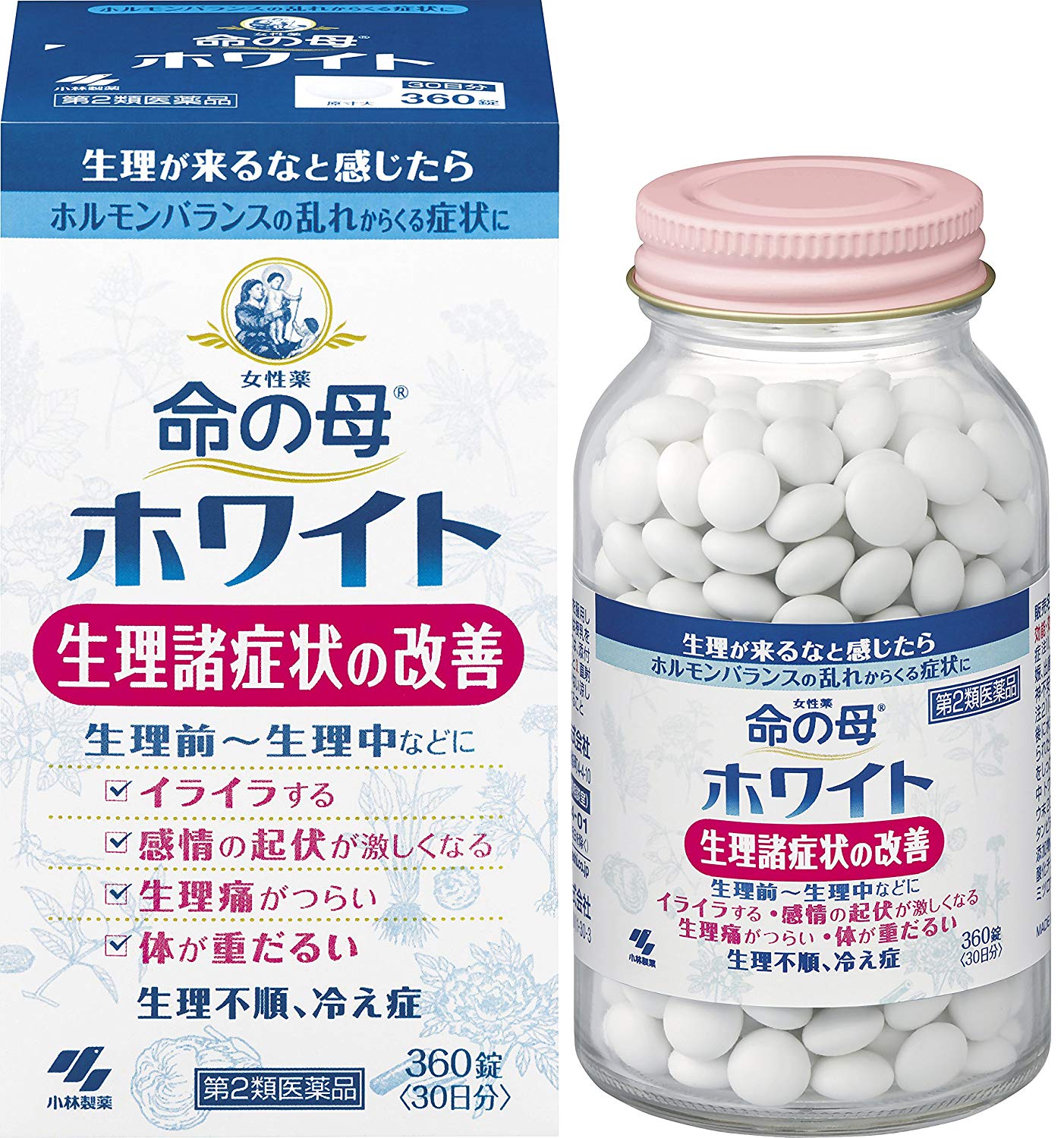
Inochi no Haha White — Kobayashi, 360 Tablets
Overview
Inochi no Haha White (命の母ホワイト) is a Kobayashi preparation of eleven powdered crude drugs, taken for the cluster of symptoms around menstruation: period pain, headache and low-back pain at that time of the month, irregular cycles, sensitivity to cold and irritability.
Two things need saying before anything else. First, this is 第2類医薬品 — a Class-2 Japanese over-the-counter medicine, not a dietary supplement. Our catalogue filed it under Vitamins & Supplements and the old description called it a supplement six times over; that was wrong in a way that matters, because the import rules and the cautions for a medicine are not the ones for a supplement. Second, White is not the same product as Inochi no Haha A. A is the menopause preparation. White is the menstrual one. See also Japanese health products and health.
Key Benefits
- ✓ All eleven crude drugs named — tōki, senkyū, shakuyaku, bukuryō, sōjutsu, takusha, keihi, botanpi, daiō, tōnin and ninjin, powdered and pressed into tablets rather than taken as a decoction
- ✓ A registered Japanese OTC medicine, stated as such — Class 2, with the maker's published indications rather than our own description of what it does
- ✓ No hormones — the formula contains no hormonal ingredient, which is the reason many people look for it in the first place
- ✓ A month in one box — 360 tablets at the label dose of 4 tablets three times daily is exactly 30 days, so there is no arithmetic to do at reorder time
- ✓ Aimed at the menstrual complex, not menopause — period pain, cycle irregularity, cold sensitivity, headache and low-back pain at menstruation, and irritability
- ✓ A long-standing Japanese pharmacy product — the Inochi no Haha line has been sold in Japan for over a century and is stocked in ordinary drugstores
- ✓ Dispatched from our base in Kobe, Japan, with tracking
Product Details
| Brand | Inochi no Haha White (命の母ホワイト) |
|---|---|
| Manufacturer | Kobayashi Pharmaceutical Co., Ltd. (小林製薬) |
| Country of origin | Japan |
| Product type | Women's medicine for menstrual symptoms, oral |
| Regulatory status in Japan | 第2類医薬品 — Class-2 over-the-counter medicine |
| Format | Coated tablets |
| Pack size | 360 tablets — 30 days at the label dose |
| Composition | 11 powdered crude drugs; no hormones |
| Age | 15 years and over |
| Barcode | 4987072039359 |
| Vendor | Tsujimoto Market, Kobe, Japan |
Who Is This For?
- People aged 15 and over with painful or irregular periods, or with headache, low-back pain, cold sensitivity or irritability around menstruation
- Anyone specifically looking for a preparation with no hormonal ingredient
- People already familiar with Japanese kampō-style crude-drug medicines and comfortable with a three-times-daily schedule
- Anyone who wants a full month in one box rather than a fortnight's supply
- Not for: pregnancy and breastfeeding; anyone looking for a menopause preparation (that is Inochi no Haha A, a different product); vegetarians and anyone observing halal, because the tablets contain gelatin of undisclosed origin
How to Use
- Take 4 tablets before a meal, with water or warm water.
- Repeat three times a day — 12 tablets in total per day.
- Take for at least 14 days before judging the effect; the maker's usual course is 2 to 3 months.
- Do not take more than the stated dose.
- Stop and consult a doctor or pharmacist if symptoms do not improve, or if loose stools or abdominal pain develop.
Frequency: 12 tablets a day, in three doses of 4, before meals. One box covers 30 days.
Full Ingredients
Active ingredients — 11 powdered crude drugs (Kobayashi's declaration): tōki (Angelica acutiloba root), senkyū (Cnidium officinale rhizome), shakuyaku (peony root), bukuryō (poria), sōjutsu (atractylodes rhizome), takusha (alisma rhizome), keihi (cinnamon bark), botanpi (moutan bark), daiō (rhubarb), tōnin (peach kernel), ninjin (ginseng).
Other ingredients: silicic acid, talc, calcium carbonate, titanium oxide, gelatin, gum arabic, sugar, beeswax, carnauba wax.
Gelatin is in the coating. Kobayashi does not publish its animal source, so this product is not suitable for vegetarians and cannot be assumed to meet halal requirements.
Cautions
- This is a Japanese Class-2 over-the-counter medicine, not a supplement. Read the package insert and keep to the stated dose.
- Do not use if you are pregnant, may be pregnant, or are breastfeeding.
- Not for children under 15.
- It contains daiō (rhubarb), an anthraquinone crude drug with a laxative action. Loose stools or abdominal pain are the expected reason to stop and ask a pharmacist.
- If you are already taking other medicines — particularly laxatives or other crude-drug preparations — check with a doctor or pharmacist first, as several of the eleven appear in other kampō formulas.
- If symptoms have not improved after about a month, stop and seek advice rather than continuing.
- Contains gelatin of undisclosed animal origin, and sugar.
- Keep out of reach of children. Store dry and cool, away from direct sunlight.
Package Contents
1 × Inochi no Haha White, 360 tablets, in the maker's sealed box with the Japanese package insert.
Shipping & Store Notes
- Ships directly from Japan
- Processing time: 2–6 business days
- Tracking number provided after dispatch
- Import duties and taxes may apply depending on destination country
- This is a registered Japanese over-the-counter medicine. Several countries restrict or prohibit importing medicines by post, including for personal use. Please check your own country's rules before ordering — we cannot refund a parcel seized by your customs authority
- Medicines cannot be returned once the seal is broken, for safety reasons
Authenticity Guarantee
Every product at Tsujimoto Market is sourced directly from Japan and verified for authenticity. We never sell fakes or grey-market goods. Each order is carefully packed in Kobe, Japan and dispatched with full tracking.
FAQ
Is this a supplement or a medicine?
A medicine — 第2類医薬品, Class-2 Japanese over-the-counter. It is not a food and not a dietary supplement. That distinction is what the customs rules, the cautions and the reason to talk to a pharmacist all hang on.
What is the difference between White and Inochi no Haha A?
They are different products for different people. White is for the menstrual complex — period pain, irregular cycles, headache and low-back pain at menstruation, cold sensitivity, irritability. A is the menopause preparation and has a different formula. The two are easily confused, and buying the wrong one is the commonest mistake in this brand; if menopause is what you are treating, A is the one to look at.
Does it contain gardenia?
No. Kobayashi's eleven are tōki, senkyū, shakuyaku, bukuryō, sōjutsu, takusha, keihi, botanpi, daiō, tōnin and ninjin. Gardenia (sanshishi) appears in other Japanese crude-drug formulas, which is where the confusion usually comes from, but it is not in this one.
Does it have side effects?
Yes. Kobayashi's insert lists possible reactions, and the most predictable one is digestive: daiō is rhubarb, an anthraquinone laxative, so loose stools and abdominal discomfort are the effects to watch for. Stop taking it and ask a pharmacist if they appear.
Is it suitable for vegetarians or for halal requirements?
No. The tablets contain gelatin, and Kobayashi does not publish its animal source. There is no halal certification for this product. If either matters to you, please treat it as unsuitable rather than assume.