
Why Japan Treats Placenta Supplements as Completely Normal
The first time I mentioned placenta supplements to friends back home, I got the reaction you'd expect — raised eyebrows, disbelief, a few jokes. After 23 years of living in Japan, I barely blink at them anymore. They're sold in every major drugstore. Dermatologists recommend them. Clinics offer placenta injections as a standard beauty treatment. They appear in the supplement aisle right next to your daily vitamins.
Japan has decades of clinical use and a deeply pragmatic relationship with placenta in both medicine and beauty. So when questions arrive at Tsujimoto Market about side effects and safety, I take them seriously — because the concerns are real, even if the fear is often exaggerated.
Here's everything Japan knows about placenta supplements, and how to use them safely.
What Are Placenta Supplements?
Placenta supplements are derived from placenta tissue — typically pig (porcine) placenta in the case of most Japanese oral supplements — which is processed, concentrated, and standardised into capsule or drink form. The placenta is exceptionally nutrient-rich: it contains amino acids, growth factors, peptides, vitamins, and a variety of bioactive compounds.
In Japanese beauty medicine, placenta extract is valued for its potential to support skin regeneration, reduce oxidative stress, and promote cellular renewal. It's been used in Japan's pharmaceutical-grade injectable market (Laennec, Melsmon) since the 1950s.
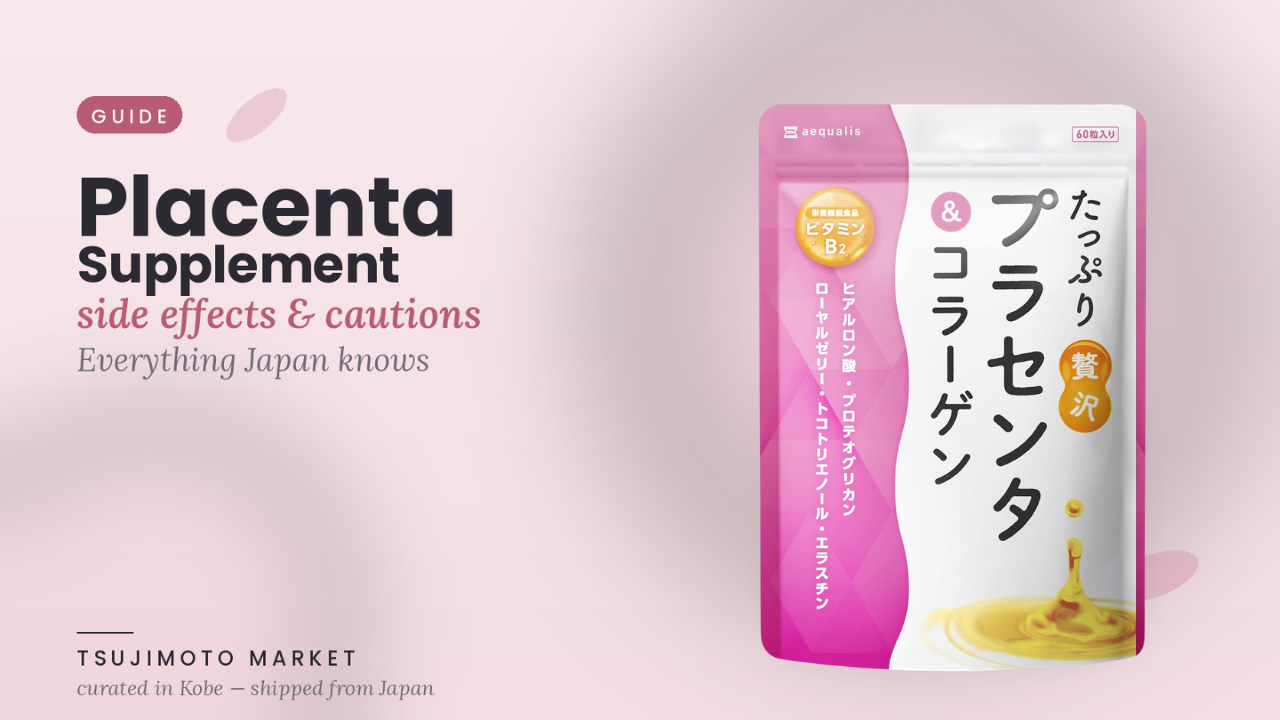
Oral supplements deliver a different bioavailability profile than injectables — the compounds pass through the digestive system — but the Japanese market has spent decades optimising concentration levels and formulations to compensate. The Aequalis Luxury Placenta Supplement that we carry, for example, uses 13,400mg of pig placenta concentrate at 50x concentration — an exceptionally high potency that reflects this approach.
What's Actually in High-Quality Placenta Supplements?
Japanese placenta supplements are rarely just placenta. Premium formulations combine the extract with synergistic ingredients to support absorption and broaden the beauty benefit. The Aequalis Luxury Placenta Supplement contains, alongside its 50x concentrated placenta complex:
- Royal Jelly — long used in Japanese beauty supplements for its amino acid and fatty acid content
- Collagen — to support skin elasticity and structure from within
- Hyaluronic Acid — the moisture-retention molecule found throughout Japanese skincare
- Proteoglycan — a Japanese-derived ingredient from salmon cartilage, valued for skin hydration
- Elastin — the protein responsible for skin's snap and bounce
- Vitamin B2, Vitamin C, and Tocotrienol — antioxidant support and cofactors for collagen synthesis
This is a comprehensively stacked formulation — not just placenta extract, but a full beauty supplement matrix designed to work together.
What Are the Real Side Effects?
Let me be clear about what the evidence actually shows. Serious adverse events from oral placenta supplements are uncommon in the literature. The most frequently reported effects are mild and temporary.
1. Digestive Discomfort
The most commonly reported side effect — particularly when starting — is mild digestive discomfort: a slight feeling of nausea, bloating, or an unsettled stomach, usually occurring when the supplement is taken on an empty stomach. This is not unique to placenta; many concentrated protein- and peptide-based supplements produce this effect in some people.
The solution: always take placenta supplements with food or immediately after a meal. Most Japanese manufacturers recommend this as standard practice.
2. Changes in Menstrual Cycle
This is the most discussed potential side effect in Japan and the one that generates the most caution. Some women report changes in their menstrual cycle when taking placenta supplements — lighter or heavier periods, cycle irregularity, or breakthrough spotting.
Placenta extract contains naturally occurring hormonal precursors and bioactive peptides. Whether these reach systemic levels sufficient to affect hormonal balance through oral supplementation is not definitively established in research. The effect, when reported, is typically temporary and resolves after stopping the supplement.
Who should be most cautious: Women who are pregnant, trying to conceive, breastfeeding, or who have hormone-sensitive conditions (endometriosis, PCOS, hormone-positive cancers) should consult a doctor before starting any placenta supplement.
3. Allergic Reactions
Allergy to porcine (pig) placenta is possible, as with any animal-derived protein source. Symptoms would be consistent with typical food allergy: itching, hives, swelling, or in severe cases, anaphylaxis. If you have known allergies to pork or pork products, avoid pig placenta supplements entirely.
Additionally, because formulations like the Aequalis contain royal jelly, anyone with known bee product allergies should check the ingredient list carefully.
4. Skin Breakouts (Temporary)
A minority of users report initial breakouts when starting a placenta supplement — sometimes called a "detox" response in Japanese wellness culture, though the clinical basis for this framing is not well established. What may be happening is a temporary shift in hormonal or metabolic activity as the body adjusts. This typically resolves within two to four weeks if the supplement is continued.
If breakouts persist beyond a month or are severe, discontinue use and consult a dermatologist.
5. Sleep Disturbances
Occasionally reported: difficulty sleeping or vivid dreams, particularly when supplements are taken in the evening. The mechanism is unclear. If this occurs, try shifting intake to morning or lunchtime.
Who Should Avoid Placenta Supplements?
Placenta supplements are not appropriate for everyone. Clear categories where caution or avoidance is warranted:
- Pregnant and breastfeeding women
- Women with hormone-sensitive conditions without medical clearance
- People with pork allergies or dietary restrictions against pork (pig placenta is not halal or kosher)
- People with bee product allergies (if the formula contains royal jelly)
- Children and adolescents
- Anyone on medication that could interact with hormonal precursors — consult your doctor
The Question of Bioavailability
One honest conversation worth having: the bioavailability of oral placenta supplementation is a genuine scientific debate. When placenta proteins and peptides pass through the digestive system, they are broken down — whether the specific bioactive compounds survive in sufficient quantity to produce measurable effects systemically is not as definitively established as the enthusiastic marketing might suggest.
What the Japanese market has done, pragmatically, is push concentration very high to compensate — hence the 50x concentrate approach in products like Aequalis. Whether this translates to meaningful systemic effect is ultimately something your own experience will tell you, which is why most Japanese users commit to at least three months of consistent use before evaluating results.
What is not in question: the supporting ingredients — collagen, hyaluronic acid, proteoglycan, elastin, and the vitamin cofactors — have a more established absorption and efficacy profile, and many users find value in the supplement regardless of where exactly the benefit originates.
How to Take Placenta Supplements Safely
Take with food. This reduces the risk of nausea and digestive discomfort significantly.
Start with half the dose. For the first two weeks, take half the recommended daily amount and observe how your body responds before moving to the full dose.
Commit to three months. Beauty supplement benefits — whether from collagen, HA, or placenta — do not appear overnight. The Japanese approach is typically three to six months of consistent use.
Watch for hormonal signals. Note any changes in your menstrual cycle, energy levels, or skin in the first month. If changes are significant or concerning, reduce the dose or stop.
Don't combine with other hormonal supplements without guidance. If you're already taking other supplements with potential hormonal activity — DHEA, red clover, dong quai, maca — consult a healthcare provider before adding placenta.
Frequently Asked Questions
Are placenta supplements safe for long-term use?
Long-term use data on oral placenta supplements is limited. In Japan, many women take them seasonally or in cycles — three months on, one month off — rather than continuously year-round. This approach is common in Japanese supplement culture more broadly and may be a reasonable framework for managing the unknown effects of extended use.
Is pig placenta the same as human placenta?
No, and not the same as deer placenta or horse placenta used in some other formulations. Pig placenta is the most commonly used source in Japanese oral supplements because its protein profile is considered close to human biology. Human placenta is used in some injectable treatments in Japanese medical clinics (Laennec, Melsmon) but is not used in over-the-counter oral supplements.
Will placenta supplements affect my hormones?
This is the key question and the honest answer is: possibly, in some individuals, to a degree not yet fully characterised by research. The compounds in placenta extract include hormonal precursors. Whether oral supplementation at the doses in commercial products produces measurable systemic hormonal effect remains uncertain. Women with hormonally sensitive conditions should seek medical advice before starting.
How long before I see results?
Japanese supplement culture generally recommends three months minimum. Many users report changes in skin quality — texture, glow, moisture retention — first, followed by changes in hair and nails if continued. Very few users see dramatic results in the first month.
Can I take placenta supplements alongside my skincare?
Yes — placenta supplements are designed as an internal beauty complement to topical skincare, not a replacement. Combining internal hydration support (from the HA and collagen in the supplement) with a strong topical hydration routine is the Japanese approach to "beauty from within."
The Bottom Line
Placenta supplements are not magic, and they are not risk-free. They occupy a well-established place in Japanese beauty medicine that is worth understanding on its own terms — with an honest assessment of both what they may offer and where caution is warranted.
For most healthy adult women without hormonal conditions or dietary restrictions, the main risks are mild and manageable: digestive discomfort that resolves with food, and possible temporary menstrual changes worth monitoring. The ingredient synergies in premium formulations — collagen, hyaluronic acid, proteoglycan, elastin, and antioxidant vitamins — provide a well-rounded beauty support matrix regardless of the placenta-specific debate.
The Aequalis Luxury Placenta Supplement represents one of the highest-quality formulations available through our store — 13,400mg at 50x concentration with a comprehensive supporting complex. If you're interested in exploring the Japanese approach to beauty supplementation, it's the place to start.
— Natalia Tsujimoto, 23 years in Kobe, Japan
Note: This article is for informational purposes only and does not constitute medical advice. Consult a healthcare professional before starting any new supplement, particularly if you have existing health conditions, are pregnant, or are on medication.