
Is Hyaluronic Acid Really Side-Effect Free?
When I first moved to Japan in 2002, hyaluronic acid was already everywhere — in toners, serums, eye creams, sheet masks. Japanese women didn't question it the way Western beauty communities sometimes do today. It was just… a given. A molecule your skin already makes, a molecule that keeps joints lubricated and skin plump, something as neutral as water.
Over 23 years of living here, using Japanese skincare daily, and running Tsujimoto Market — a shop sourcing authentic products straight from Japanese pharmacies and beauty stores — I've answered hundreds of questions about hyaluronic acid side effects. Most of them come from first-time buyers who've read something alarming online. So let me give you the full, honest picture: what's real, what's a myth, and what actually matters when choosing a hyaluronic acid product.
What Is Hyaluronic Acid and Why Does Japanese Skincare Use So Much of It?
Hyaluronic acid (HA) is a glycosaminoglycan — a type of sugar molecule — that occurs naturally in your body, particularly in your skin, eyes, and joints. Its superpower is water retention: one gram can hold up to six litres of water. Your skin produces it naturally, but output drops significantly with age, UV exposure, and stress.
Japanese skincare philosophy has centred on deep, sustained hydration for decades, which is why HA became a staple here long before it hit Western shelves. The approach isn't to mask dryness with occlusives alone — it's to draw water into the skin and keep it there. HA does exactly that.
Not All Hyaluronic Acid Is the Same
This is where it gets interesting, and where many side-effect concerns originate. Hyaluronic acid molecules come in different sizes, and size determines how deep into the skin they can penetrate.
High molecular weight HA sits on the surface and forms a film — excellent for immediate plumpness but it can feel slightly sticky in humid weather. Low molecular weight HA penetrates more deeply and delivers hydration into the lower layers of the skin. Nano-HA goes even deeper. Some formulas also use fermented or modified forms of HA for improved skin compatibility and gentleness.
Japanese brands, particularly Hada Labo, have invested heavily in multi-molecular HA technology. Their Hada Labo Gokujun Super Hyaluronic Acid Lotion contains four distinct types of HA: Nano-HA, Super-HA, Lacto-Fermented HA, and HA-Na (sodium hyaluronate). The idea is layered hydration — each type works at a different depth simultaneously. This sophisticated approach is why Japanese HA products tend to feel more effective than simpler single-molecule formulas.
The Real Side Effects of Hyaluronic Acid — And How Rare They Are
Let me be direct: topical hyaluronic acid has one of the cleanest safety profiles in skincare. Serious side effects from topical application are genuinely uncommon. That said, they do exist in specific circumstances.
1. Breakouts or Congestion
The most frequently reported complaint — especially in humid climates — is that HA can cause small bumps or clogged pores. This is not the HA itself causing this; it's typically the other ingredients in the formula. Most HA serums contain preservatives, emulsifiers, and sometimes silicones that can be pore-clogging for some skin types. Pure HA is non-comedogenic.
Japanese HA formulas tend to be much simpler. The original Hada Labo Gokujun lotion is famously free of alcohol, fragrance, mineral oil, and parabens. Fewer ingredients mean fewer opportunities for reactions.
2. Temporary Dryness in Dry Climates
This one surprises people. In very low-humidity environments — dry winter air, heated indoor spaces, certain climates — HA can theoretically pull moisture from the deeper layers of your skin when there isn't enough moisture in the air for it to draw from. The result is that skin feels drier after application rather than more hydrated.
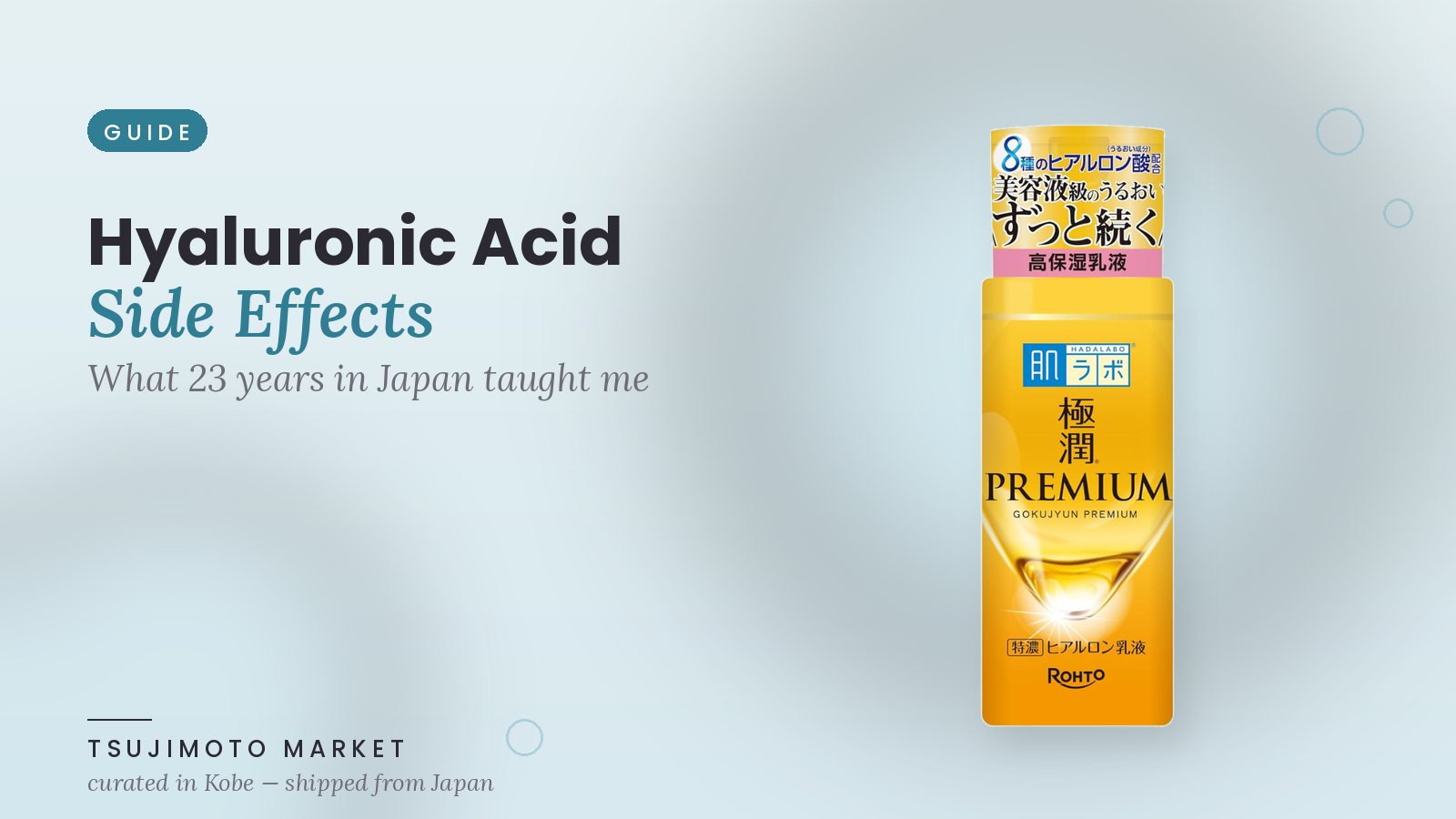
The solution is twofold: apply HA to damp skin (right after cleansing, before the skin fully dries), and always follow with a moisturiser or emulsion to seal the hydration in. In Japan, this is standard practice — the toner (lotion) goes on first to prep and hydrate, then the emulsion (milk) locks it in. The Hada Labo Gokujun Premium Milk is designed specifically for this second step, pairing beautifully with the HA lotion.
3. Sensitivity or Stinging
A small percentage of people with very reactive or compromised skin barriers experience mild stinging with HA products, usually on first application. This is rarely the HA molecule itself — it's more often the formula's pH, preservatives, or alcohol content.
If you have sensitive skin, Japanese HA formulas are often a better choice precisely because they're formulated without alcohol and fragrance, two of the most common irritants in Western serums. The Hada Labo range is dermatologist-tested and frequently recommended for post-procedure skin, eczema-prone skin, and allergy-sensitive individuals in Japan.
4. Allergic Reaction (Very Rare)
True allergy to hyaluronic acid itself is extremely rare. Hyaluronic acid is structurally nearly identical across species and is recognised as "self" by the immune system, which is why it's also used in injectable fillers and medical procedures. When allergic reactions do occur with topical HA products, patch testing usually reveals the culprit is a preservative (like phenoxyethanol), a botanical extract, or a fragrance component — not the HA.
If you suspect a reaction, patch test first: apply a small amount to your inner wrist or behind the ear and wait 24 hours.
Hyaluronic Acid and Different Skin Types
Oily and Combination Skin
HA is ideal. It delivers deep hydration without adding oils or occlusives that can feel heavy or cause shine. Well-hydrated skin actually produces less compensatory sebum, so regular use of a lightweight HA toner can help balance oiliness over time. The water-thin texture of the Hada Labo Gokujun lotion is particularly popular among oily skin types in Japan.
Dry Skin
HA works beautifully for dry skin when used correctly (on damp skin, followed by a richer moisturiser or emulsion). For very dry skin, the Hada Labo Gokujun Premium Gold version offers an enhanced HA complex with additional moisturising actives for deeper, longer-lasting hydration.
Sensitive and Reactive Skin
Japanese HA formulas — especially the Hada Labo range — are among the safest options for sensitive skin globally. No fragrance, no alcohol, no colourants. The molecule itself is anti-inflammatory. Many dermatologists in Japan recommend it as a foundational step for patients managing rosacea, eczema, or post-procedure recovery.
Acne-Prone Skin
HA is non-comedogenic and doesn't feed the bacteria associated with acne. However, if you're in an active breakout phase with open lesions, any topical product can potentially irritate. In that case, introduce it slowly and watch how your skin responds.
How to Use Hyaluronic Acid the Japanese Way
The Japanese approach to HA application is one of the most effective methods I've encountered — and it's different from what many Western guides recommend.
Step 1: Cleanse, then don't fully dry your face. Pat gently with a clean towel but leave the skin slightly damp. This gives HA the surface moisture it needs to draw from immediately.
Step 2: Apply the HA toner/lotion generously. Japanese HA lotions are designed to be used in quantity — not the two-to-three drops that some Western HA serums suggest. Pour a palmful, press it gently into the skin with both hands. For very dry skin, apply two to three layers, allowing each to absorb before applying the next (the "7-skin method" in Korean beauty terminology is based on this same principle).
Step 3: Seal with an emulsion or moisturiser immediately. Don't let the HA lotion sit on your skin without a sealant. The Hada Labo Gokujun Premium Milk is formulated as the ideal follow-up step, locking in the HA layer with a lightweight non-greasy film.
Step 4: Morning: always follow with SPF. HA itself offers no sun protection. UV exposure degrades HA in the skin over time, so protecting it is essential for long-term results.
What You Can Realistically Expect
Hyaluronic acid is not a treatment for wrinkles, dark spots, or acne. It's a hydration ingredient — one of the best available, but with a specific and limited mandate. What you can expect from consistent daily use:
- Softer, more supple skin texture within one to two weeks
- Reduced tightness and flakiness for dry skin types
- A more even "canvas" that makes other actives (retinol, vitamin C, niacinamide) work more effectively — because they absorb better into well-hydrated skin
- Over months: a measurable improvement in skin plumpness and fine lines caused by dehydration (not deep wrinkles, which require different interventions)
What you should not expect: overnight transformation, reduction of pigmentation, or pore minimisation. If a product promises all of these from HA alone, question the claims.
Frequently Asked Questions
Can I use hyaluronic acid every day?
Yes — daily use is the standard in Japan. Unlike stronger actives such as retinol or AHAs, hyaluronic acid does not require rest days or cycling. It's a hydration ingredient, not an exfoliant or treatment. Most Japanese women use it morning and evening as part of their base routine.
Can hyaluronic acid cause breakouts?
Pure HA is non-comedogenic. If you're breaking out after introducing an HA product, the more likely culprits are the formula's other ingredients — preservatives, emollients, or silicones. Try switching to a simpler, fragrance-free formulation. Japanese HA lotions like Hada Labo Gokujun are among the simplest formulations available globally.
Is hyaluronic acid safe during pregnancy?
Topical HA is generally considered safe during pregnancy — it doesn't penetrate to systemic levels. However, as with any skincare change during pregnancy, it's always best to consult your obstetrician or dermatologist for personal guidance.
Why does my skin feel drier after using HA?
This is the "dry climate effect" described above. Apply to damp (not dry) skin, and always follow immediately with an emulsion or moisturiser to seal. If you live in a particularly dry climate, layering an occlusive (like a facial oil or rich cream) as the final step will help lock everything in.
How is Japanese HA different from Western HA serums?
Japanese HA formulas tend to use multiple molecular weights of HA rather than a single type, have fewer additional ingredients (simpler = less irritation risk), and come in toner format rather than thick serum — making them suitable for layering and for oily skin types that find heavy serums uncomfortable. The Hada Labo Gokujun range in particular is a benchmark for the Japanese approach.
Can I use hyaluronic acid with retinol or vitamin C?
Yes — and it's actually recommended. HA helps cushion the potential irritation of stronger actives. Apply HA first on damp skin, let it absorb, then apply your active serum, then moisturise. This sequencing is standard practice in Japanese multi-step routines.
The Bottom Line
After 23 years of using Japanese skincare and sourcing it for customers worldwide, I can say with confidence: hyaluronic acid is one of the safest, most universally beneficial ingredients in skincare. True side effects from topical application are rare and almost always trace back to other ingredients in the formula — not the HA itself.
The key is choosing the right formula. Japanese HA products, particularly the Hada Labo Gokujun range, are formulated with exceptional simplicity — multiple types of HA, no fragrance, no alcohol, no unnecessary additives. That's why Japanese women have trusted this ingredient for decades.
If you're new to hyaluronic acid, the Hada Labo Gokujun Super Hyaluronic Acid Lotion is the place to start. For very dry or mature skin, the Hada Labo Gokujun Premium Gold offers the enhanced formula. And for the complete Japanese two-step hydration method, pair either with the Hada Labo Gokujun Premium Milk.
Your skin already makes hyaluronic acid. Give it a top-up — and do it the Japanese way.
— Natalia Tsujimoto, 23 years in Kobe, Japan