
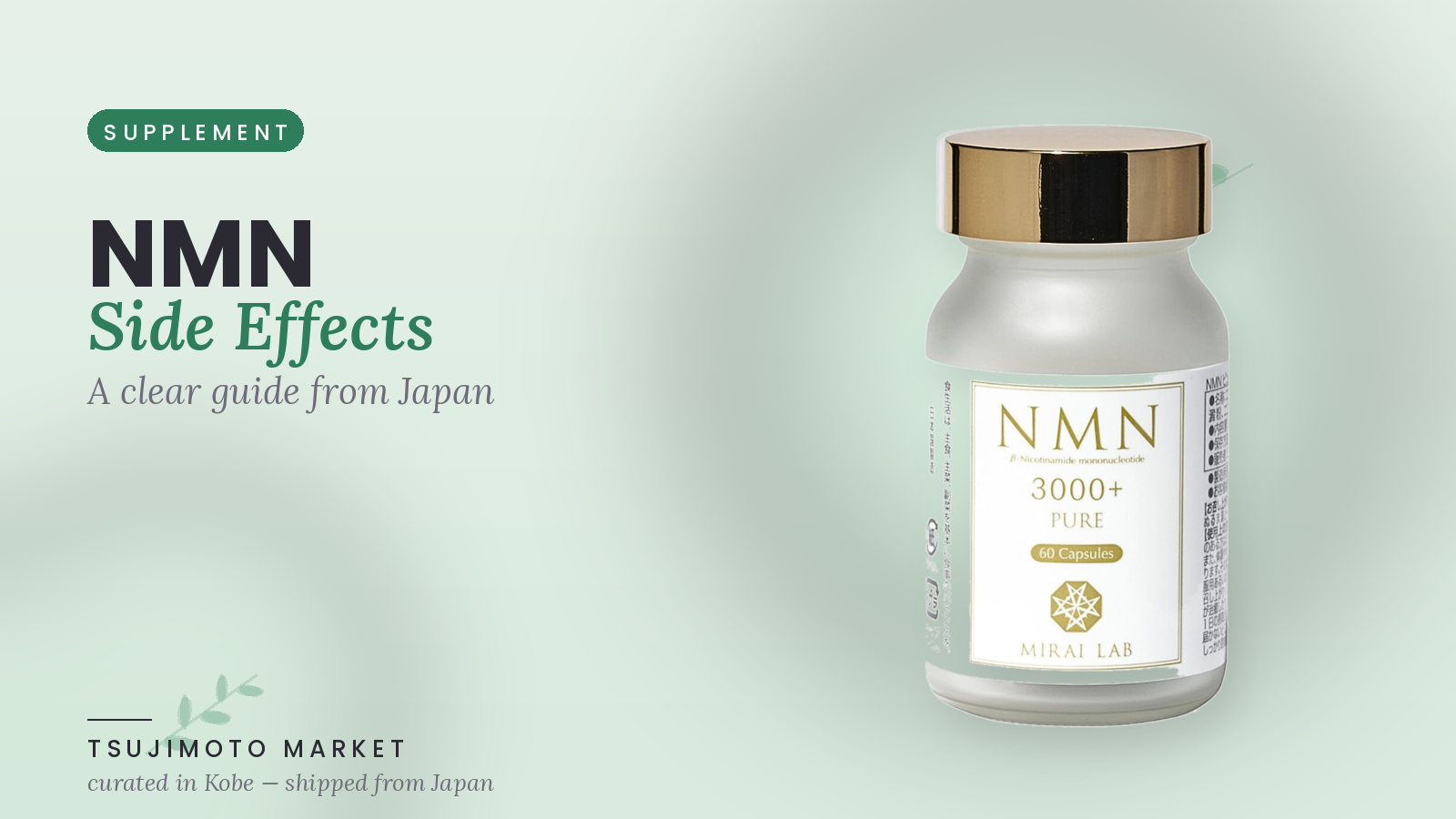
Every week I get emails asking the same question: "Is NMN safe? Will it cause side effects?" As someone who has lived in Japan for 23 years and stocks authentic Japanese supplements at Tsujimoto Market, I want to give you the honest, evidence-based answer — not the one designed to make you buy.
NMN (β-Nicotinamide Mononucleotide) is a NAD+ precursor that has become one of Japan's most talked-about anti-aging supplements since the early 2020s. FANCL — Japan's pioneering additive-free (無添加) brand — formulated one of the country's most trusted NMN products. But popularity doesn't mean side-effect-free. Here's what you genuinely need to know.
What Is NMN and Why Do Japanese People Take It?
NMN is a naturally occurring compound found in small amounts in foods like edamame, broccoli, and avocado. Inside the body, it converts into NAD+ (nicotinamide adenine dinucleotide) — a coenzyme essential for cellular energy, DNA repair, and metabolic function. NAD+ levels decline significantly with age, which is why researchers and supplement makers see NMN as a potential way to support healthy aging.
In Japan, NMN supplements are classified as food products (食品) rather than pharmaceuticals. This means they are not approved to treat or cure any disease — and reputable Japanese brands are careful to stay within these boundaries when making claims.
Reported NMN Side Effects: What the Evidence Actually Shows
Digestive Discomfort
The most commonly reported side effect in human trials is mild digestive discomfort — nausea, bloating, or loose stools — particularly when NMN is taken on an empty stomach or at high doses. These effects tend to be dose-dependent and temporary. Taking NMN with food typically reduces gastrointestinal sensitivity.
Flushing
Some users report mild skin flushing (warmth and redness), a reaction more commonly associated with plain niacin (vitamin B3). β-NMN — the specific form used in quality Japanese supplements like FANCL NMN×CoQ10 — produces significantly less flushing than niacin itself, but individual sensitivity varies.
Headache
A small number of users in clinical studies reported mild headaches, often in the first week of supplementation. This is thought to be related to the body adapting to changes in NAD+ metabolism. For most people, this resolves within a few days.
Interactions With Medications
NMN may interact with certain medications that affect NAD+ pathways — particularly cancer drugs, PARP inhibitors, or drugs affecting sirtuin activity. If you are on any prescription medication, especially for cancer, diabetes, or cardiovascular conditions, consult your doctor before adding NMN to your routine.
Pregnancy and Breastfeeding
There is insufficient data on NMN safety during pregnancy or breastfeeding. Japanese supplement brands including FANCL explicitly advise against use during pregnancy and nursing. This is the standard precautionary position across the Japanese supplement industry.
What Japanese Brands Don't Say — and Why That Matters
One thing I respect about Japanese supplement culture is the restraint in making claims. FANCL's NMN product, which I personally stock, is marketed around its proprietary Licaps® absorption technology and ingredient purity — not miracle promises. The product contains 300mg of 99%+ purity β-NMN and 100mg of reduced CoQ10 (ubiquinol) per daily serving, delivered in liquid hard capsules for optimal absorption.
What FANCL does not claim: it will extend your life, reverse aging, or replace a healthy lifestyle. This restraint is legally required in Japan — and it reflects the kind of honest supplement culture that made Japanese brands trusted globally.
Who Should Be More Cautious With NMN?
- People with active cancer or in cancer treatment — NAD+ pathways are complex in cancer biology; discuss with your oncologist.
- People taking blood thinners or cardiovascular medications — general precaution, not specific contraindication.
- Those with known sensitivity to B vitamins — NMN is a B3 derivative; B vitamin sensitivity may manifest.
- Pregnant or breastfeeding individuals — avoid until more data is available.
How to Take NMN to Minimise Side Effects
Based on what Japanese brands recommend and what clinical data suggests:
- Take with food, not on an empty stomach — reduces GI sensitivity significantly.
- Start at a lower serving if you're new to NMN supplements. FANCL NMN×CoQ10 is formulated at 300mg/day — a dose consistent with safety data from human trials.
- Stay hydrated — adequate water intake supports metabolic pathways.
- Be consistent — NMN works cumulatively; effects (if any) build over weeks, not days.
The FANCL NMN×CoQ10 Difference: Why Formulation Matters
Not all NMN supplements are equal. The β-type (beta-NMN) is the biologically relevant form — some cheaper products use α-NMN or undisclosed types. FANCL certifies 99%+ β-NMN purity through third-party testing, which is a meaningful quality marker.
The addition of 100mg Reduced CoQ10 (ubiquinol) per serving is also notable. CoQ10 and NMN support overlapping cellular energy pathways, and the combination is a logical one for mitochondrial health. The Licaps® liquid capsule technology improves the absorption of fat-soluble CoQ10 in particular.
If you're considering NMN as part of an anti-aging supplement stack, FANCL NMN×CoQ10 is the product I recommend — not because it's guaranteed to work for everyone, but because the formulation transparency, purity standards, and Japan-domestic manufacturing meet the bar I set for what I put in my own body.
FAQ: NMN Side Effects
Is NMN safe for long-term use?
Current human studies (up to 12 months in published research) show a good safety profile at standard doses. Long-term effects beyond that window are not yet fully established. Most Japanese brands recommend cycling use or consulting a doctor if taking long-term.
Can NMN cause liver damage?
There is no evidence from current human studies linking NMN supplementation to liver damage at standard doses. Animal studies at very high doses showed no significant liver toxicity. As always, if you have existing liver conditions, consult your doctor.
Does NMN interact with caffeine?
No known significant interaction. Many Japanese people take NMN in the morning alongside their regular coffee or green tea without issue.
How quickly can I expect to notice effects?
Honest answer: NMN is not a fast-acting supplement. If you notice anything, it tends to be subtle — slightly more energy, better sleep quality — over weeks to months. Individual responses vary significantly.
Is the NMN in FANCL the same as research-grade NMN?
FANCL uses β-NMN with 99%+ purity and third-party certification. Research-grade β-NMN used in human trials is typically at 99%+ purity as well. The forms are comparable.
Conclusion
NMN side effects are generally mild and manageable — digestive sensitivity, occasional flushing, and headaches in the first few days are the most commonly reported. Serious adverse effects have not been documented in peer-reviewed human trials at standard supplement doses.
The key is choosing a well-formulated product and taking it sensibly. At Tsujimoto Market, we ship the authentic Japanese-market version of FANCL NMN×CoQ10 directly from our warehouse in Kobe — the same formulation available in Japanese pharmacies, not reformulated versions created for export.
If you have specific health conditions or are on medication, please consult your healthcare provider before starting any new supplement. That's advice I give to every customer — and follow myself.
— Natalia Tsujimoto, 23 years in Kobe, Japan