
Every spring, the same scene plays out in Japanese drugstores: a wall of sunscreen tubes, each one stamped with a code that looks like a secret password. SPF50+. PA++++. Then a cluster of little plus signs that seem to multiply for no obvious reason. I have lived in Japan for years and watched countless visitors stand in front of that wall, completely paralysed, eventually grabbing whatever has the most plus signs and hoping for the best.
The truth is that those numbers are not marketing noise. They are two separate measurements of two separate kinds of damage, and once you understand what each one means, you can read any Japanese sunscreen label in about three seconds and pick the right one with confidence. This is the guide I wish I could hand to every person standing in front of that wall. I am Natalia, I source skincare directly from Japanese pharmacies, and I am going to translate the code for you.
UVA and UVB: the two enemies your sunscreen is fighting
Before any of the numbers make sense, you need to know that sunlight reaches your skin as two different kinds of ultraviolet radiation, and they damage you in two different ways.
UVB is the burning ray. It is the one responsible for sunburn, the red, sore skin you get after a day at the beach. UVB is strongest in summer and at midday, and it mostly hits the surface layers of your skin. An easy way to remember it: UVB = Burning.
UVA is the ageing ray. It penetrates deeper, reaches the layers where collagen lives, and is the main driver of wrinkles, sagging, and the dark spots and uneven tone that show up years later. UVA stays roughly constant all day and all year, and crucially it passes through clouds and window glass. UVA = Ageing. This is the ray that quietly does the long-term work while you are not even thinking about the sun.
A good sunscreen has to defend against both. And because the two were historically measured by different testing methods, the industry ended up with two separate ratings on the label: SPF for UVB, and PA for UVA. Japan happens to use the clearest, most consistent version of both.
The SPF number: how it works and what it really tells you
SPF stands for Sun Protection Factor, and it measures protection against UVB, the burning ray. The number is the part everyone fixates on, so let us clear up exactly what it does and does not mean.
SPF is about how much UVB is blocked, not how long you can stay out
You will often hear that SPF tells you how many times longer you can stay in the sun before burning, for example that SPF30 lets you stay out thirty times longer than with bare skin. That formula is technically how the lab test is structured, but in real life it is misleading, because it assumes a perfect, thick, even layer that almost nobody applies. A far more useful way to read the number is as the percentage of UVB it filters out.
SPF15 blocks roughly 93 percent of UVB. SPF30 blocks about 97 percent. SPF50 blocks around 98 percent. Notice how the curve flattens: the jump from 30 to 50 adds only a percentage point or so. That single point still matters for fair or sun-sensitive skin and for long outdoor days, but it explains why dermatologists say the difference between applying SPF30 properly and applying SPF50 too thinly is enormous, while the difference between 30 and 50 applied correctly is small.
What the plus sign in SPF50+ means
Here is the first plus sign that confuses people. In Japan, the highest number a sunscreen is allowed to print is 50. If a formula tests higher than 50 in the lab, the brand cannot legally write 60 or 70 — it simply adds a plus and prints SPF50+. So SPF50+ does not mean a vague extra boost; it means "tested protection greater than 50, capped at the label limit." It is the maximum SPF rating sold in Japan, and almost every serious daily sunscreen on this list carries it.
The PA system: Japan's UVA rating and those multiplying plus signs
This is where Japanese sunscreens become genuinely easier to read than many Western ones. PA stands for Protection Grade of UVA, a rating system developed in Japan that tells you, at a glance, how much protection a product gives against the ageing ray. Instead of a number, it uses plus signs, and there are exactly four possible levels.
PA+ means some UVA protection. PA++ means moderate protection. PA+++ means high protection. PA++++ — four plus signs, the maximum — means extremely high UVA protection. The four-plus rating was added in 2013 to keep pace with stronger formulas, and today it is the standard for any sunscreen designed to protect against photo-ageing.
So when you see a tube marked SPF50+ / PA++++, you are looking at the highest protection on both axes that Japan certifies: maximum defence against burning and maximum defence against ageing. That single line is doing the work of two separate ratings, and it is why this combination appears on nearly every premium Japanese sunscreen. When people grab "the one with the most plus signs," they are accidentally reaching for the strongest UVA protection — they are just doing it without knowing why.
Why you actually need sunscreen, and what happens if you skip it
It is tempting to treat sunscreen as a beach-only product, something you only need when you can feel the heat. But the ray that does the most lasting damage, UVA, is the one you cannot feel at all, and it is present on grey winter mornings and through your office window.
The short-term cost of skipping sunscreen is the obvious one: sunburn, from UVB, which is not just painful but is itself a form of DNA damage to skin cells. The long-term cost is the one that creeps up on you. The large majority of what we think of as "skin ageing" on the face — fine lines, loss of firmness, leathery texture, and especially uneven pigmentation and dark spots — is driven by cumulative UV exposure rather than the calendar. Dermatologists call this photo-ageing, and it is the single most preventable cause of an older-looking complexion.
There is a reason Japanese skincare culture treats daily sunscreen as the non-negotiable final step of a morning routine, more important than any serum or expensive cream. You can layer the most advanced anti-ageing essence in the world underneath, but if you skip the sunscreen on top, you are actively undoing that work every time you step outside. Protecting skin is far easier than repairing it, and sunscreen is the cheapest anti-ageing product you will ever buy.
Reading the label in practice: five Japanese sunscreens decoded
Now that the code makes sense, let us apply it to real products. I have chosen five sunscreens from our shelves that span the main textures and use-cases, so you can see how the same SPF50+/PA++++ rating shows up in very different formulas. Every one of these ships directly from Japan.
Skin Aqua Super Moisture UV Gel — the lightweight everyday gel
If you want to understand what a "light as water" Japanese sunscreen feels like, the Skin Aqua Super Moisture UV Gel SPF50+ PA++++ is the textbook example. It is a transparent gel by Rohto that spreads easily, absorbs fast, and leaves no white cast, carrying three types of hyaluronic acid for hydration and Rohto's Light Endurance NEO capsule filters. It is fragrance-free, dye-free, mineral-oil-free and paraben-free, and the generous 140 g tube makes it practical for face and body alike. It is the one I recommend most often to people who say they "hate the feeling of sunscreen," because it genuinely does not feel like much at all.
Skin Aqua Hyaluronic Serum UV — the alcohol-free option for sensitive skin
Many high-protection gels contain alcohol, which can sting reactive skin. The Skin Aqua Hyaluronic Serum Sunscreen UV SPF50+ PA++++ is built differently: it is explicitly formulated without alcohol, with a triple hyaluronic acid complex and a light, fragrance-free, watery serum texture. It carries a two-star water-resistance rating, so it holds up to an active day while staying gentle. This is my pick for anyone whose skin is dry or easily irritated and who has been put off sunscreen by a tight, drying finish.
Biore UV Aqua Rich Watery Essence — the cult watery essence
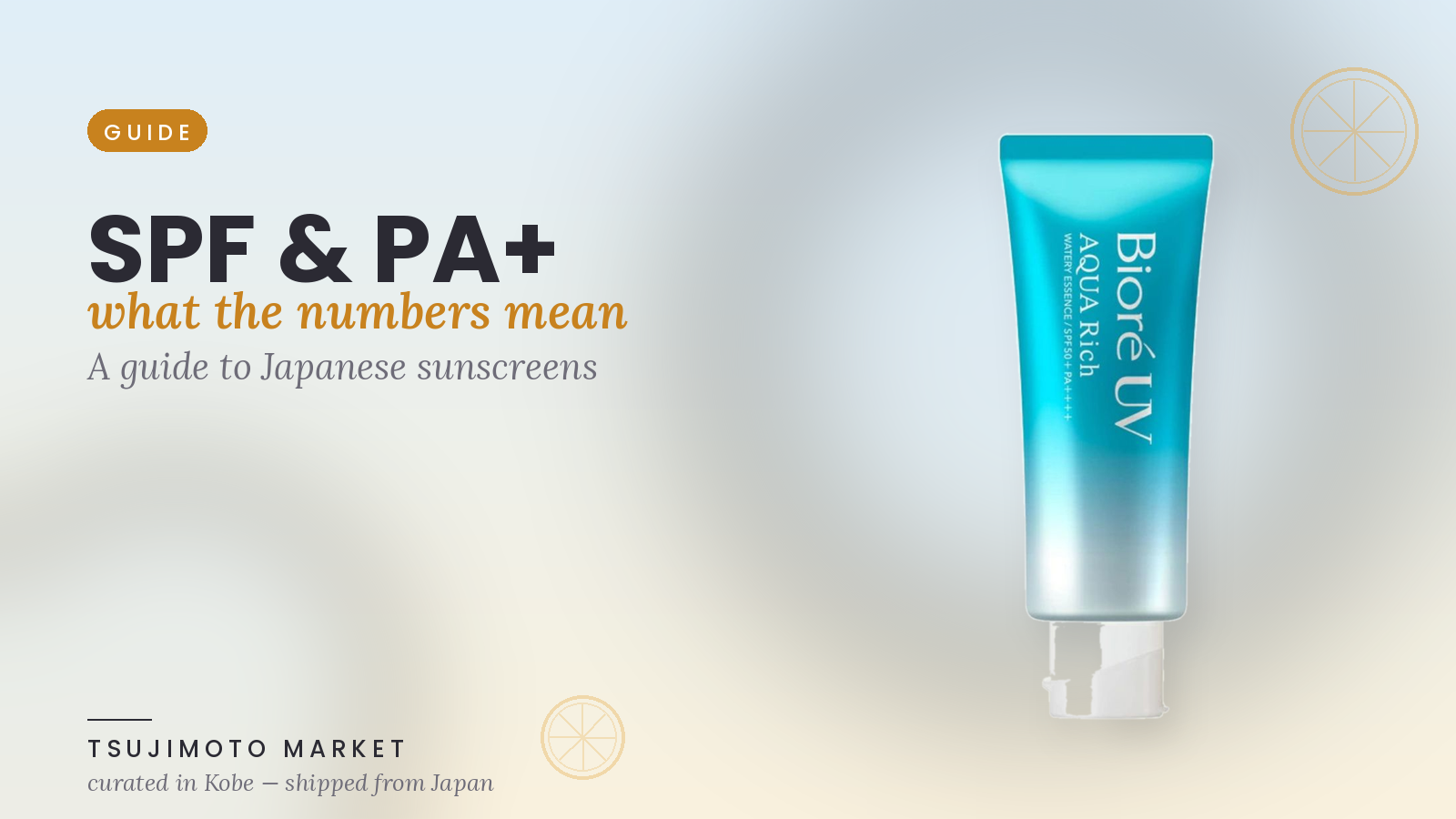
Few sunscreens have the global following of Biore UV Aqua Rich Watery Essence SPF50+ PA++++. Kao's formula spreads into a thin, second-skin film and combines several UV filters for broad-spectrum coverage, alongside hyaluronic acid, glycerin and ascorbyl glucoside, a stable form of vitamin C, for antioxidant support. It is super water-resistant yet washes off with ordinary soap, and it works beautifully as a makeup base. Two honest notes: it is lightly scented (a soft white-musk and lily-of-the-valley aroma) and it does contain alcohol, so it suits normal and oily skin better than very reactive skin.
Rohto Skin Aqua Tone Up — the colour-correcting tinted base
This one shows that a sunscreen can also be a complexion product. The Skin Aqua Tone Up UV Essence in Lavender SPF50+ PA++++ is a tinted gel-essence whose cool lavender shade optically neutralises yellow and sallow tones, giving skin a fresh, luminous translucency without a heavy foundation. Micro strobe pearls add a soft glow, and hyaluronic acid plus a vitamin C derivative care for the skin underneath. Lavender corrects dullness and yellowness; if redness is your concern, the same line offers a mint-green version. It is a lovely option for minimal-makeup days when you want to look more awake.
Shiseido Anessa Perfect UV Skincare Milk — the outdoor and sport benchmark
When you need protection that survives sweat, water and a full day outdoors, the Anessa Perfect UV Sunscreen Skincare Milk SPF50+ PA++++ is the benchmark, and Anessa has been Japan's number-one sunscreen line for two decades. It carries the highest UV rating issued in Japan, is strongly water- and sweat-resistant, and combines mineral and chemical filters — zinc oxide, octocrylene, ethylhexyl salicylate and a UVA-focused filter among them. The light milk emulsion suits face and body and is recommended for ages 12 and up. If you want to compare it with Anessa's gel formats, I cover the whole range in our Anessa 2026 lineup guide.
How to use any sunscreen so the number on the label is real
Here is the uncomfortable secret of the whole category: the SPF50+ on the tube is measured in a lab using a thick, even layer that most people never apply. Use too little, and an SPF50 behaves more like an SPF20. The rating is a promise the product can keep only if you hold up your end.
Apply enough. The standard dermatologists use is roughly two finger-lengths of product for the face and neck, which corresponds to about two milligrams per square centimetre. A thin smear is the most common reason sunscreen "doesn't work." Apply it as the final step of your morning routine, after moisturiser and before makeup, and give it a minute or two to set. Then reapply through the day, because the protective film breaks down with sweat, rubbing and time — every two to three hours during sun exposure, and after swimming or towelling off. A sunscreen mist or stick makes mid-day reapplication over makeup realistic.
Sunscreen myths and the questions I hear most
Is SPF100 twice as good as SPF50?
No. Because protection is measured as the percentage of UVB blocked, and SPF50 already blocks around 98 percent, there is simply no room for a doubling. Higher numbers give marginal gains and can encourage a false sense of security that leads people to apply less and reapply less. SPF50+ applied properly beats SPF100 applied carelessly every time.
I have a dark complexion — do I really need sunscreen?
Yes. More melanin does offer some natural protection against burning, but it does not prevent UVA-driven photo-ageing, uneven pigmentation, or the deeper damage UV can cause. In fact, hyperpigmentation and dark spots can be more stubborn on deeper skin tones, which makes daily UVA protection — the PA rating — especially worthwhile.
Do I need sunscreen indoors or on cloudy days?
If you sit near a window or spend time outdoors at all, yes. UVA passes through glass and cloud cover, so the ageing ray reaches you on overcast days and at your desk. This is exactly why the PA rating exists and why so many Japanese formulas are designed for daily, year-round wear rather than beach-only use.
Does makeup with SPF replace sunscreen?
Not on its own. The SPF in a foundation or powder is real, but you would have to apply far more than anyone normally does to reach the labelled protection. Treat SPF makeup as a welcome bonus layer on top of a dedicated sunscreen, not as a substitute for it.
Is a higher PA always better?
For protecting against ageing and pigmentation, more plus signs are better, and PA++++ is the sensible default for daily use. The honest caveat is that, just like SPF, the rating only delivers if you apply enough and reapply. The grade on the label is a ceiling, not a guarantee.
The bottom line
Two ratings, two rays. SPF, with its single plus sign at 50+, measures defence against UVB — the burning ray. PA, with its one to four plus signs, measures defence against UVA — the ageing ray. A tube marked SPF50+ PA++++ gives you Japan's maximum on both, and now you know exactly why that matters rather than just grabbing whatever looks strongest.
The best sunscreen is the one you will actually wear every day, so let texture and skin type guide your choice: a weightless gel, an alcohol-free serum, a cult watery essence, a tone-up base, or a sweat-proof milk for the outdoors. You can explore all of them in our Japanese sunscreen collection, and if you want my ranked picks for the season, the Best Japanese Sunscreens 2026 guide is the natural next read. Whichever you choose, wear it every morning — your future skin will thank you.
— Natalia Tsujimoto, Kobe