
Tsujimoto Market: Our Guarantees
Description
A Shizuoka Green Tea Gift Set — Two Teas That Want Two Different Water Temperatures
Overview
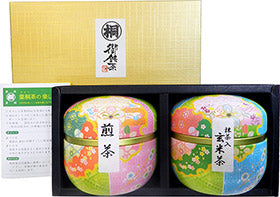
Two Japanese green teas from Shizuoka, gift-wrapped, 50 g of each. Shizuoka is the prefecture that grows around forty per cent of Japan's tea, on the slopes running down from Mount Fuji toward the sea, and it is where most Japanese people's idea of what green tea tastes like comes from.
Sencha is the everyday tea of Japan and the one in nine cups out of ten. The leaves are steamed within hours of picking, which stops oxidation and is the fork in the road where Japanese tea goes green and Chinese and Indian tea go dark; then they are rolled into fine needles and dried. It tastes fresh, grassy and faintly sweet, with a savoury depth underneath that the Japanese call umami and that no other tea quite has.
Genmaicha with matcha is sencha blended with roasted brown rice, and matcha powder added on top. The roasted rice gives it a warm, nutty, almost popcorn quality that makes it the friendliest Japanese tea for someone who has never had one, and the matcha thickens the body and deepens the colour. It is comforting in a way plain sencha is not.
Two things the old page did not say, and they matter. First, this is loose leaf, not tea bags — the recipient will need a pot with a mesh, or an infuser basket. Second, and this is the useful part: the two teas want different water temperatures. Sencha wants water off the boil, around 70–80 °C, because boiling water pulls its bitterness forward and flattens the sweetness. Genmaicha wants it much hotter, near boiling, because the roasted rice needs the heat to give up its aroma and the blend does not go bitter the way plain sencha does. Brew them both the same way and one of the two will disappoint. Brew them properly and the set makes sense as a pair.
Caffeine. A cup of Japanese green tea from a bag lands somewhere around 20-30 mg, against roughly 80-100 mg for a filter coffee — a quarter of the dose, in other words, which is why green tea is the all-afternoon drink and coffee is not. Where a tea carries added matcha, as this one does, the figure sits a little higher than plain sencha, because matcha is powdered leaf swallowed whole rather than an infusion. The manufacturer does not publish a per-serving figure and we are not going to invent one, but the practical point holds: two or three cups in an afternoon is unremarkable, and if you are counting for pregnancy or for a sleep problem, count it as tea rather than as nothing.
See the rest of our Japanese tea and matcha and our other Japanese health products.
Key Benefits
- ✓ Two contrasting Japanese green teas rather than two of the same thing — one fresh and grassy, one roasted and nutty
- ✓ Shizuoka leaf: the prefecture that grows roughly 40% of Japan's tea
- ✓ Genmaicha is the easiest entry point into Japanese tea for someone who has never had one
- ✓ Matcha added to the genmaicha for a fuller body and a deeper green in the cup
- ✓ Both packs gift-wrapped in Japan, so it arrives ready to give
- ✓ 50 g each — around 20–25 cups per pack at a level 2 g measure, so roughly 40–50 cups in the box
- ✓ No sugar, no flavouring, no colour in either tea
- ✓ Genuine Japanese domestic stock, shipped from Kobe with tracking
Product Details
| Brand | Hagiri |
|---|---|
| Country of origin | Japan — Shizuoka Prefecture |
| Product type | Green tea gift set, loose leaf |
| Contents | 1 × sencha 50 g, 1 × genmaicha with matcha 50 g |
| Net weight | 100 g total (2 × 50 g) |
| Format | Loose leaf — a teapot with a mesh or an infuser basket is required |
| Ingredients | Sencha: green tea. Genmaicha: green tea, roasted brown rice, matcha |
| Caffeine | Approximately 20–30 mg per cup, about a quarter of a filter coffee |
| Brewing temperature | Sencha 70–80 °C; genmaicha 90–95 °C — they are not the same |
| Presentation | Both packs gift-wrapped |
| Vendor | Tsujimoto Market, Kobe, Japan |
Who Is This For?
- Right as a gift if the recipient likes tea but has not gone deep into Japanese tea. The genmaicha is welcoming and the sencha is the real thing, and having both is more interesting than having 100 g of either.
- Right for you if you want to taste the difference between the two styles side by side, which is genuinely instructive and costs you one box.
- Right for you if you already own a teapot with a mesh basket or a simple infuser.
- Not right if the recipient has no way to brew loose leaf. It is not tea bags, and a gift that needs equipment the recipient does not own is not a good gift.
- Not right if they avoid caffeine — both teas contain it, at roughly a quarter of a coffee per cup.
- Not right if they avoid grains: the genmaicha contains roasted brown rice, which is the whole point of it.
How to Use
- Sencha. One level teaspoon (about 2 g) per cup. Water off the boil, 70–80 °C. Steep 60–90 seconds for the first cup.
- Genmaicha. One level teaspoon per cup. Water much hotter, 90–95 °C — near boiling. Steep 30–60 seconds. The roasted rice needs the heat and the blend forgives it.
- Pour the pot out completely each time. Leaf sitting in hot water is what turns a good Japanese tea harsh.
- Second steep, both teas: hotter water, half the time. Sencha gives two or three good infusions; genmaicha gives two.
- For iced sencha: brew at double strength and pour straight over a full glass of ice.
- For cold brew: a heaped teaspoon of sencha in 500 ml of cold water, overnight in the fridge. Genmaicha is less suited to this — the roasted rice wants heat.
- Store both packs sealed, cool, dark and away from strong smells. Tea takes on whatever is next to it.
- If you are being treated for iron deficiency, drink between meals rather than with them.
Frequency: Two to four cups a day suits most people. Sencha in the morning and genmaicha in the afternoon is the conventional order in Japan, and it works — the roasted tea is the more relaxing of the two.
Full Ingredients
Sencha: green tea. That is the whole list.
Genmaicha with matcha: green tea, roasted brown rice, matcha. Also the whole list — no sugar, no flavouring, no colour, and the popcorn note comes from the rice rather than from anything added.
On the rice, because people ask. Genmaicha contains roasted brown rice, which is a grain and is present in a meaningful quantity — it is roughly half the volume of the blend, not a trace. It is rice, so it contains no gluten, and genmaicha is a normal choice for someone avoiding wheat. But if you are avoiding grains altogether, or you are giving this to someone who is, the genmaicha half of the set is not for them and the sencha half is.
What is not published. Hagiri does not publish a harvest date, a cultivar or a per-serving nutrition panel for this set, and we have not invented any of the three. The caffeine figure in the details table is the general range for Japanese green tea by infusion rather than a manufacturer's declaration.
Cautions
- Contains caffeine — roughly 20–30 mg a cup, about a quarter of a filter coffee. Count it in if you are limiting caffeine for pregnancy or sleep.
- The genmaicha contains roasted brown rice. Not suitable for anyone avoiding grains. It is naturally gluten-free.
- In pregnancy and breastfeeding, count both teas toward the 200 mg a day caffeine limit from all sources.
- Tea polyphenols reduce the absorption of non-haem (plant) iron. If you are being treated for iron deficiency, drink it between meals rather than with them, and leave an hour either side of an iron tablet.
- If you take warfarin, keep green tea intake steady rather than swinging. An infusion carries far less vitamin K than matcha powder does, but a stable habit is what keeps an INR stable.
- Do not brew sencha with boiling water. It is the most common way to make a good Japanese tea taste bad, and it cannot be corrected afterwards.
- Do not leave leaf sitting in the pot between cups. Pour it out completely each time.
- Store sealed and away from strong-smelling foods, and out of direct sunlight. Both teas will fade in flavour within a few months of opening.
- Not suitable as a drink for infants. For older children, treat it as a caffeinated drink.
- Keep out of reach of children.
- This is a food, not a supplement and not a medicine. It does not treat, prevent or cure anything, and we have taken the health claims off this page.
Package Contents
Two gift-wrapped packs — 50 g of Shizuoka sencha and 50 g of genmaicha with matcha, 100 g in total. Loose leaf: a teapot with a mesh or an infuser basket is needed, and neither is included. Japanese retail packaging with Japanese-language labelling. If this is going straight to a recipient, tell us at checkout and we will pack it accordingly.
Shipping & Store Notes
- Ships directly from Japan
- Processing time: 2–6 business days
- Tracking number provided after dispatch
- Import duties and taxes may apply depending on destination country
- Opened cosmetics cannot be returned for hygiene and safety reasons
Authenticity Guarantee
Every product at Tsujimoto Market is sourced directly from Japan and verified for authenticity. We never sell fakes or grey-market goods. Each order is carefully packed in Kobe, Japan and dispatched with full tracking.
FAQ
Do the two teas brew the same way?
No, and this is the most useful thing on the page. Sencha wants water off the boil — around 70–80 °C — because it was grown and processed to be sweet, and boiling water drags the bitterness forward and flattens that sweetness. Genmaicha wants water much hotter, close to boiling, because the roasted brown rice only gives up its aroma with heat and the blend does not turn harsh the way plain sencha does. If you brew both at the same temperature, one of the two will be wrong: either the sencha is bitter or the genmaicha is flat. It is a thirty-second adjustment and it changes the cup completely.
Is this loose leaf or tea bags?
Loose leaf, and no infuser is included. The recipient will need a Japanese kyusu, any teapot with a built-in mesh, or a basket infuser that sits in a mug. This was not stated on the old version of this page, and it is worth checking before you send it as a gift — a beautiful box of tea that someone cannot brew is a slightly awkward present. If they have no equipment, our bagged green tea is the better gift and we will happily point you at it.
What is genmaicha, and why does it taste like popcorn?
It is green tea blended with roasted brown rice, in roughly equal parts. The rice is roasted until some grains pop, which is where the popcorn comparison comes from, and it contributes a warm, nutty, toasty aroma that softens the tea considerably. The story that it was originally a way to make expensive tea go further is often told and is probably true, but it survives on merit — it is the most approachable Japanese tea there is, and the version in this set has matcha added, which gives it more body and a deeper green than plain genmaicha.
How many cups will the set make?
Around 40 to 50 in total. Each pack is 50 g, and a level teaspoon is about 2 g, so each gives roughly 20 to 25 cups from the first infusion alone — and both teas take a second steep, which effectively adds a good deal more. Store them sealed and dark and use them within a few months of opening, because green tea fades: it does not spoil, but it loses the fresh sweetness that is the reason to buy Japanese tea in the first place.
Will I pay customs duty or import VAT?
That depends on your country and on the declared value of the parcel, not on us. We ship from Japan with a correct customs declaration and full tracking; any duty or import VAT your country charges is collected by your local carrier or customs office on delivery. Check your national de-minimis threshold before ordering if you want to avoid a surprise.