
Tsujimoto Market: Our Guarantees
Description
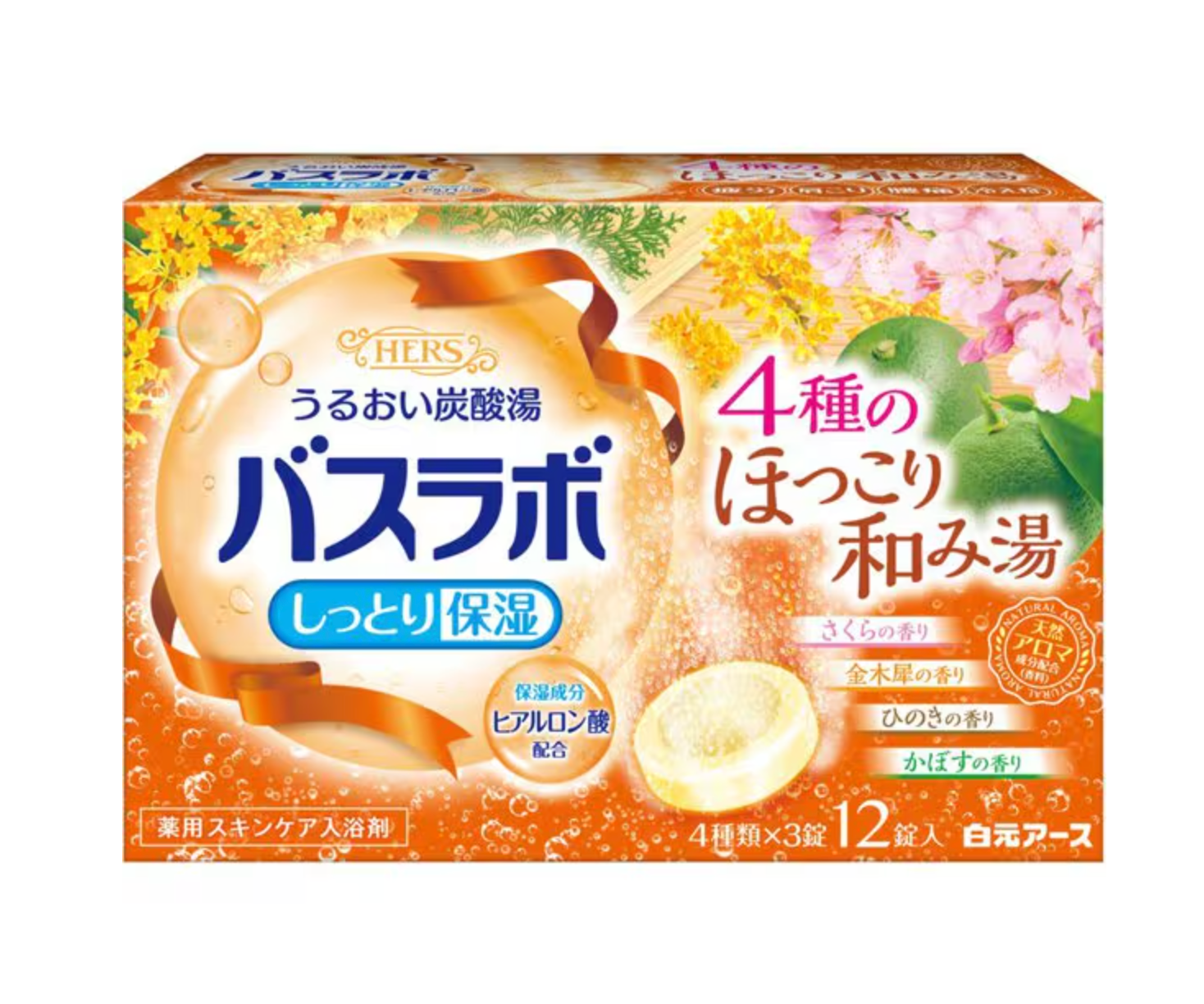
Hakugen Earth HERS Bath Lab — 4 Japanese Scents, 12 Tablets
Overview
Twelve carbonated bath tablets from Hakugen Earth (白元アース), three each of four Japanese scents: sakura, osmanthus, hinoki and kabosu. Total 45 g x 12 tablets, 540 g.
This is a quasi-drug (医薬部外品), not a cosmetic. Its two active ingredients are sodium bicarbonate and sodium sulfate — the pair used in Japanese carbonated bath tablets to carry warmth into the water and hold it there. Hyaluronic acid and jojoba oil are added as moisturisers. Each scent gives the water its own colour.
See also Japanese bath products and Japanese body care.
Key Benefits
- ✓ A registered quasi-drug, so the maker’s indications are printed on the box, not invented for a listing
- ✓ Sodium bicarbonate and sodium sulfate, the two registered actives, named on this page
- ✓ Hyaluronic acid and jojoba oil added as moisturisers
- ✓ Four Japanese scents in one box, three tablets of each, so you can find the one you keep
- ✓ Each scent colours the water differently, which makes the difference visible as well as scented
- ✓ 45 g tablets — the full-size Japanese format, one per standard bath
- ✓ 540 g in the box, twelve baths, individually wrapped so they keep
- ✓ Bought in Japan and dispatched from our own shop in Kobe
Product Details
| Brand | HERS Bath Lab (HERSバスラボ) |
|---|---|
| Maker | Hakugen Earth Co., Ltd. (白元アース), Tokyo, Japan |
| Country of origin | Japan |
| Product type | Carbonated bath tablets, assortment |
| Regulatory status | 医薬部外品 — quasi-drug |
| Active ingredients | Sodium bicarbonate, sodium sulfate |
| Moisturisers | Hyaluronic acid, jojoba oil |
| Scents | Sakura, osmanthus, hinoki, kabosu — 3 tablets of each |
| Tablet weight | 45 g |
| Tablets per box | 12 |
| Net weight | 540 g |
| One tablet treats | A standard bath of about 200 litres |
| Water temperature | 38–40 °C |
| Soak | 10–15 minutes |
Who Is This For?
- Anyone who wants a Japanese carbonated bath tablet and has not yet decided which scent they like
- People who take a warm bath in the evening as a routine rather than as a treatment
- Anyone buying a first Japanese bath product as a gift — four scents makes it easy to give
- People who prefer a registered quasi-drug over an unregistered scented fizz
- Not for use on broken skin or over a diagnosed skin condition without medical advice
- Not for people who react to fragrance; every tablet in this box is scented
How to Use
- Run a standard bath, about 200 litres, at 38–40 °C.
- Unwrap one tablet and drop it in.
- Let it dissolve completely. It fizzes; the fizz is carbon dioxide leaving the bicarbonate.
- Soak for 10–15 minutes.
- Rinse off afterwards if your skin is reactive, and do not leave the water standing in the tub overnight.
Frequency: One tablet per bath. Daily use is fine for most skin.
Full Ingredients
Active ingredients (医薬部外品): sodium bicarbonate, sodium sulfate.
Moisturising ingredients: hyaluronic acid, jojoba oil.
Other ingredients: fumaric acid or a comparable acidulant to drive the fizz, PEG, fragrance and colourant, varying by scent. Hakugen Earth prints the complete other-ingredients list on each wrapper in Japanese. We do not reproduce a full list here because it differs between the four scents in the box and we will not publish one list as though it covered all four.
Registered indications (医薬部外品). Because this is a quasi-drug rather than a cosmetic, the maker may state what it is for, and these are the approved entries: fatigue recovery, sensitivity to cold, stiff shoulders, prickly heat, rough and chapped skin, cracked skin, chilblains, lower-back pain, neuralgia, bruises and sprains.
That list is the manufacturer’s and is registered in Japan. It is not a promise from us, and it is not a treatment for a diagnosed condition.
Cautions
- A quasi-drug bath additive is not a treatment for a diagnosed skin or joint condition. See a doctor for that.
- Do not use it if you have an open wound, severe eczema, or badly broken skin.
- Stop using it and rinse if redness, itching or stinging appears.
- Do not swallow the tablets and keep them out of reach of children and pets.
- One tablet is for a standard bath of roughly 200 litres. More tablets do not make a better bath.
- Do not use the tablets in a bathtub with a circulating heater if the appliance maker advises against bath additives.
- The bath water may be reused for the wash cycle of laundry, but not for the rinse, and not together with bleach or fabric softener.
- Keep the tablets in their sealed wrappers, dry and away from direct sun. They react with moisture.
Package Contents
One box, 12 individually wrapped tablets of 45 g — three each of sakura, osmanthus, hinoki and kabosu. Net 540 g. Japanese retail packaging, unopened.
Shipping & Store Notes
- Ships directly from Japan
- Processing time: 2–6 business days
- Tracking number provided after dispatch
- Import duties and taxes may apply depending on destination country
- Opened bath products cannot be returned for hygiene and safety reasons
Authenticity Guarantee
Every product at Tsujimoto Market is sourced directly from Japan and verified for authenticity. We never sell fakes or grey-market goods. Each order is carefully packed in Kobe, Japan and dispatched with full tracking.
FAQ
What is actually in the box — how many of each scent?
Twelve tablets: three sakura, three osmanthus, three hinoki, three kabosu. Each tablet weighs 45 g, so the box holds 540 g.
Some listings give a millilitre figure for these tablets. Which is right?
Weight, not volume. It is 45 g per tablet across twelve tablets, 540 g in total. These are solid tablets and the product carries no millilitre figure at all.
What does "quasi-drug" mean, and is it a medicine?
医薬部外品 is a Japanese category between cosmetics and medicines. It means the actives are registered and the maker may state approved indications on the box, but it is not a prescription or an over-the-counter medicine and it does not treat a diagnosed condition.
Will the colour stain my bathtub?
The colourants are used at bath-additive concentration and rinse away with the water. Acrylic and enamel tubs are normally unaffected. Do not leave coloured water standing overnight, particularly in an older or crazed tub, and rinse the tub after draining.
What do the four scents smell like?
Sakura is light and floral; osmanthus is sweet and apricot-like; hinoki is the woody smell of Japanese cypress, the timber traditional baths are made from; kabosu is a sharp green citrus, closer to lime than to orange.