
Tsujimoto Market: Our Guarantees
Description
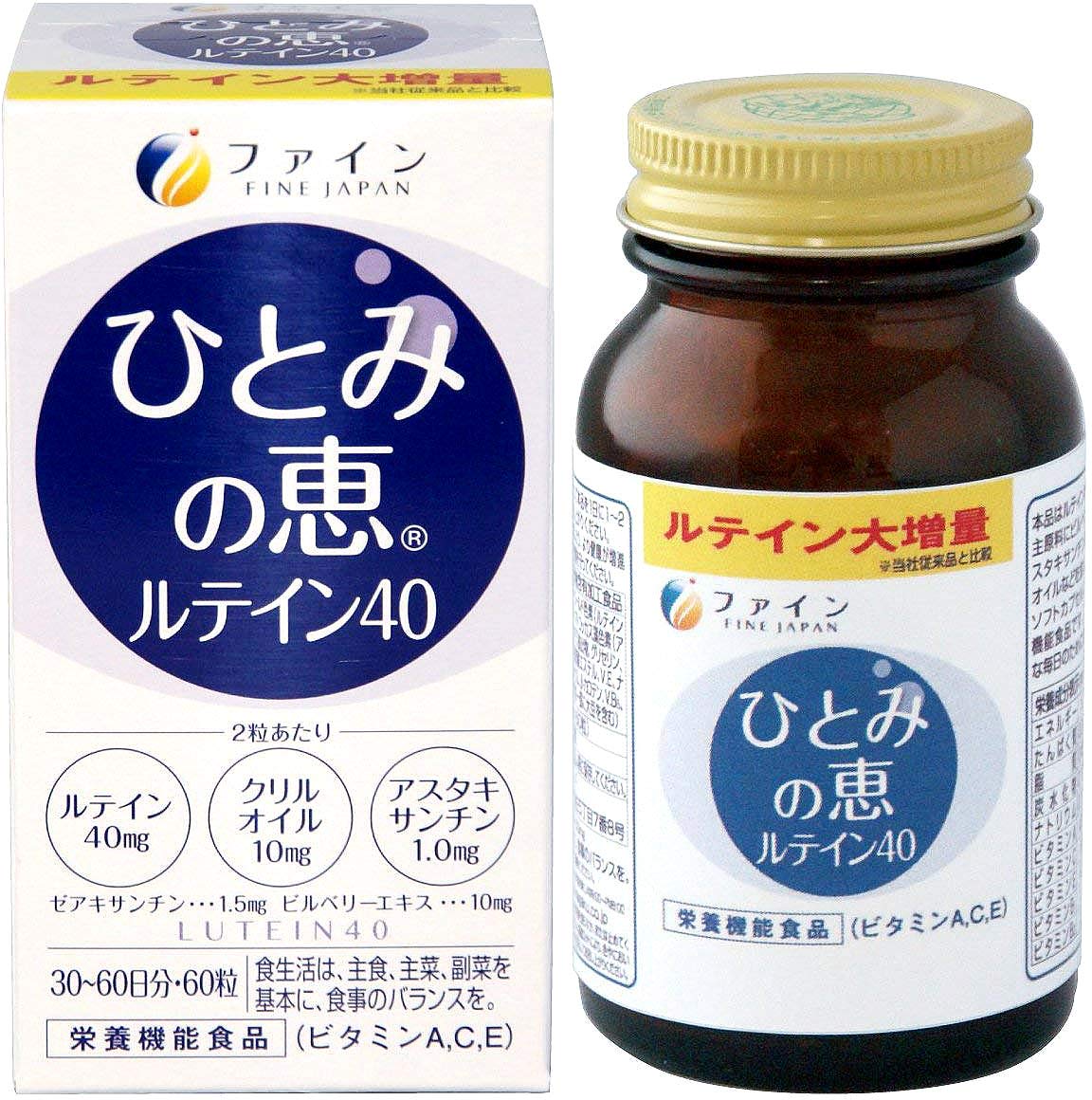
Fine Japan Hitomi no Megumi Lutein 40, 60 capsules
Overview
Two soft capsules a day, thirty days to a box, and 40 mg of free lutein in that daily pair — a high declared amount by the standards of the Japanese market, extracted from marigold. Alongside it: zeaxanthin 1.5 mg, astaxanthin 1.0 mg, krill oil 10 mg, bilberry extract 10 mg, and a set of vitamins that makes the product a 栄養機能食品 (nutrient function food) in Japan.
Two things the previous page did not tell you: the krill oil is a crustacean allergen, and the capsule shell is gelatin. Both are below.
See also: Japanese Eye Health Supplements.
Key Benefits
- ✓ Free lutein 40 mg per two capsules, from marigold
- ✓ Zeaxanthin 1.5 mg and astaxanthin 1.0 mg in the same daily pair
- ✓ Krill oil 10 mg, a phospholipid-form source of EPA and DHA
- ✓ Bilberry extract 10 mg
- ✓ Vitamins A, C, E, B1, B2, B6, B12, niacin and pantothenic acid — declared amounts below
- ✓ 60 capsules of 450 mg — a clean thirty days at two a day
- ✓ Fine Japan, made in Japan, at a Japanese domestic price
Product Details
| Brand | Hitomi no Megumi (Fine Japan Co., Ltd.) |
|---|---|
| Product type | Soft capsule supplement, nutrient function food (栄養機能食品) |
| Quantity | 60 capsules of 450 mg — 30 days |
| Serving | 2 capsules a day |
| Lutein per serving | 40 mg (free form, marigold-derived) |
| Zeaxanthin / astaxanthin | 1.5 mg / 1.0 mg |
| Country of origin | Japan |
| Allergens | Crustacean (krill oil) |
| Capsule shell | Gelatin — animal source not declared |
Who Is This For?
- Adults who spend long days at a screen and want a lutein supplement with a declared amount
- People comparing lutein products: 40 mg free lutein is high, and free-form is the figure to compare
- Anyone who wants zeaxanthin and astaxanthin in the same capsule rather than separately
- Not for anyone with a crustacean allergy — the formula contains krill oil
- Not vegetarian (gelatin shell, krill oil), not for children, and not for use in pregnancy without medical advice
How to Use
- Take two capsules a day with water or lukewarm water.
- Fine Japan does not require a particular time; with a meal containing some fat is a sensible habit for carotenoids.
- Swallow whole.
- The box is thirty days. Carotenoid levels in the body change slowly, so judge it over months rather than days.
- Store away from heat and direct sunlight.
Frequency: Two capsules daily. 60 capsules is thirty days.
Full Ingredients
Declared amounts per daily serving of 2 capsules:
| Free lutein (marigold-derived) | 40 mg |
|---|---|
| Zeaxanthin | 1.5 mg |
| Astaxanthin | 1.0 mg |
| Krill oil | 10 mg |
| Bilberry extract powder | 10 mg |
| Vitamin A | 450 µg |
| Vitamin C | 80 mg |
| Vitamin E | 8.0 mg |
| Vitamin B1 | 1.0 mg |
| Vitamin B2 | 1.1 mg |
| Vitamin B6 | 1.0 mg |
| Vitamin B12 | 2.0 µg |
| Niacin | 11 mg |
| Pantothenic acid | 5.5 mg |
Allergen and diet notes: krill oil is crustacean-derived; the soft capsule shell is gelatin. The product is not vegetarian.
Composition and specification as declared by Fine Japan on the Japanese-market pack and the manufacturer's official product page.
Cautions
- This is a food, not a medicine. It is not intended to diagnose, treat, cure or prevent any disease, and it does not replace a varied diet or advice from your doctor.
- Crustacean allergen: contains krill oil. Do not take it if you react to shellfish.
- The capsule shell is gelatin and the manufacturer does not declare its animal source, so we cannot confirm halal status either way.
- Contains vitamin A 450 µg per serving. If you are pregnant or planning a pregnancy, high retinol intake matters — speak to your doctor before taking any vitamin-A-containing supplement.
- Krill oil contains omega-3 fatty acids. If you take an anticoagulant, mention it to your doctor.
- Check the declaration below against your own allergies before you order, not after.
- Do not exceed the stated daily amount. More is not better here.
- Stop taking it and consult a doctor if you notice any change that does not suit you.
- Store in a cool, dry place away from direct sunlight, and keep out of reach of children.
- Changes in vision, floaters, flashes or sudden blurring are reasons to see an ophthalmologist, not reasons to take a supplement.
Package Contents
One box of 60 soft capsules, 450 mg each. Thirty days at two a day. Japanese-language packaging.
Shipping & Store Notes
- Ships directly from Japan
- Processing time: 2–6 business days
- Tracking number provided after dispatch
- Import duties and taxes may apply depending on destination country
- Opened food and supplements cannot be returned for hygiene and safety reasons
Authenticity Guarantee
Every product at Tsujimoto Market is sourced directly from Japan and verified for authenticity. We never sell fakes or grey-market goods. Each order is carefully packed in Kobe, Japan and dispatched with full tracking.
FAQ
Does lutein prevent cataracts or macular degeneration?
No, and the previous version of this page should not have said so. It stated that lutein's preventive use "prevents the development of cataracts, glaucoma, diabetic retinopathy" and reduces "the risk of radiation leading to macular degeneration and vision loss". Those are disease claims that a food may not make. Lutein and zeaxanthin do concentrate in the macula; what any supplement does about eye disease is a question for research and for your ophthalmologist.
Is 40 mg a lot?
Yes, by the standards of the Japanese lutein market, and it is free-form lutein rather than lutein esters, which is the figure worth comparing between products. Whether more is better is a separate question the label does not answer.
Can I take it if I am allergic to shellfish?
No. The formula contains krill oil, which is crustacean-derived. This was not stated anywhere on the previous version of the page.
Is it suitable in pregnancy?
Ask your doctor. It contains 450 µg of vitamin A per serving, and retinol intake in pregnancy is something clinicians pay attention to. That is not a reason for alarm; it is a reason to ask.
What was the "screens 80% of rays" claim?
A figure the previous page attributed to lutein in the macula with no source. We could not trace it, so it is gone. The card describes what is in the capsule and leaves the physiology to people qualified to describe it.