
Tsujimoto Market: Our Guarantees
Description
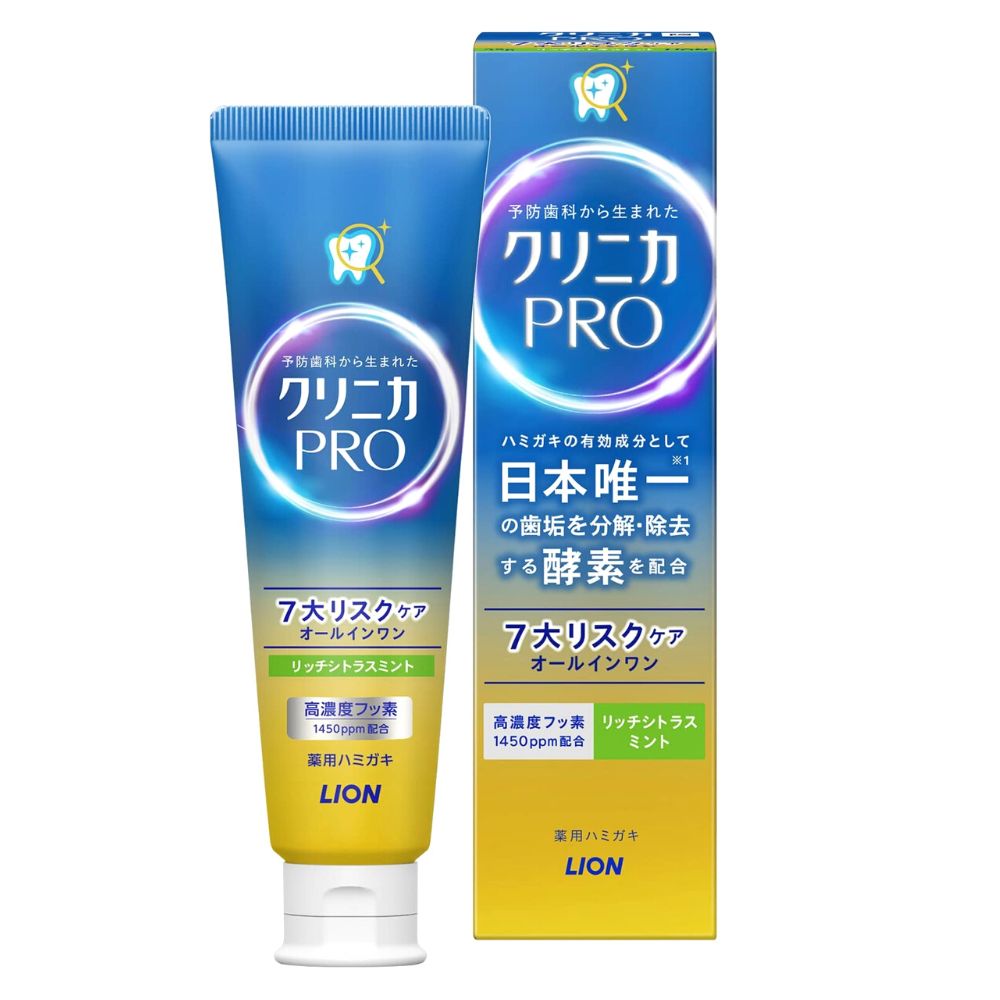
Lion Clinica PRO All-in-One — Fluoride Plus a Plaque-Digesting Enzyme, 95 g
Overview
Clinica PRO is Lion's answer to the multi-claim toothpaste, and its distinguishing ingredient is not the fluoride — plenty of pastes carry 1450 ppm — but dextranase, an enzyme that digests the sugar polymer holding dental plaque together. Lion states that no other active of this kind is approved for a Japanese toothpaste. Around it sit potassium nitrate for sensitivity, lauroyl sarcosinate sodium and tocopherol acetate for the gum margin, and sodium fluoride at the maximum concentration Japan permits in an over-the-counter paste.
The one thing to check before buying: 1450 ppm is an adult-and-over-six concentration. Japanese and European guidance both restrict this level to children aged six and above, and a younger child needs a lower-fluoride paste instead. If you are buying for a household with small children, buy them their own tube.
Browse the whole Japanese oral care range, or the wider selection of Japanese health products we ship from Kobe.
Key Benefits
- 1450 ppm fluoride — the maximum concentration permitted in a Japanese over-the-counter paste
- Dextranase, an enzyme that breaks the polymer holding plaque together, rather than only scrubbing it
- Potassium nitrate for dentine sensitivity, so a sensitivity paste is not needed alongside
- Lauroyl sarcosinate sodium and vitamin E aimed at the gum margin
- No sodium lauryl sulfate — the foaming agent here is a milder betaine system
- Full ingredient list published here, translated from the Japanese carton
Product Details
| Brand | Lion (ライオン) |
|---|---|
| Country of origin | Japan |
| Product type | Toothpaste (dentifrice) |
| Regulatory class (Japan) | Quasi-drug (医薬部外品) — a Japanese category between cosmetic and medicine, requiring approval of the active ingredient |
| Net weight | 95 g |
| Flavour | Fresh clean mint (citrus mint) |
| Key active | Sodium fluoride at 1450 ppm plus dextranase enzyme |
| Fluoride | 1450 ppm (sodium fluoride) — age six and over |
| Format | Squeeze tube in a printed Japanese carton |
| JAN code | 4903301339038 |
| Sold by | Tsujimoto Market, Kobe, Japan |
Who Is This For?
- Adults and children aged six and over who want maximum-strength fluoride protection
- Anyone with plaque that builds up quickly between cleanings
- People with mild dentine sensitivity who would otherwise buy a separate sensitivity paste
- Anyone who reacts badly to SLS — this formula uses a betaine foaming system instead
- Not for children under six, for whom the fluoride level is too high; buy a children's paste instead
How to Use
- Use a dry or lightly damp brush. A wet brush dilutes the fluoride before it reaches the enamel.
- Squeeze out a pea-sized amount for an adult, or a smaller amount for a child over six.
- Brush for two minutes, angling the bristles into the gum margin as well as across the tooth surfaces.
- Spit out thoroughly. Do not rinse with a mouthful of water — the fluoride needs to stay on the enamel.
- Avoid eating or drinking for around thirty minutes afterwards.
Frequency: Twice a day, morning and night. Fluoride protection depends on frequency, not on quantity.
Full Ingredients
Approved active ingredients
- Sodium fluoride — 1450 ppm fluoride, the maximum permitted in a Japanese OTC toothpaste
- Dextranase (DEX) — enzyme that breaks down the dextran polymer holding plaque together
- Potassium nitrate — the standard active for dentine sensitivity
- Lauroyl sarcosinate sodium (LSS) — antibacterial, for the gum margin
- Tocopherol acetate (vitamin E) — for gum tissue
Full ingredients (as published by the manufacturer)
Humectants: sorbitol solution, PG. Abrasive: anhydrous silicic acid A. Coating agents: DL-pyrrolidone carboxylic acid sodium solution, hydroxyethylcellulose dimethyldiallylammonium chloride. Medicinal components: potassium nitrate, sodium fluoride (1450 ppm as fluoride), dextranase (DEX), lauroyl sarcosinate sodium (LSS), tocopherol acetate (vitamin E). Foaming agents: coconut oil fatty acid amidopropyl betaine solution, POE hydrogenated castor oil, POE stearyl ether. Viscosity adjusters: anhydrous silicic acid, xanthan gum. Flavouring: fragrance (fresh clean mint type), sodium saccharin. Stabilisers: titanium oxide, DL-alanine, glycerin fatty acid ester. Binder: sodium alginate. Cleaning aid: sodium polyacrylate. Cooling agent: menthol. Detergent: sodium tetradecene sulfonate.
Ingredient list as declared by the manufacturer. Formulations are occasionally revised, so always read the list printed on the package you receive.
Cautions
- Contains 1450 ppm fluoride. Japanese and European guidance restricts this concentration to ages six and over; use a lower-fluoride children's paste below that age. Adults and children over six should use a pea-sized amount and spit, not rinse heavily, to leave the fluoride in contact with the enamel.
- For adults and children who can reliably spit out. Do not swallow. Rinse after brushing.
- Stop using the paste and consult a dentist if the gums, mouth or lips become sore, red or swollen, or if a rash appears.
- This is a toothpaste, not a treatment for gum disease, decay or sensitivity. If you have bleeding gums, a persistent ache or a tooth that reacts to cold, see a dentist rather than changing paste.
- Do not use as a substitute for professional cleaning or for a filling that needs replacing.
- Keep out of reach of small children. Store away from direct sunlight and high temperatures.
Package Contents
One 95 g tube of toothpaste in its Japanese retail carton. Nothing is decanted or repackaged.
Shipping & Store Notes
- Ships directly from Japan
- Processing time: 2–6 business days
- Tracking number provided after dispatch
- Import duties and taxes may apply depending on destination country
- Opened cosmetics cannot be returned for hygiene and safety reasons
Authenticity Guarantee
Every product at Tsujimoto Market is sourced directly from Japan and verified for authenticity. We never sell fakes or grey-market goods. Each order is carefully packed in Kobe, Japan and dispatched with full tracking.
FAQ
What does the dextranase enzyme actually do?
Dental plaque is held together by a sticky sugar polymer called dextran, produced by oral bacteria from dietary sugars. Dextranase is an enzyme that cuts that polymer, which loosens the plaque film so brushing lifts it rather than smearing it. Lion states that no other active of this kind is approved for Japanese toothpaste. It supplements brushing; it does not replace it, and it will not remove hardened tartar, which needs a dental hygienist.
Will it help with sensitive teeth?
It contains potassium nitrate, the active used in sensitivity toothpastes: potassium ions reduce the excitability of the nerve inside the tooth, which is why those pastes take a couple of weeks of twice-daily use to show an effect rather than working on the first brush. If a specific tooth reacts sharply to cold, or if the sensitivity is new, that is worth a dental appointment — sensitivity can be a symptom of a crack, a failing filling or exposed root, and no paste fixes those.
Is 1450 ppm too much fluoride?
Not for an adult. 1450 ppm is the standard adult concentration across Japan and the EU, and the evidence that this level prevents decay better than a lower one is why it is standard. The restriction is by age, not by adult risk: children under six swallow more paste than they spit, so they need a lower-fluoride formula. Use a pea-sized amount, spit rather than rinse, and do not let a small child use this tube.
Is this product halal or suitable for vegans?
Every ingredient in this paste is mineral, plant-derived or synthetic. The dextranase enzyme is produced by microbial fermentation, not from an animal. There is no alcohol, gelatin or animal protein in the formula. Lion does not hold halal certification for its Japanese domestic range, so if formal certification is what you need, this product does not carry it — but nothing in the published composition conflicts with halal or vegan use.
The packaging is in Japanese — how do I know what I am using?
The carton and bottle carry Japanese-language labelling, because this is stock made for the Japanese domestic market. Where an ingredient list appears on this page, it is translated from that labelling or from the manufacturer's own published data; where the manufacturer does not publish one, the ingredients section says so rather than filling the gap. Either way, send us a photo of anything unclear on the box after delivery and we will translate it, and ask us before ordering if you need the full label list first.