
Tsujimoto Market: Our Guarantees
Description
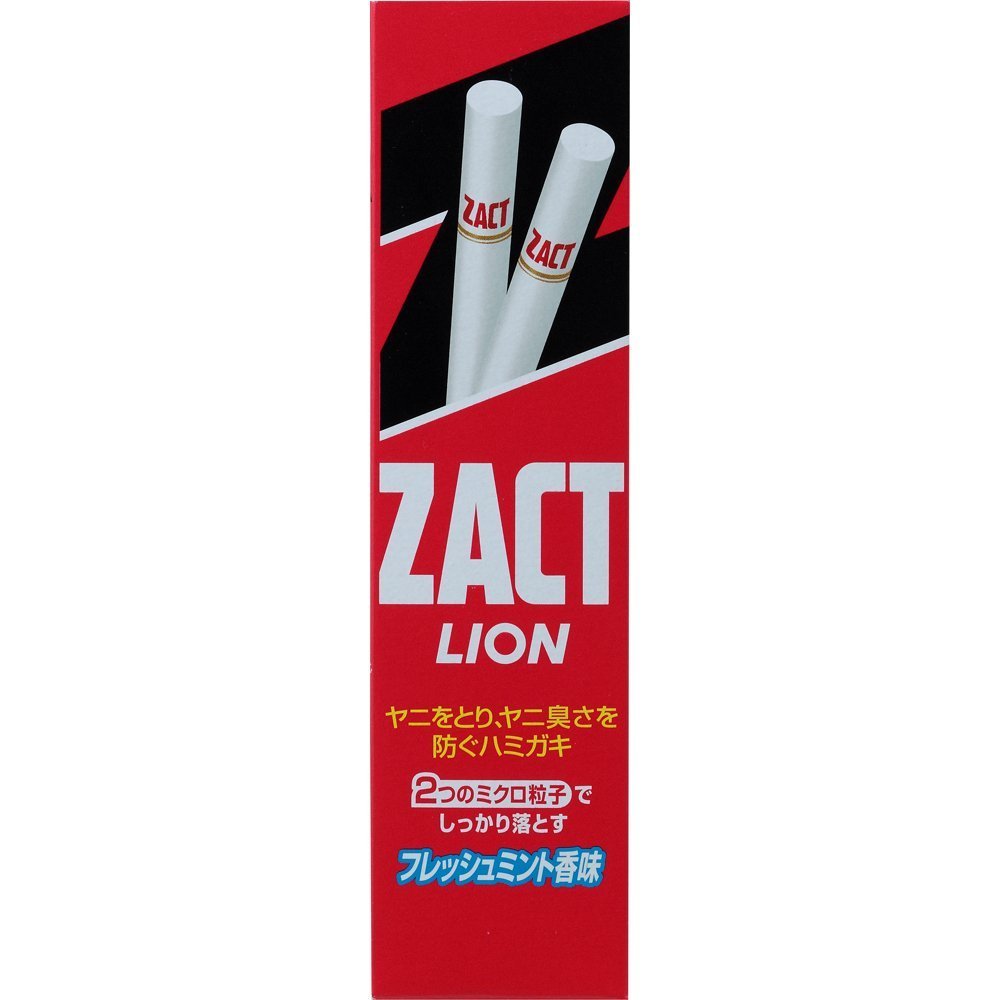
Lion Zact, 150 g — Excellent at Stain, and It Has No Fluoride in It
Overview
Read this first: Zact contains no fluoride, and the old version of this page told you to use it like a regular toothpaste, several times a day. Lion publishes the full formula for this product, and it lists a single active ingredient — polyethylene glycol, which is the agent that dissolves tar. There is no sodium fluoride and no sodium monofluorophosphate in it. That is not a defect; Zact is a stain-removal paste and it is very good at the job it was designed for. But it means that every time you brush with Zact instead of your usual paste, that brushing does nothing against decay. Do that two or three times a day, as the old page suggested, and you have quietly removed fluoride from your entire routine. Use Zact alongside a fluoride toothpaste, not instead of one.
With that out of the way: Zact is a specialist and a good one. It is Lion's tar-removal paste, sold in Japan for decades to people who smoke, and it works by a different route from an ordinary whitening paste. The active ingredient, polyethylene glycol, is a solvent for the sticky tar film that tobacco lays down on enamel — it loosens what abrasion alone struggles with. Behind it sit two cleaning agents, heavy calcium carbonate and silica, and an alumina polishing agent that leaves the surface smooth enough to be slower to re-stain.
It is not only for smokers, and the old card was right about that: coffee, tea and red wine leave a stain film that responds to the same chemistry. If you drink four coffees a day and your teeth have gone dull at the gum line, this is the product.
The flavour is Lion's Fresh Savory Mint — sharper and more herbal than a sweet mint, which is deliberate, because the odour it is formulated to cover is tobacco.
What "whitening" means on a Japanese toothpaste, because it is not what you think. Japanese whitening pastes — ホワイトニング — work by lifting and dispersing the stain film that sits on the outside of the enamel: the brown that coffee, tea, red wine and tobacco leave behind. They do this with polishing agents and with chemical dispersants such as polyphosphates and PEG. They contain no peroxide, and they do not and cannot change the natural colour of the tooth underneath, because that colour is dentine showing through translucent enamel and nothing applied for two minutes and rinsed off will reach it. So: if your teeth are stained, this will make them visibly lighter, sometimes strikingly so. If your teeth are clean and simply not as white as you would like, no Japanese toothpaste will change that, and anyone selling you one on that promise is selling you a disappointment. That is a bleaching treatment and it comes from a dentist.
On the wording we removed. In Japan this is a 医薬部外品 — a quasi-drug — a middle category between a cosmetic and a medicine, with a fixed list of phrases a manufacturer is licensed to print. Translated literally into English those phrases become medicinal claims that are not approved anywhere else, which is how our pages ended up saying things like "therapeutic toothpaste", "kills pathogenic bacteria" and "prevention of periodontitis". A toothpaste sold as a cosmetic in the EU cannot claim to treat gum disease. We have replaced that language with what the product does mechanically and chemically, which is less impressive-sounding and considerably more useful.
See the rest of our Japanese oral care and our other Japanese health products.
Key Benefits
- ✓ Polyethylene glycol dissolves the tar film rather than only scrubbing at it — a different mechanism from a standard whitening paste
- ✓ Two cleaning agents, heavy calcium carbonate and silica, working with the solvent rather than instead of it
- ✓ Alumina polishing agent leaves the enamel surface smoother, which slows down re-staining
- ✓ Works on coffee, tea and red wine stain as well as tobacco tar
- ✓ Fresh Savory Mint — a sharper, more herbal mint, formulated to cover tobacco odour rather than to taste like sweets
- ✓ Large 150 g tube, and as an adjunct paste it will last a long time
- ✓ Full ingredient list published by Lion and reproduced in full on this page
- ✓ Genuine Japanese domestic stock, shipped from Kobe with tracking
Product Details
| Brand | Lion |
|---|---|
| Country of origin | Japan |
| Product type | Stain and tar removal toothpaste |
| Japanese regulatory status | 医薬部外品 (quasi-drug) |
| Net weight | 150 g |
| Flavour | Fresh Savory Mint |
| Active ingredient | Polyethylene glycol — one only |
| Fluoride | NONE. This paste contains no fluoride and does not protect against decay |
| Cleaning agents | Heavy calcium carbonate, silica |
| Foaming agent | Sodium lauryl sulfate (SLS) |
| Vendor | Tsujimoto Market, Kobe, Japan |
Who Is This For?
- Right for you if you smoke, or you have smoked, and there is a tar film on your teeth that an ordinary paste is not shifting.
- Right for you if you drink a lot of coffee, tea or red wine and the stain has built up faster than your normal brushing removes it.
- Right for you if you already use a fluoride toothpaste and want to add a stain paste to the routine two or three times a week.
- Not for you if this would be your only toothpaste. It contains no fluoride, and replacing a fluoride paste with this one leaves you with no protection against decay.
- Not for you if you are buying it for a child, or for anyone who cannot be relied on to keep using a fluoride paste alongside it.
- Not for you if your teeth are already clean and you want them a lighter natural colour. Read the whitening section above — no toothpaste does that.
How to Use
- Use it as an addition to your routine, not a replacement. Fluoride paste for your main brushings; Zact for stain.
- Two or three times a week is enough for most people. Daily is reasonable if the staining is heavy, provided your other brushings are with fluoride.
- Soft brush, light pressure. This paste contains two cleaning agents and a polish, and pressing harder does not remove more stain — it removes more of everything else.
- Brush for two minutes, covering all surfaces, with attention to the gum line where tar and coffee stain concentrate.
- Spit out the excess and do not rinse with water afterwards — and on the brushings where you use your fluoride paste, this matters a great deal.
- Do not brush within thirty minutes of anything acidic — citrus, wine, vinegar, fizzy drinks. Enamel is temporarily softened and brushing it then is what actually damages it.
- If you smoke, expect the stain to return. This paste manages the film; it does not stop it forming.
- Rinse the brush thoroughly. Cleaning agents that dry in the bristles make the brush harsher than it should be.
Frequency: Two or three times a week as an adjunct, or daily if staining is heavy — but always with a fluoride toothpaste doing the rest of your brushings.
Full Ingredients
Lion publishes the full formula. This is it, by function, and it is worth reading because the shape of the list is the point.
- Active (薬用成分): polyethylene glycol — and this is the only one
- Cleaning agents: heavy calcium carbonate, hydrated silica
- Humectants: sorbitol solution, propylene glycol
- Foaming agent: sodium lauryl sulfate
- Polishing agent: aluminium oxide
- Thickener: sodium carboxymethyl cellulose
- Flavour: fragrance (fresh savory mint type), sodium saccharin
- Cooling agent: menthol
- Preservative: parabens
No fluoride appears anywhere in that list. Neither sodium fluoride nor sodium monofluorophosphate is present, which means this paste offers no protection against decay at all. It is worth saying twice because the old card said the opposite by implication.
Contains sodium lauryl sulfate (SLS), the foaming agent. If you get recurrent mouth ulcers, SLS is a well-known trigger for some people and switching to an SLS-free paste is the standard first thing to try.
Contains parabens as the preservative and sodium saccharin as the sweetener, neither of which was disclosed before. The manufacturer does not publish an RDA (relative dentin abrasivity) figure for this paste, so we cannot tell you how abrasive it is, and we have removed the old page's claim that it "does not damage tooth enamel". Any stain-removing paste works partly by abrasion. Use a soft brush, light pressure, and do not brush within thirty minutes of anything acidic.
Cautions
- Contains no fluoride. Do not use it as your only toothpaste. Brushing with Zact does nothing to prevent decay, and using it two or three times a day in place of a fluoride paste removes fluoride from your routine entirely.
- Not suitable as a child's toothpaste, for the same reason.
- Contains sodium lauryl sulfate (SLS), the foaming agent. If you get recurrent mouth ulcers, SLS is a well-known trigger for some people and switching to an SLS-free paste is the standard first thing to try.
- The manufacturer does not publish an RDA (relative dentin abrasivity) figure for this paste, so we cannot tell you how abrasive it is, and we have removed the old page's claim that it "does not damage tooth enamel". Any stain-removing paste works partly by abrasion. Use a soft brush, light pressure, and do not brush within thirty minutes of anything acidic.
- Contains parabens and sodium saccharin. Avoid if you react to either.
- Do not brush within thirty minutes of citrus, wine, vinegar or fizzy drinks. Softened enamel plus an abrasive paste is the actual route to enamel damage.
- Stop using it and consult a doctor if a rash or any other unusual reaction appears — this is Lion's own instruction on the pack.
- This is a toothpaste, not a treatment. It does not treat gum disease, periodontitis or any infection. Bleeding gums, persistent bad breath, pain or a receding gum line are reasons to see a dentist, not reasons to change toothpaste.
- Persistent bad breath, bleeding gums or teeth that stain again within days are reasons to see a dentist. A stain paste addresses the surface only.
- For external use in the mouth. Do not swallow. Keep out of reach of children.
Package Contents
One 150 g tube of Lion Zact in Japanese retail packaging with Japanese-language labelling. Lion confirms this product is not classified as dangerous goods for air transport, which is why it ships without restriction.
Shipping & Store Notes
- Ships directly from Japan
- Processing time: 2–6 business days
- Tracking number provided after dispatch
- Import duties and taxes may apply depending on destination country
- Opened cosmetics cannot be returned for hygiene and safety reasons
Authenticity Guarantee
Every product at Tsujimoto Market is sourced directly from Japan and verified for authenticity. We never sell fakes or grey-market goods. Each order is carefully packed in Kobe, Japan and dispatched with full tracking.
FAQ
Does Zact contain fluoride?
No. Lion publishes the full formula and it lists exactly one active ingredient: polyethylene glycol, the solvent that lifts tobacco tar. There is no sodium fluoride and no monofluorophosphate in it. This is the most important thing on the page and it was not on the old version at all — worse, the old version said the paste "can be used like a regular paste, several times a day", which is an instruction to stop using fluoride without realising it. Buy Zact for what it is good at, keep a fluoride toothpaste for your main brushings, and you get both.
Will it whiten my teeth?
It will remove the stain film on them, and if you smoke or drink a lot of coffee that is likely to be a visible difference. It will not change the natural colour of the tooth, because that colour comes from dentine under translucent enamel and no toothpaste reaches it. Japanese "whitening" — ホワイトニング — always means stain removal rather than bleaching; there is no peroxide in any of it. If your teeth are clean and you want them lighter, that is a dentist's bleaching treatment and no product on this page substitutes for it.
Is it safe for enamel? The old page said it does not damage it.
We have taken that line out, because it was an absolute claim about a paste built around two cleaning agents and an alumina polish, and Lion does not publish an RDA figure that would let anyone check it. What we can say usefully: any stain-removing paste works partly by abrasion, so use a soft brush and light pressure, keep it to two or three times a week unless staining is heavy, and never brush within half an hour of anything acidic. That last point does more for your enamel than the choice of paste does.
Does it work on coffee and tea, or only tobacco?
Both, and the old card was right about that. Coffee, tea and red wine leave a stain film held to the enamel by much the same mechanism as tobacco tar, and polyethylene glycol lifts it the same way. If you are a heavy coffee drinker who has never smoked, this is still a sensible product for you — with the same rule attached: alongside a fluoride paste, never instead of one.
I smoke. How often will I need it?
As often as the film comes back, which while you are smoking will be continuously — the paste manages the stain, it does not prevent it. Most people in that situation use it daily and keep a fluoride paste for at least one brushing a day. That is a workable routine and it is what we would suggest. We are not going to use a product page to give you a lecture you did not ask for, but your dentist is a better source than we are on what smoking is doing to the gum underneath the stain.