
Tsujimoto Market: Our Guarantees
Description
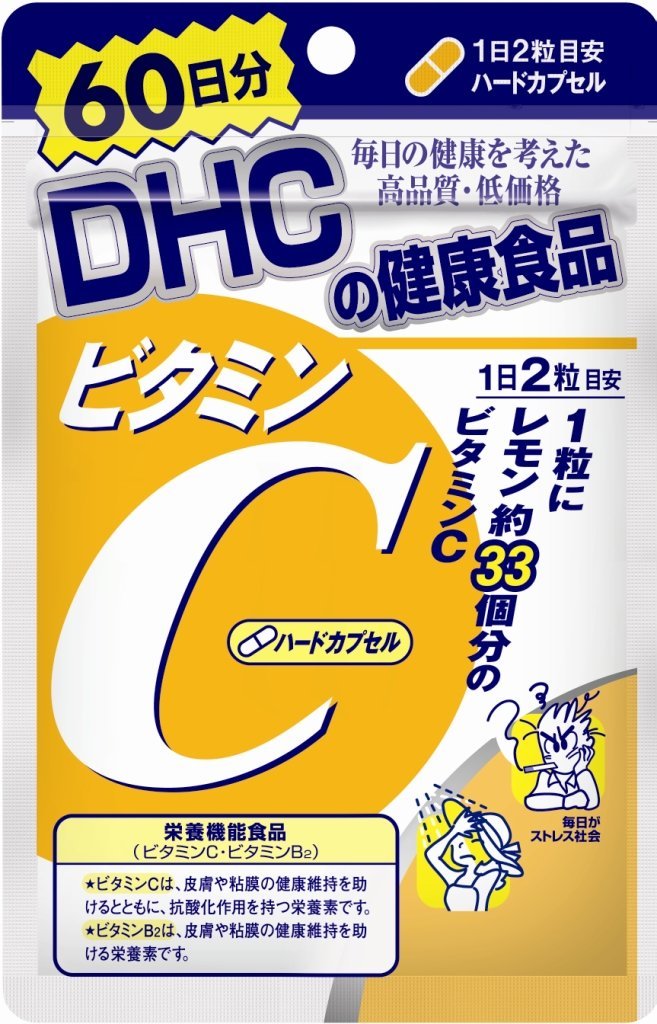
DHC Vitamin C Hard Capsule 60-Day Supply — 120 Capsules, 1,000 mg Vitamin C with Vitamin B2
Overview
The DHC vitamin C that has been a Japanese drugstore staple for years, in its hard-capsule form. Two capsules a day supply 1,000 mg of vitamin C and 2.0 mg of vitamin B2. The pack holds 120 capsules, 69.3 g, which is 60 days at that serving.
In Japan this is a nutrient function claim food. That is a self-certified category based on the nutrient content meeting a set range — it is not a drug approval and it carries no standing outside Japan.
1,000 mg is a deliberately high dose — more than ten times the European nutrient reference value of 80 mg. That is the product, and the cautions below say what that means in practice rather than treating the number as a selling point on its own.
See also: Japanese vitamin supplements and the full Japanese supplements range.
Key Benefits
- ✓ 1,000 mg of vitamin C per daily serving of two capsules
- ✓ Vitamin B2 2.0 mg in the same capsule
- ✓ 120 capsules, 69.3 g — 60 days at the stated serving, with the arithmetic printed
- ✓ Hard capsule rather than a chewable or a powder, so there is no sweetener and no flavouring
- ✓ Four-item declaration, printed in full below including the colorant
- ✓ A Japanese nutrient function claim food, with what that category does and does not mean spelled out
- ✓ Shipped from our own stock in Kobe, Japan, in the Japanese-market pack
Product Details
| Brand | DHC |
|---|---|
| Country of origin | Japan |
| Product type | Vitamin C supplement (nutrient function claim food) |
| Format | Hard capsule |
| Pack size | 120 capsules, 69.3 g |
| Daily serving | 2 capsules |
| Supply | 60 days |
| Vitamin C per serving | 1,000 mg |
| Vitamin B2 per serving | 2.0 mg |
| Energy per serving | 4.5 kcal |
| Declared allergen | Gelatin |
| Colorant | Caramel and titanium dioxide (E171) |
| Quasi-drug status | No — this is a food |
| JAN (Japanese-market pack) | 4511413404133 — not yet on this listing |
| Vendor | Tsujimoto Market, Kobe, Japan |
Who Is This For?
- Adults who want a plain high-dose vitamin C in capsule form rather than a flavoured tablet or drink
- People who avoid sweeteners and flavourings — a hard capsule has neither
- Anyone who prefers to buy sixty days at a time
- People who want the actual milligram figure on the page before they buy
- NOT for anyone with a history of kidney stones without asking a doctor — high-dose vitamin C raises urinary oxalate
- NOT for vegetarians or vegans — the capsule shell is gelatin
How to Use
- Take two capsules per day.
- Swallow them with water or lukewarm water.
- Split them morning and evening if you want to — vitamin C is water-soluble and does not store, so two doses spread the intake more evenly than one.
- Take them with food if 1,000 mg at once upsets your stomach.
- Keep the pack closed, dry, and out of the reach of children.
Frequency: Two capsules every day. The 120-capsule pack covers 60 days at that rate.
Full Ingredients
Full declaration (Japanese-market pack): vitamin C, gelatin, colorant (caramel, titanium dioxide), vitamin B2. Four items, nothing else.
Nutrition per 2 capsules (1,156 mg): energy 4.5 kcal, protein 0.13 g, fat 0 g, carbohydrate 1.0 g, salt equivalent 0.001 g, vitamin C 1,000 mg, vitamin B2 2.0 mg.
Contains titanium dioxide (E171) as part of the colorant. Titanium dioxide has not been authorised as a food additive in the European Union since 2022; it remains permitted in Japan, where this product is made and sold. We state this plainly because these packs are shipped into the EU.
The capsule shell is gelatin, so this is not a vegetarian or vegan product. DHC does not declare the animal source of the gelatin on the pack, so we cannot confirm halal status either way.
Composition and specification as declared by DHC on its official product page.
Cautions
- 1,000 mg a day is a high dose. Above roughly this level vitamin C commonly causes diarrhoea, stomach cramps and nausea. If that happens, split the serving across two meals or reduce it.
- Ask a doctor first if you have had kidney stones or have kidney disease. High-dose vitamin C increases urinary oxalate, which is the main component of the commonest stone type.
- High-dose vitamin C can interfere with some home blood-glucose meters and with certain laboratory tests, including faecal occult blood. Tell the person running the test that you take it.
- Vitamin C increases iron absorption. If you also take an iron supplement, that is not automatically a problem — but it is worth knowing if you have been told to limit iron.
- Vitamin B2 will turn urine bright yellow. That is the riboflavin leaving the body and is not a cause for concern.
- Contains gelatin. The capsule shell is gelatin, so this is not a vegetarian or vegan product. DHC does not declare the animal source of the gelatin on the pack, so we cannot confirm halal status either way.
- Contains titanium dioxide (E171) as part of the colorant. Titanium dioxide has not been authorised as a food additive in the European Union since 2022; it remains permitted in Japan, where this product is made and sold. We state this plainly because these packs are shipped into the EU.
- In Japan this is a nutrient function claim food. That is a self-certified category based on the nutrient content meeting a set range — it is not a drug approval and it carries no standing outside Japan.
- Do not exceed the stated daily serving. More is not better with this formula.
- This is a food, not a medicine. It does not diagnose, treat, cure or prevent any disease, and it is not a substitute for a varied diet or for medical advice.
- Stop taking it and speak to a doctor if you feel unwell after use.
- Store away from direct sunlight, high temperature and humidity, and out of the reach of children.
Package Contents
One sealed DHC pack containing 120 hard capsules, net 69.3 g. At the stated two capsules a day the pack lasts 60 days. Japanese-market packaging with the Japanese declaration printed on it; no English insert is included.
Shipping & Store Notes
- Ships directly from Japan
- Processing time: 2–6 business days
- Tracking number provided after dispatch
- Import duties and taxes may apply depending on destination country
- Opened supplements cannot be returned for hygiene and safety reasons
Authenticity Guarantee
Every product at Tsujimoto Market is sourced directly from Japan and verified for authenticity. We never sell fakes or grey-market goods. Each order is carefully packed in Kobe, Japan and dispatched with full tracking.
FAQ
How much vitamin C is in a serving?
1,000 mg, from two capsules, plus 2.0 mg of vitamin B2. That is more than ten times the European nutrient reference value of 80 mg, which is the point of this particular product — but it also means the cautions about high-dose vitamin C apply, and they are listed above rather than left out.
Is 1,000 mg a day safe?
For most healthy adults it is tolerated, but it is the level at which vitamin C commonly causes diarrhoea and stomach upset, and it raises urinary oxalate. If you have had kidney stones or have kidney disease, ask your doctor before starting. If it upsets your stomach, splitting the two capsules across two meals usually helps.
Does it contain titanium dioxide?
Yes — the colorant is caramel and titanium dioxide (E171). Titanium dioxide has not been authorised as a food additive in the European Union since 2022; it remains permitted in Japan, where this product is made and sold. We say so plainly because these packs are shipped into the EU.
Is it suitable for vegetarians?
No. The capsule shell is gelatin. DHC does not name the animal source, so we cannot confirm halal status either.
Why does my urine turn bright yellow?
That is the vitamin B2. Riboflavin is water-soluble, the body excretes what it does not use, and it is strongly coloured. It is expected and harmless.