
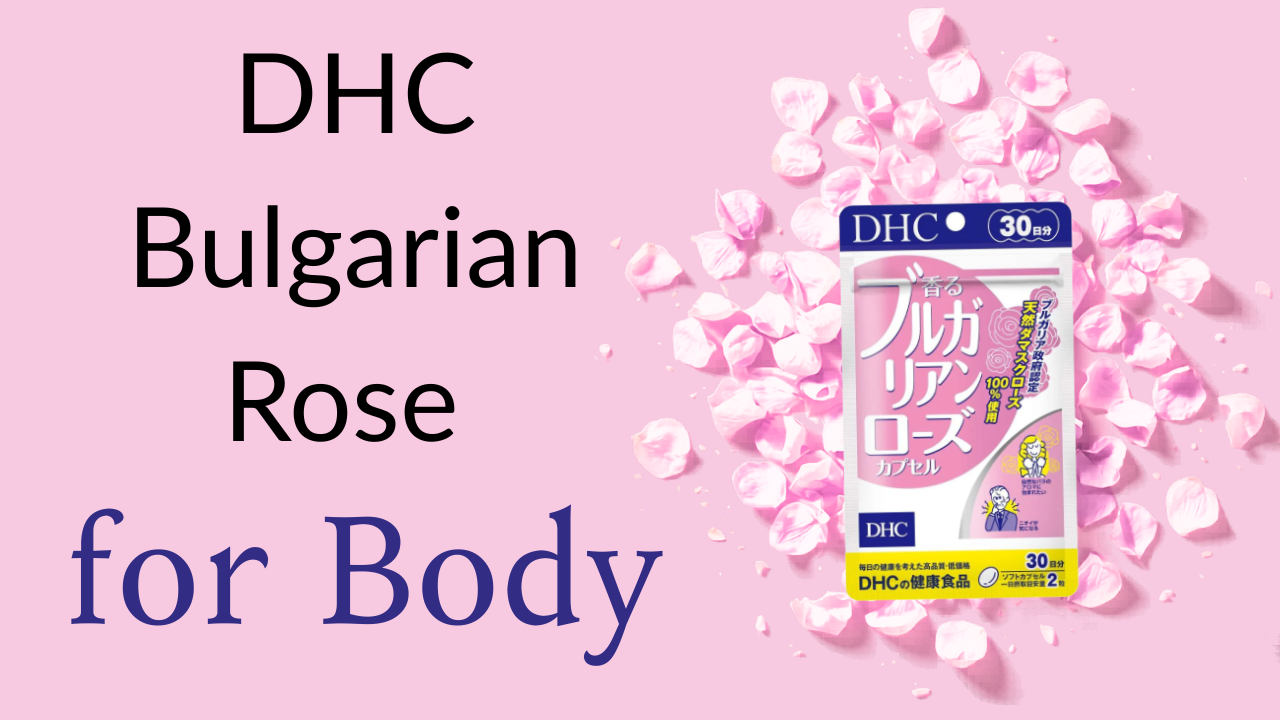
If you've been searching "where to buy DHC Bulgarian Rose", you've probably already discovered the awkward truth: the product is everywhere and nowhere at the same time. Major Western marketplaces list it sporadically. Some sellers have it priced 2-3× the Japanese retail. Counterfeits with similar packaging circulate quietly. Stock vanishes for weeks, then comes back. If you live outside Japan and you want the authentic DHC supplement at a price that resembles what people actually pay in Tokyo or Osaka, this guide will save you some time.
I'm Natalia Tsujimoto. I've lived in Kobe for 23 years and have run Tsujimoto Market for the last 11, sourcing Japanese beauty and supplements directly from the Japanese pharmacy and brand-counter network. DHC is one of our most-purchased supplement vendors and Bulgarian Rose is one of the products customers ask about most often. Here's what's actually going on with it and how to buy it without overpaying or getting a fake.
Quick answer: where to buy DHC Bulgarian Rose
The authentic Japan-domestic SKU is at Tsujimoto Market — DHC Bulgarian Rose for Body. It's ¥2,980 (the standard Japanese retail price for the 30-day supply) and ships directly from Kobe with tracked airmail in 2-6 business days. Every box is sourced through authorized DHC distribution in Japan — same product you'd buy in a DHC store in Tokyo.
If you want to understand why this product is hard to find, what it does, and whether it's worth buying at all before you order — keep reading.
What DHC Bulgarian Rose actually is
DHC Bulgarian Rose for Body is an oral beauty supplement — softgel capsules containing concentrated extract of Bulgarian Damask Rose (Rosa damascena), harvested in the Rose Valley of Bulgaria, which produces what is widely considered the world's most prized rose variety for cosmetic and fragrance use.
The promise is unusual enough that it's worth being clear about what is and isn't being claimed. DHC Bulgarian Rose is not a perfume. It is not a body lotion. You don't apply it to your skin. You take two softgel capsules a day, with water, and the aromatic compounds in the rose extract — primarily geraniol, citronellol and rose oxide — are absorbed through your digestive tract, enter the bloodstream, and are gradually excreted through your sebaceous and sweat glands. The result is a subtle floral undertone to your perspiration. Your skin smells faintly like roses, from the inside out.
This is the same mechanism that makes garlic perceptible through the skin after eating a strong meal — but with a much more pleasant compound. The Japanese pharmaceutical and food industry has names for this category: it's a form of "transpiration fragrance" (体内香), and it's been studied in Japan for decades. DHC's Bulgarian Rose is the best-known commercial example of the category.
Why DHC Bulgarian Rose is hard to find outside Japan
Three reasons. First, DHC is a Japan-headquartered supplement brand with the bulk of its retail presence in Japanese drugstores and DHC's own boutique stores. Western distribution is patchy. Second, demand outside Japan is built almost entirely on word-of-mouth and Korean/Chinese beauty community recommendations — there's been almost no Western advertising — which creates spiky, unpredictable demand that small importers can't always supply. Third, because real demand exists and supply is irregular, the grey-market and counterfeit ecosystem around DHC supplements is unusually active. Lookalike Bulgarian Rose products from less reputable brands, expired stock relabeled, and outright fakes all circulate on the larger marketplaces.
The result for a customer outside Japan is the situation you've probably already encountered: you find the product, the price feels off, the seller can't tell you where stock was sourced, the listing description doesn't quite match DHC's official one, and you can't tell whether what you're about to buy is real.
The reliable path is buying through a seller actually based in Japan, who sources directly from DHC's Japanese retail network and can ship internationally. That's why Tsujimoto Market exists in this category.
What you're paying for at the ¥2,980 Japan price
The Japanese retail price for DHC Bulgarian Rose for Body is ¥2,980 for a 30-day supply (60 softgel capsules, two per day). When you see the same SKU listed at the equivalent of ¥6,000-¥9,000 on a Western marketplace, you are paying for the seller's import margin, fulfillment costs, and very often a reseller-of-reseller markup chain.
Buying from a Japan-based source like Tsujimoto Market gives you the retail Japan price plus tracked international shipping. That's the closest you can get to walking into a Tokyo DHC store and buying the box yourself — which is what most savvy customers want when they're looking for this kind of product.
How DHC Bulgarian Rose actually works
The mechanism is worth understanding in some detail, because most online discussions of the product oversimplify it.
The active fragrant molecules in the Bulgarian Damask Rose extract — geraniol, citronellol, rose oxide and a handful of co-aromatic compounds — are fat-soluble (lipophilic). When you swallow the softgel, these compounds dissolve in the fats present in your digestive system and are absorbed through the small intestine into the bloodstream. From there, because they're lipophilic, they preferentially partition into the body's lipid-rich tissues, including the sebaceous glands of the skin. Over the following hours and days, they are gradually secreted through perspiration and sebum, where the volatile compounds evaporate from the skin's surface and produce a faint floral scent.
This is not a strong perfume effect. It is a subtle baseline modification of how your skin smells when warm or active. Friends or partners in close proximity tend to notice before you do. Most users describe the result as "my skin smells fresh — like soap, but lighter and floral" rather than "I smell like a rose garden."
Three factors strongly influence the result:
- Consistency. Skipping days breaks the accumulated effect. The clinical-style effect builds over 2-4 weeks of every-day intake.
- Activity level. The effect is more perceptible during summer, exercise, or hot weather — because the aromatic compounds escape via perspiration.
- Body chemistry. A small number of users metabolize the aromatic compounds very efficiently and don't perceive much external scent. This isn't the product failing — it's individual variation in lipophilic compound excretion.
What DHC Bulgarian Rose is most often used for
Three distinct use cases in Japan, in roughly the popularity order I see at Tsujimoto Market:
1. Age-related body odor (加齢臭 / karei-shū). The Japanese category that gives DHC Bulgarian Rose its serious-customer base. From the mid-30s onward, the skin produces increasing amounts of 2-nonenal — a compound from the oxidation of omega-7 fatty acids on the skin's surface — which produces the slightly musky odor associated with aging. Rose polyphenols provide antioxidant activity that reduces oxidation, and the rose-derived aromatic compounds add a pleasant floral baseline that competes with the unwanted compound. The combination is, in practice, surprisingly effective for many users in their 40s and 50s.
2. A natural alternative to perfume. Users who don't like applying synthetic fragrances — sensitive skin, fragrance allergies, or simply a preference for an unscented top-note — use Bulgarian Rose as a baseline scent that doesn't require any topical product.
3. A subtle enhancement in hot months. The fragrance effect is most noticeable when the body is warm and perspiring. Many Japanese women add it to their routine specifically for summer.
How to take it — the actual protocol
- Two softgel capsules per day, with water.
- Best taken after meals — fat-soluble compounds are better absorbed when there are dietary fats in the stomach. After breakfast and after dinner is a common split.
- Can also be taken all at once after one meal if you prefer.
- Daily, without skipping, for at least four weeks before evaluating. The effect builds; intermittent use does not produce the documented result.
- One box = 30 days. For a first proper evaluation, plan on buying two boxes so you complete a full 60-day window.
What to expect on the timeline
Week 1: Almost nothing perceptible. The compounds are accumulating in lipid tissues and saturating the excretion pathway. Don't get discouraged.
Week 2-3: Most users start to notice a subtle change. People in close proximity may comment before the user themselves does. Skin tends to smell "cleaner" in the morning. Karei-shū users typically see the biggest first improvement here.
Week 4 onward: Full effect. Consistent floral undertone to perspiration, more perceptible after exercise or in summer. Continued daily use maintains the effect; stopping causes it to fade over roughly 2 weeks.
Who should and shouldn't buy DHC Bulgarian Rose
Good fit:
- Adults concerned about age-related body odor (karei-shū) — this is the strongest practical use case.
- People who dislike topical perfumes and want a subtle baseline scent.
- Anyone curious about the inside-out fragrance category, willing to commit to 4-8 weeks of daily use.
- Travelers who want a discreet, no-spray scent option for long flights or business trips.
Not a fit:
- Anyone looking for a "I'll smell strongly of roses" effect. The product is subtle by design.
- Pregnant or breastfeeding without medical clearance.
- Anyone taking medication for liver function or with a known sensitivity to volatile aromatic compounds — discuss with your doctor first.
- People who can't commit to daily intake for 4+ weeks. Sporadic use doesn't produce the effect.
How to verify you're buying the authentic DHC version
If you're buying from anywhere other than a Japan-based seller, check these:
- Packaging. Authentic DHC Bulgarian Rose for Body has DHC's standard Japanese-language label, with the Bulgarian rose botanical illustration and the proper kanji product name (DHCブルガリアンローズ).
- Expiry date. Japanese-printed expiry (typically formatted as YYYY.MM or YYYY/MM/DD), at least 6 months in the future. Grey-market expired or near-expired stock is a common scam.
- Seller location. If the seller isn't based in Japan and can't tell you which Japanese distributor they source from, treat that as a red flag.
- Price. Japan retail is ¥2,980. Anything dramatically lower than that, after import costs, is suspect. Anything dramatically higher is overpaying.
- Capsule appearance. Authentic DHC softgels are uniformly amber-colored, oval, with a clear (not cloudy) interior. Cloudy capsules, broken seals, or inconsistent sizing suggest counterfeit or improperly stored stock.
The simplest way to avoid all of this is to buy from a Japan-based source you can verify. Tsujimoto Market ships every DHC product directly from Kobe — every box is sourced through DHC's Japanese authorized distribution network.
How DHC Bulgarian Rose stacks with other Japanese inner-beauty products
Bulgarian Rose pairs well with the rest of the Japanese inner-beauty category because it works on a completely different mechanism than the more familiar ingestibles. Specifically:
With oral ceramide (e.g. URUHIME MOMOKO): different mechanisms, no overlap. Ceramide supports the skin barrier; Bulgarian Rose modifies sweat scent. Combine freely.
With collagen drinks: same, no overlap. Combine freely.
With other DHC supplements (Vitamin C, B-complex, etc.): DHC's own product family is designed to stack. The Bulgarian Rose softgel is a small daily addition that fits next to anything else.
For more on how the Japanese ingestible-beauty system is structured, see my full piece on the Japanese skincare routine.
FAQ
Q: How quickly will I smell like roses?
A: Most users notice a subtle change at 2-3 weeks of daily use. Full effect at 4 weeks. The effect is subtle — closer to "my skin smells fresh and slightly floral" than "I smell like a rose garden."
Q: How long does one box last?
A: 30 days at two capsules per day. For a fair first evaluation, plan on two boxes.
Q: Does it help with karei-shū (age-related body odor)?
A: Yes — this is one of its primary uses in Japan. Rose polyphenols' antioxidant activity reduces the oxidation that produces 2-nonenal, and the rose-derived aromatic compounds compete with the unwanted scent. Many users in their 40s and 50s find it noticeably effective for this specific issue.
Q: Can I take it with other supplements?
A: Yes, generally — including ceramide sachets, collagen drinks, vitamin C and the rest of the Japanese inner-beauty category. If you take prescription medication, consult your doctor first.
Q: Is it safe during pregnancy or breastfeeding?
A: Consult your obstetrician before starting any new supplement during pregnancy or breastfeeding. DHC recommends professional medical clearance for these situations.
Q: What if I don't notice any effect?
A: A small percentage of users metabolize the aromatic compounds very efficiently and excrete them faster than the typical 4-week buildup curve. This is individual variation, not the product failing. If you've completed 8 weeks of consistent daily use and notice nothing, this category may not be the right fit for your body chemistry.
Q: Are there any side effects?
A: DHC Bulgarian Rose has a very mild side-effect profile. The most commonly reported issue is mild digestive sensitivity in the first few days for some users, which generally resolves on its own. Discontinue if you experience adverse reaction.
Q: Is this the authentic Japanese version?
A: Yes. Tsujimoto Market ships the authentic DHC Japan-domestic SKU directly from Kobe with full tracking. Every box is sourced through DHC's authorized distribution in Japan.
Final thoughts
DHC Bulgarian Rose for Body is one of the most interesting products in the Japanese supplement category because it works on a mechanism that almost nothing else in the Western market does. For people specifically dealing with age-related body odor, or people who want a subtle baseline scent without applying anything topical, it's a small daily addition with a clinical-style track record going back two decades in Japan.
The hard part has never been the product — it's been buying the authentic version at a reasonable price. If you're ready to try it, the Japan-domestic SKU at the Japan retail price is at DHC Bulgarian Rose for Body, shipped direct from Kobe.
— Natalia Tsujimoto, Kobe