
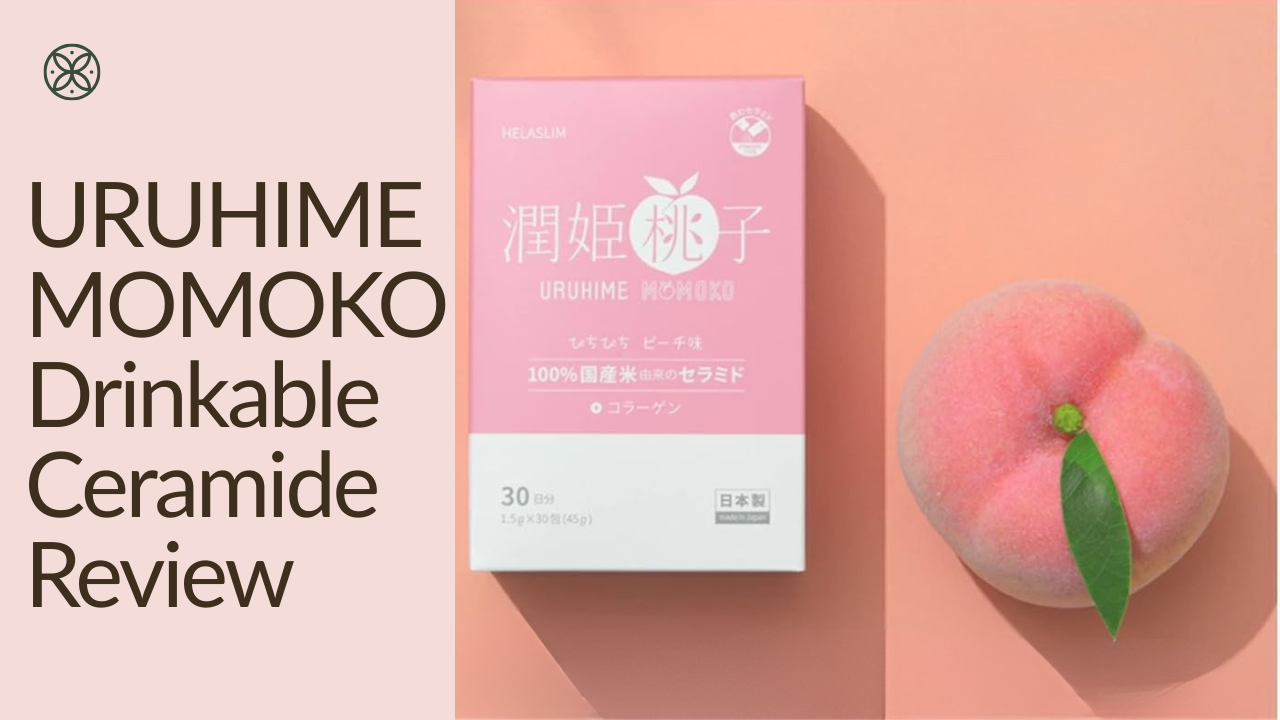
The Japanese beauty category that's grown most consistently for the last five years isn't a serum or a sunscreen — it's ingestible beauty. Oral collagen, oral hyaluronic acid, oral peptides, and most recently the category I want to talk about today: oral ceramide. Drugstore shelves in Tokyo and Osaka now dedicate entire endcaps to it, and one of the best-selling sachets in the category is URUHIME MOMOKO Drinkable Ceramide Supplement — over a million units sold across Japan, Taiwan, Hong Kong, Singapore and Malaysia, and the format is exactly what its name says: a powder you pour onto your tongue and let dissolve, no water needed.
I get asked about ingestible ceramide more than almost any other supplement at Tsujimoto Market. "Does drinking ceramide actually do anything?" is the polite version of the question. The slightly less polite version is "Is this just expensive flavored powder?" Living in Kobe for 23 years and sourcing this category directly from Japanese pharmacies for the last 11, I have a real answer rather than a marketing one. Here it is.
What ceramide actually does — and why "oral" is a separate question
Ceramides are the lipid molecules that hold the outermost layer of your skin together. Picture brick-and-mortar: the corneocytes are the bricks, ceramides are the mortar. When you're young and well-rested, your skin produces them in abundance. With age, with dryness, with sun damage, with the winter heating in Japanese apartments, ceramide production drops. The mortar thins out. Water escapes more easily, irritants get in more easily, and skin starts to feel tight, dull or "rough" even after moisturizing.
Topical ceramide creams — the famous category for which Curel and CeraVe are the household-name brands — replace ceramides from the outside in. That works, and I'm a big proponent of it, but it has a ceiling: a cream can resurface the very top of the skin's barrier, but it does not reach the layers underneath where new corneocytes are forming. That's where oral ceramide enters the conversation.
The mechanism for ingestible ceramide is not "you eat ceramide and it gets pasted onto your face." That's the cartoon version and it's wrong. Glucosyl-ceramide — the form used in URUHIME MOMOKO and most Japanese oral ceramide products — is digested into smaller signal molecules that participate in the skin's own ceramide synthesis pathway. The clinical research on rice-derived glucosyl-ceramide (which is what I'll focus on, because that's what's in this product) suggests that consistent daily intake over four to eight weeks supports skin hydration and barrier function, particularly in people who are already dry.
So the honest framing is this: it's not a miracle, it's not topical replacement, and it doesn't work in three days. But it does work at the level of skin from the inside, on a timeline of roughly a month and a half of daily use.
Why Japanese ingestible beauty is structured around glucosyl-ceramide
If you spend any time looking at Japanese drugstores, you'll notice that the country's beauty-supplement aisle is structured very differently from the Western "marine collagen / hair, skin, nails / hyaluronic capsules" lineup. The Japanese category is engineered around a handful of well-studied actives with clinical data behind them: glucosyl-ceramide, low-molecular collagen peptides, hyaluronic acid, and a small cluster of vitamins and antioxidants that support each.
Glucosyl-ceramide became the breakthrough ingredient because rice extraction made it both cheap enough to formulate at meaningful doses and pure enough to clear quasi-drug-adjacent quality standards. Japanese manufacturers have nearly two decades of data on it now. That's why almost every Japanese inner-beauty product you'll find sources ceramide from rice rather than from konjac or wheat — the rice extraction profile has the strongest research base and the cleanest allergen story.
URUHIME MOMOKO sits in this category at the popular-everyday tier (not at the prestige tier — that would be products like the prescription-pharmacy supplements I'll write about separately). The brand has built its position on a few things: 100% Japanese-rice-derived ceramide, the sachet format that's portable and doesn't require water, a peach-flavored powder that's actually pleasant, and pricing that makes daily use realistic.
What's actually in the URUHIME MOMOKO sachet
Each individually wrapped sachet contains:
- Glucosyl-ceramide — 100% Japanese-rice-derived. The core active.
- Fish collagen peptides — low-molecular collagen that's well absorbed orally.
- Vitamin C — supports collagen synthesis and acts as an antioxidant.
- Vitamin B1, B2, B6, B12 — the B-vitamin set most commonly bundled with Japanese ingestible-beauty formulas for skin and metabolism support.
- Peach flavor — natural-tasting and the reason the product earned the "drinkable without water" reputation.
- Reduced maltose, gelatin — formulation components.
One sachet a day, 30 sachets per box = one month of consistent use. The synergy is intentional: the ceramide does its work in the barrier, collagen contributes to dermal support, vitamin C supports collagen production, and the B-complex provides general skin and metabolic co-factors. None of these in isolation is dramatic. Together, used daily for a month, the typical user reports softer, more moisturized skin — particularly noticeable in winter or in dry climates.
How to actually use it (and where most people go wrong)
The "drinkable without water" format is the easiest supplement compliance I've seen. There is genuinely no friction. But two things matter:
- Take it with food, ideally after a meal. Glucosyl-ceramide is fat-soluble at the digestion stage and is better absorbed when there are some dietary fats in the stomach. Empty-stomach is fine in a pinch — it's not wasted — but with-meal is better.
- Tear the sachet, pour onto the tongue, let it dissolve. The powder is engineered to dissolve cleanly. Don't tip it into water — the format is the format. If you want to drink water after, that's fine.
- Take it every day for at least 4 weeks before you decide whether it works. This is the single most important sentence in this article. Inconsistent use does not give you a clinical-style outcome. The clinical studies on glucosyl-ceramide all measure at 4-8 weeks of daily intake.
- Travel in handbag, not in pocket. The sachets are sealed but the powder is fine — keep them flat in a small pouch.
If you're already using a topical ceramide routine — Curel, Etude House, or in the prestige tier the formulations I cover in my Japanese skincare routine piece — URUHIME MOMOKO is the inside-out complement, not the replacement. They work on the same problem from opposite directions.
Who URUHIME MOMOKO is genuinely for
This product fits a specific person well: someone with dry or maturing skin, in any adult age range, who already has a basic topical routine but feels that skin still gets tight or dehydrated in dry climates or seasons. People who travel often — particularly on long-haul flights — also benefit, because the sachet format is portable in a way that a bottle of collagen drink is not.
It's a good fit if:
- You're in your 30s+ and have started to notice skin doesn't bounce back from a long day or a flight the way it used to.
- You live in or travel through dry, cold, heated, or air-conditioned environments for significant portions of the year.
- You eat enough protein and want to stack a ceramide signal on top of that for skin barrier specifically.
- You like the supplement category but don't want to drink a liquid collagen drink every day.
It's not the right product if:
- Your skin issue is acne, sensitivity, redness, or oiliness — those are inflammation issues, not barrier-mortar issues. Different category.
- You're allergic to fish or follow a strict vegetarian/vegan diet — the sachet contains fish collagen and gelatin.
- You follow halal dietary requirements — the standard Japan-domestic SKU contains gelatin which is most likely porcine and is not halal-certified. A separate halal-certified export version exists for some Asian markets; please contact us before ordering if halal is essential.
- You're pregnant or breastfeeding without checking with your doctor.
How URUHIME MOMOKO compares to other Japanese inner-beauty options
Customers ask me how to choose between the ingestible-beauty options on Tsujimoto Market. The short version:
Oral collagen drinks (the Astalift, Shiseido or premium ranges): higher daily collagen dose, liquid format, more expensive per day. Best if your priority is dermal collagen support and you'll commit to a liquid daily.
URUHIME MOMOKO drinkable ceramide: ceramide-led with a smaller collagen and vitamin stack, sachet format, lower daily cost. Best if your priority is barrier support and ease of use.
NMN supplements: completely different mechanism — NAD+ precursor for cellular energy and longevity claims. Not a ceramide substitute. If you're curious about that category, I've written about it in what is NMN.
For most people the cleanest stack is ceramide sachet + a daily food-grade vitamin C + topical ceramide cream. That's three small interventions that cover the inside-out barrier story without duplicating each other.
On authenticity
URUHIME MOMOKO is not the most counterfeited Japanese product on the grey market — it's not a luxury label — but lookalike packaging and grey-import expired stock both circulate. Tsujimoto Market buys URUHIME MOMOKO from Japanese authorized channels and ships every box directly from Kobe with tracked airmail. Processing 2-6 business days. If you've seen it on a non-Japan-based marketplace at an unusually low price, check the expiry date carefully before ordering.
FAQ
Q: How long does one box last and how many should I buy?
A: One sachet per day, 30 sachets per box = one month. For a meaningful first evaluation, buy two boxes — that gives you the 4-8 week consistent-use window the research uses.
Q: Can I take more than one sachet a day?
A: One daily is the formulated dose. There is no benefit to doubling — you'd just use up your supply faster. Consistency beats intensity in this category.
Q: Will I notice the difference in a week?
A: Unlikely. Most users notice at the 4-week mark. By 8 weeks of daily use the difference in skin hydration is what people most commonly comment on, especially in dry seasons.
Q: Can I take it with collagen drinks or vitamin C tablets?
A: Yes. They stack well. If you take prescription medication, ask your doctor whether collagen and ceramide are compatible with what you're on.
Q: Is it halal?
A: The standard Japan-domestic SKU contains gelatin which is most likely porcine — it is not halal-certified. A separate halal-certified export version exists for some Asian markets. Please contact us before ordering if halal is essential.
Q: Is it suitable for vegetarians?
A: No. The sachet contains fish collagen peptides and gelatin. Vegetarian and vegan customers should look at our plant-based supplement options instead.
Q: Is the peach flavor sweet?
A: Lightly sweet, naturally flavored. Most customers describe it as pleasant — closer to a fruit candy powder than a medicinal taste.
Q: Is this the authentic Japanese version?
A: Yes. We ship the Japan domestic SKU directly from Kobe with full tracking. Every box is verified before it leaves.
Final thoughts
URUHIME MOMOKO Drinkable Ceramide is one of the cleanest entry points into the Japanese inner-beauty category. It's not flashy, it doesn't claim things it can't deliver, and the format is so frictionless that compliance — which is the actual hard part of supplement protocols — almost takes care of itself. If you have dry or maturing skin, a topical routine that's covering the basics, and you've been curious about whether the inside-out approach is worth the investment, this is a fair-priced product to try for two months and see.
If you want to read more about how to structure a daily Japanese routine that includes ingestibles, my full walkthrough is at the Japanese skincare routine. And the authentic 30-sachet box is here: URUHIME MOMOKO Drinkable Ceramide Supplement 30 Sachets, shipped direct from Kobe.
— Natalia Tsujimoto, Kobe
Comments: 2
Meg Kimon
I need buy the halal version. Pls reply. Thanks
roop kaur
where can I buy this product in Malaysia