
Tsujimoto Market: Our Guarantees
Description
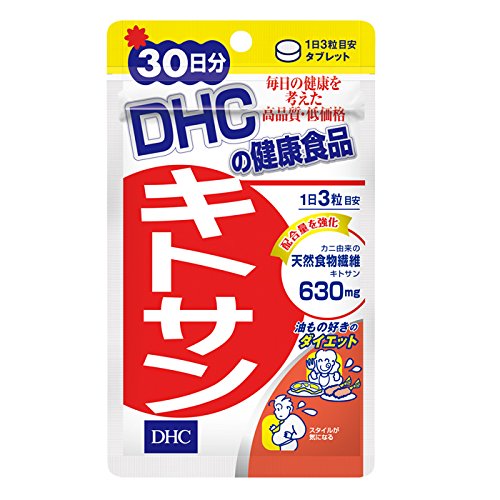
DHC Chitosan, 90 tablets, 30 days
Overview
DHC's Chitosan is a three-tablet daily serving built on 630 mg of chitosan — an animal-source dietary fibre made from crab shell — with 48 mg of rice germ powder and 45 mg of Korean ginseng extract standardised to 80% saponins. Ninety tablets, thirty days, taken straight after meals.
This is a crustacean allergen. If you react to crab, shrimp or lobster, this product is not for you, and that sentence belongs at the top of the page rather than in the middle of a paragraph about chitin.
See also: Japanese Diet Supplements.
Key Benefits
- ✓ Chitosan 630 mg per daily serving of three tablets, from crab shell
- ✓ Rice germ powder 48 mg and Korean ginseng extract 45 mg (80% saponins) in the same serving
- ✓ 90 tablets, 23.8 g in total — a clean thirty days at three a day
- ✓ Taken straight after meals, which is when a fibre of this kind is meant to be taken
- ✓ Small tablets at 265 mg each
- ✓ Full declared amounts printed below rather than a list of ingredient names
- ✓ DHC, made in Japan, at a Japanese domestic price
Product Details
| Brand | DHC Corporation |
|---|---|
| Product name | Chitosan, 30 days |
| Product type | Tablet supplement, food |
| Net content | 23.8 g — 90 tablets of 265 mg |
| Serving | 3 tablets a day, after meals |
| Chitosan per serving | 630 mg |
| Rice germ powder per serving | 48 mg |
| Korean ginseng extract per serving | 45 mg (80% saponins) |
| Country of origin | Japan |
| Allergens | Crustacean — chitosan is crab-derived |
Who Is This For?
- Adults who want to add a dietary fibre to meals that are heavier than usual
- People who already know what chitosan is and want a Japanese-market product with declared amounts
- Anyone who prefers small tablets taken with food to a powder
- Not for anyone with a crustacean allergy — the active is made from crab shell
- Not for children, not during pregnancy or breastfeeding, and not a weight-loss treatment
How to Use
- Take 3 tablets a day.
- Take them immediately after a meal, with water.
- Swallow whole without chewing.
- DHC's suggested course is one month, which is one pack.
- A fibre supplement works better alongside enough water through the day; drink accordingly.
Frequency: Three tablets a day, after meals. 90 tablets is thirty days.
Full Ingredients
Declared amounts per daily serving of 3 tablets, 795 mg:
| Chitosan (crab-derived) | 630 mg |
|---|---|
| Rice germ powder | 48 mg |
| Korean ginseng extract powder (80% saponins) | 45 mg |
| Energy | 3.1 kcal |
| Protein | 0.30 g |
| Fat | 0.05 g |
| Carbohydrate | 0.37 g |
| Salt equivalent | 0.001 g |
Full ingredient list: rice germ powder (made in Japan), Korean ginseng extract powder, reduced maltose syrup / chitosan (crab-derived), cellulose, glycerin fatty acid ester, calcium stearate.
The previous version of this page gave rice sprouts as 30 mg and ginseng extract as 60 mg. DHC declares 48 mg and 45 mg. The table follows the maker.
Composition and specification as declared by DHC Corporation on the Japanese-market pack and the manufacturer's official product page.
Cautions
- This is a food, not a medicine. It is not intended to diagnose, treat, cure or prevent any disease, and it does not replace a varied diet or advice from your doctor.
- Crustacean allergen. Chitosan here is made from crab shell. Do not take it if you react to crab, shrimp, prawn or lobster.
- Not vegetarian: the active is animal-derived. The active is derived from crab shell. It is not vegetarian, and although crustaceans are widely regarded as permissible, the maker holds no halal certification, so we do not claim one.
- Contains Korean ginseng. Ginseng is discussed in connection with blood pressure medicines, anticoagulants and diabetes medication; if you take any of these, ask your doctor first.
- A fat-binding fibre may reduce the absorption of fat-soluble vitamins if taken heavily and long-term. Do not exceed the stated serving.
- If you are pregnant, breastfeeding, under medical care or taking prescribed medication, speak to your doctor before use.
- Do not exceed the stated daily amount. More is not better here.
- Stop taking it and consult a doctor if you notice any change that does not suit you.
- Store in a cool, dry place away from direct sunlight, and keep out of reach of children.
Package Contents
One 30-day pack: 90 tablets of 265 mg, 23.8 g in total. Japanese-language packaging.
Shipping & Store Notes
- Ships directly from Japan
- Processing time: 2–6 business days
- Tracking number provided after dispatch
- Import duties and taxes may apply depending on destination country
- Opened food and supplements cannot be returned for hygiene and safety reasons
Authenticity Guarantee
Every product at Tsujimoto Market is sourced directly from Japan and verified for authenticity. We never sell fakes or grey-market goods. Each order is carefully packed in Kobe, Japan and dispatched with full tracking.
FAQ
Will it make me lose weight?
No, and we are not going to imply it. Chitosan is a dietary fibre; the older version of this page said fat bound by it "is not absorbed and quickly excreted from the body", which overstates what a food supplement does. Nothing in this pack replaces the arithmetic of what you eat.
Can I take it if I am allergic to shellfish?
No. Chitosan is made from crab shell. This is the one line on the page that is not a matter of preference.
Why did the ingredient amounts change?
Because the previous figures were wrong. Our page said rice sprouts 30 mg and ginseng extract 60 mg; DHC declares 48 mg and 45 mg per three tablets. We corrected both against the maker's own nutrition declaration.
What was removed from the old description?
Claims that the product is "recommended for maintaining health and preventing many diseases", that ginseng "prevents dehydration, which is one of the reasons for Asian longevity", and that rice sprouts "reduce damage to blood vessels and nerves caused by diabetes", "lower blood pressure and reduce blood sugar levels". Those are disease claims, and a food may not make them.
Does it interact with anything?
Ginseng comes up in discussions about blood pressure medication, anticoagulants and diabetes drugs, and a fat-binding fibre can in principle affect fat-soluble vitamin absorption if overused. Neither is a reason for alarm at the stated serving, and both are worth a sentence to your doctor if you take regular medication.