
Tsujimoto Market: Our Guarantees
Description
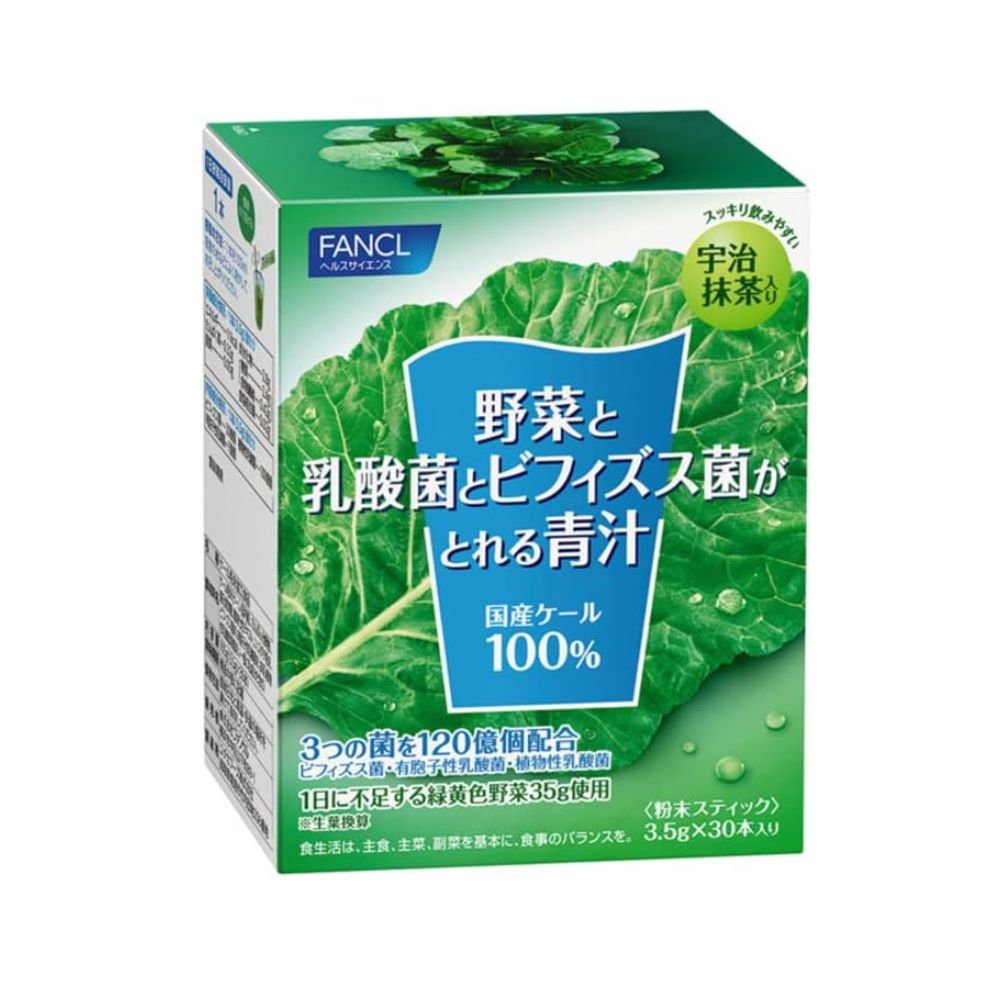
FANCL Kale Aojiru with Bifidobacteria and Uji Matcha — 30 Sticks
Overview
The Japanese name of this product is 野菜と乳酸菌とビフィズス菌がとれる青汁 — "the aojiru that gets you vegetables, lactic acid bacteria and bifidobacteria". It is built on kale rather than barley grass, the kale is entirely domestic, and each stick is made from 35 g of green-and-yellow vegetables, which FANCL describes as one day's shortfall. Uji matcha is stirred in, and it is the reason this one is drinkable for people who bounced off aojiru elsewhere.
It is also a 機能性表示食品 — a Food with Function Claims notified to Japan's Consumer Affairs Agency. That is a specific legal status with a filed dossier behind it, and it is the strongest thing about this product. Its meaning is explained under Ingredients rather than borrowed as marketing.
Aojiru (青汁) is the Japanese name for a powdered green drink, usually made from young barley grass or kale, that is stirred into water or milk and drunk once a day. It is sold in Japan as an ordinary food, not as a medicine: the point is to add vegetable material and dietary fibre to a diet that is short of both, in a format that takes fifteen seconds. Nothing on this page should be read as a treatment for any condition.
See also: Japanese aojiru supplements · Japanese supplements
Key Benefits
- ✓ Built on kale, the higher-nutrient green, rather than the more common barley grass
- ✓ Kale entirely of domestic Japanese origin, per FANCL
- ✓ 35 g of green-and-yellow vegetables per stick, FANCL's stated figure
- ✓ Uji matcha stirred in, which is what makes it drinkable for aojiru sceptics
- ✓ Two notified functional ingredients: Bifidobacterium longum BB536 and Weizmannia coagulans SANK70258
- ✓ A notified Food with Function Claims — a filed regulatory status, not a marketing phrase
- ✓ FANCL's own vitamin-K and anticoagulant warning is reproduced in full under Cautions
Product Details
| Brand | FANCL |
|---|---|
| Made by | FANCL Corporation (株式会社ファンケル), Yokohama |
| Japanese product name | 野菜と乳酸菌とビフィズス菌がとれる青汁 |
| Product type | Food (powdered drink mix) |
| Format | Individually sealed sachets |
| Flavour | Kale with Uji matcha |
| Serving size | One stick; the box states 3.5 g per stick |
| Servings per box | 30 — 30 days at one a day |
| Net contents | 30 sticks |
| Country of origin | Japan — kale entirely of domestic origin |
| JAN code | Not published by the maker. We are not inventing one |
| Regulatory status in Japan | Food with Function Claims (機能性表示食品), notified to Japan's Consumer Affairs Agency |
| Declared allergens | None declared by FANCL in the ingredient list |
Who Is This For?
- Someone who wants a kale aojiru rather than a barley-grass one, and knows the difference
- People who have tried aojiru, disliked the grassiness, and want the matcha version
- Anyone who values a filed regulatory status over a marketing claim
- Talk to your doctor first if you take warfarin or another anticoagulant, or if you have been told to limit vitamin K. Kale is high in it and FANCL says so explicitly
- Go carefully if sugar alcohols upset your stomach — maltitol is the second ingredient
How to Use
- Tear open one sachet.
- Pour 150 ml of cold or room-temperature water into a glass or shaker.
- Add the powder and stir or shake until no lumps remain. A shaker gives the cleanest result; barley-grass powder resists a spoon.
- Drink it straight away — the powder settles within a minute or two.
- Milk, soy milk, apple juice or unsweetened yoghurt all work in place of water and blunt the grassy note; they also add their own calories, which plain water does not.
Frequency: One sachet a day. It is a food, so there is no course to complete and no loading period.
Ingredients & Nutrition
Ingredients (source: FANCL official product page): kale powder (kale of domestic Japanese origin, starch hydrolysate), maltitol, indigestible (resistant) dextrin, sudachi citrus powder, bifidobacteria powder, spore-forming lactic acid bacteria powder, matcha, sterilised plant-derived lactic acid bacteria powder.
Three translation traps in this list, worth naming. ケール is kale, and it is very often rendered as "cabbage" — the two are the same species but not the same vegetable, and the nutrient profile FANCL is selling belongs to kale. 難消化性デキストリン is indigestible (resistant) dextrin; a rendering that drops the 難 says the exact opposite of the truth about the fibre in this product. And 植物性乳酸菌殺菌末 is sterilised plant-derived lactic acid bacteria powder — a powder of bacteria that have been sterilised, not a sterilising agent.
What "Food with Function Claims" means here. This product is notified to Japan's Consumer Affairs Agency with two functional ingredients. Bifidobacterium longum BB536 is notified in Japan for maintaining a good intestinal environment and regulating bowel condition, and Weizmannia coagulans SANK70258, a spore-forming lactic acid bacterium, is notified for improving bowel movement. Those are the claims on FANCL's Japanese filing. They are stated here as what Japan's system permits FANCL to say, not as promises made by us — a Japanese notification carries no regulatory weight outside Japan.
One thing FANCL does not flag and we do. Maltitol is a sugar alcohol and the second ingredient by weight. Sugar alcohols loosen the bowel in quantity. On a product whose notified benefit is bowel movement, anyone who decides to take two sticks has two mechanisms working at once. Stay at one a day.
Cautions
- This is a food, not a medicine. It is not intended to diagnose, treat, cure or prevent any disease
- If you are pregnant, breastfeeding, taking prescription medication or under medical supervision, ask your doctor before starting any supplement
- Stop taking it and consult a doctor if it disagrees with you
- Never swallow the powder dry — always dissolve it in liquid first, or it can catch in the throat
- Keep out of the reach of small children
- Store away from direct sunlight, heat and damp; finish an opened sachet the same day
- FANCL's own warning, reproduced in full: if you take medication — particularly anticoagulants — if you have been told to restrict vitamin K, or if you are under hospital care, consult your doctor before use. Kale is high in vitamin K, which is the specific reason for this warning
- Contains maltitol, a sugar alcohol, as the second ingredient. Sugar alcohols have a laxative effect in quantity — do not take more than one stick a day
Package Contents
- 1 × retail box, factory-sealed
- 30 × single-serve sticks; the box states 3.5 g per stick
- No scoop or shaker is included — the sticks are pre-measured
Shipping & Store Notes
- Ships directly from Japan
- Processing time: 2–6 business days
- Tracking number provided after dispatch
- Import duties and taxes may apply depending on destination country
- Opened cosmetics and supplements cannot be returned for hygiene and safety reasons
- Powdered supplements are shipped in the maker's sealed retail box; we do not repack or decant
Authenticity Guarantee
Every product at Tsujimoto Market is sourced directly from Japan and verified for authenticity. We never sell fakes or grey-market goods. Each order is carefully packed in Kobe, Japan and dispatched with full tracking.
FAQ
Is this kale or cabbage?
Kale. ケール is routinely mistranslated as cabbage, and you will see both words used for this product across the web. Kale and cabbage are the same species but not the same vegetable, and the nutrient profile FANCL is selling — the vitamin C and the calcium — belongs to kale.
What does 機能性表示食品 actually mean?
It is Japan's Food with Function Claims system: the maker files a dossier of evidence with the Consumer Affairs Agency and may then state specific functions for named ingredients. It is not a government approval of the product, and it carries no legal weight outside Japan — but it does mean a dossier exists, which is more than most aojiru can say.
Can I take it if I am on warfarin?
Ask the doctor who manages that prescription first. Kale is high in vitamin K, warfarin's dose is balanced against vitamin K intake, and FANCL prints this warning on the box themselves. This is the one product in our aojiru range where the maker raises the interaction unprompted.
Why does it taste better than other aojiru?
Matcha, and the maltitol. Uji matcha gives it a tea character rather than a vegetable one, and maltitol adds sweetness without sugar. Both are declared in the ingredient list.
Can I take two sticks a day to get more?
We would not. Maltitol is a sugar alcohol and the second ingredient, and the product's notified benefit is already bowel-related; doubling it stacks a laxative effect on top of the intended one. One a day is the maker's dose.