

Tsujimoto Market: Our Guarantees
Description
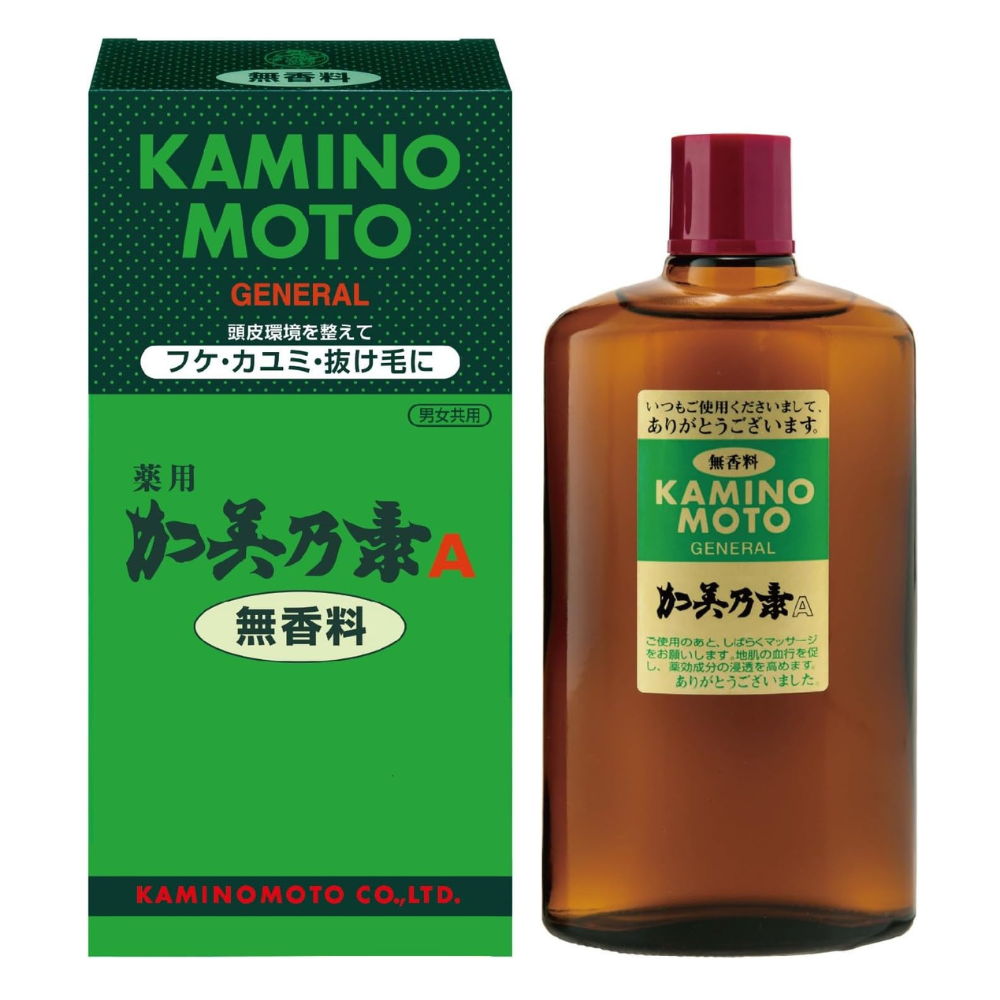
Kaminomoto A Hair Tonic, Fragrance-Free 200 ml — Japanese Medicated Scalp Tonic, Hormone-Free
Overview
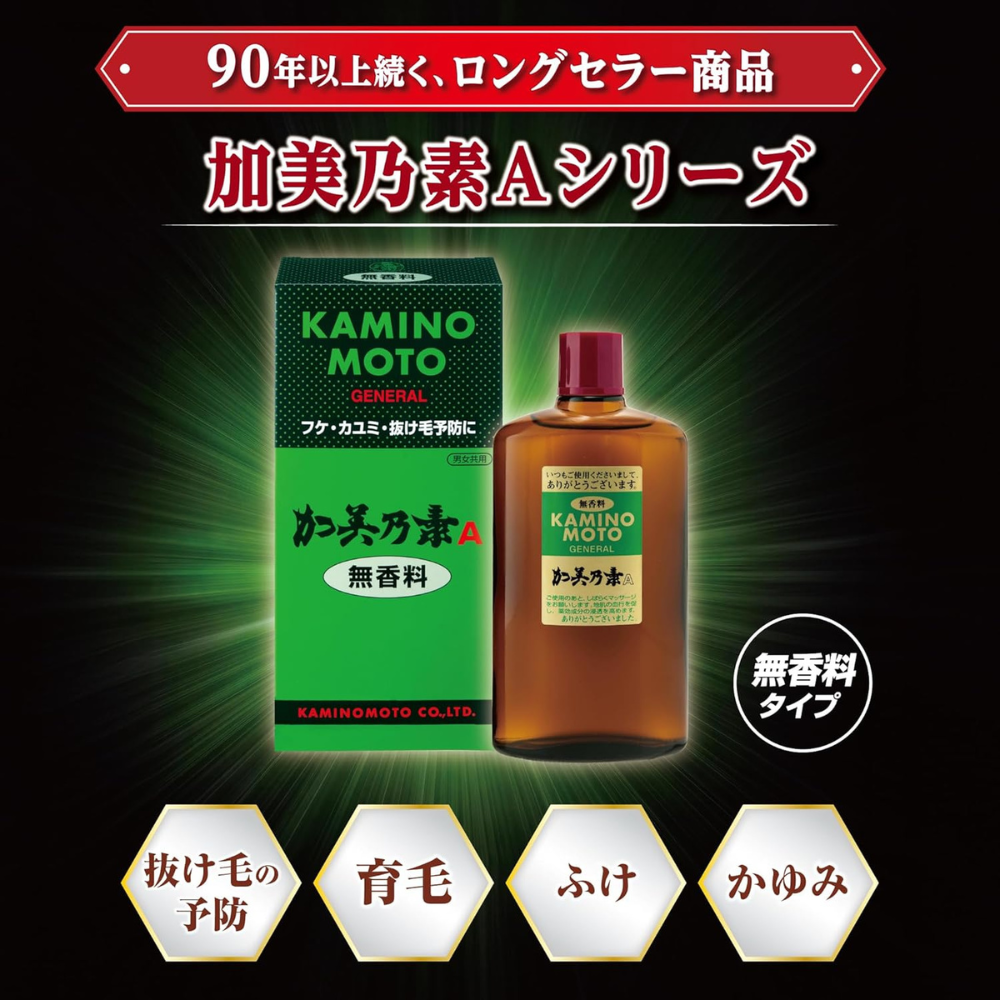
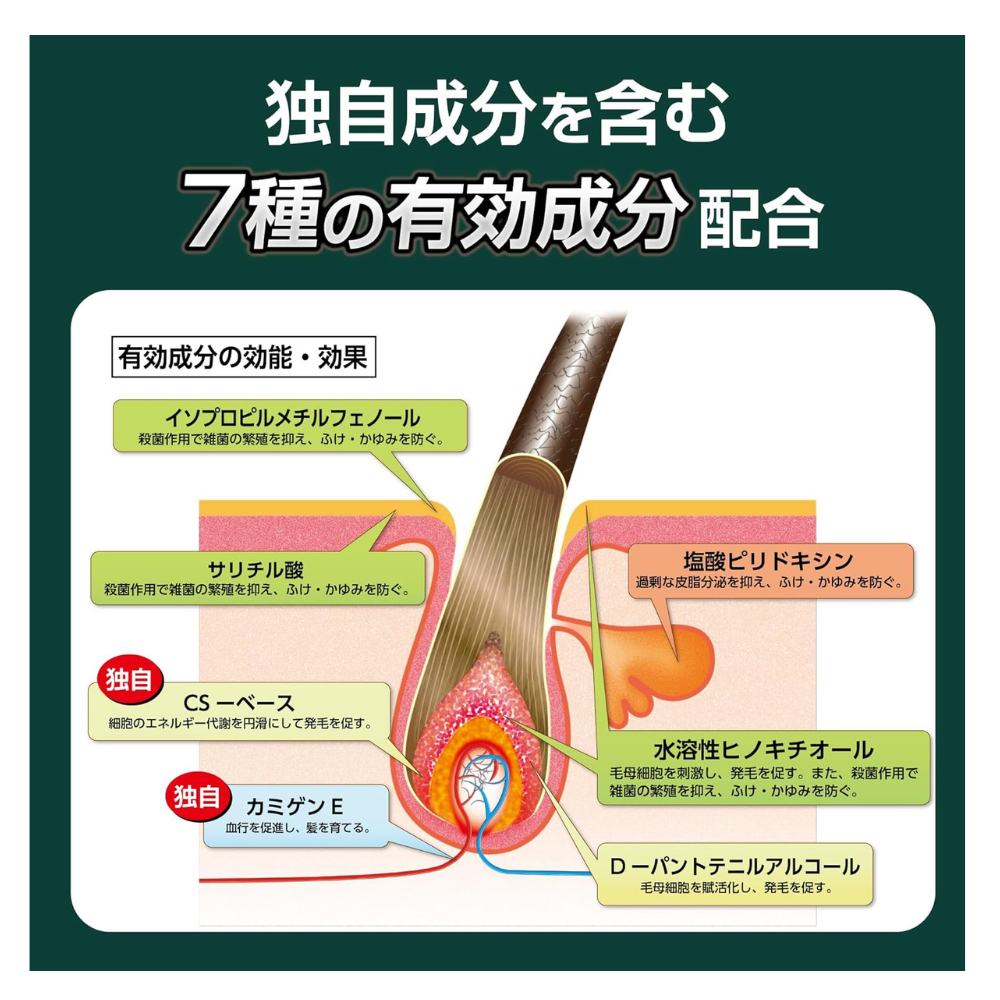
The plain entry in the Kaminomoto range: a 200 ml medicated scalp tonic in the fragrance-free version, made by Kaminomoto Honpo, a Kobe firm that has been selling hair tonic since 1932. Japan classes it as a quasi-drug (iyakubugaihin), which means seven named actives were reviewed and approved for stated effects — preventing hair loss, dandruff and itching, and keeping the scalp in condition.
One thing sets it apart inside its own range, and it is the reason to read this page rather than pick by price. Three of the four Kaminomoto tonics we stock contain ethinylestradiol, a synthetic oestrogen. This one does not. If you want the Kaminomoto formula without a hormone in it, this and Ladies Kaminomoto EX are the two options. See also Japanese scalp and hair-growth care.
Key Benefits
- ✓ Seven approved quasi-drug actives, published in full on this page instead of an unfilled template field
- ✓ No ethinylestradiol — the hormone-free choice within the Kaminomoto tonic range
- ✓ Fragrance-free: no added scent and no menthol, so it does not announce itself from across a room
- ✓ Water-soluble hinokitiol and isopropyl methylphenol address the dandruff-and-itch side of scalp care
- ✓ 200 ml at Japanese drugstore pricing — a realistic three months at once daily
- ✓ Shipped from our base in Kobe, Japan with tracking, in the Japanese domestic packaging
Product Details
| Brand | Kaminomoto |
|---|---|
| Manufacturer | Kaminomoto Honpo Co., Ltd., Kobe |
| Country of origin | Japan |
| Product type | Medicated scalp tonic (leave-on) |
| Volume / count | 200 ml |
| Scent | Fragrance-free |
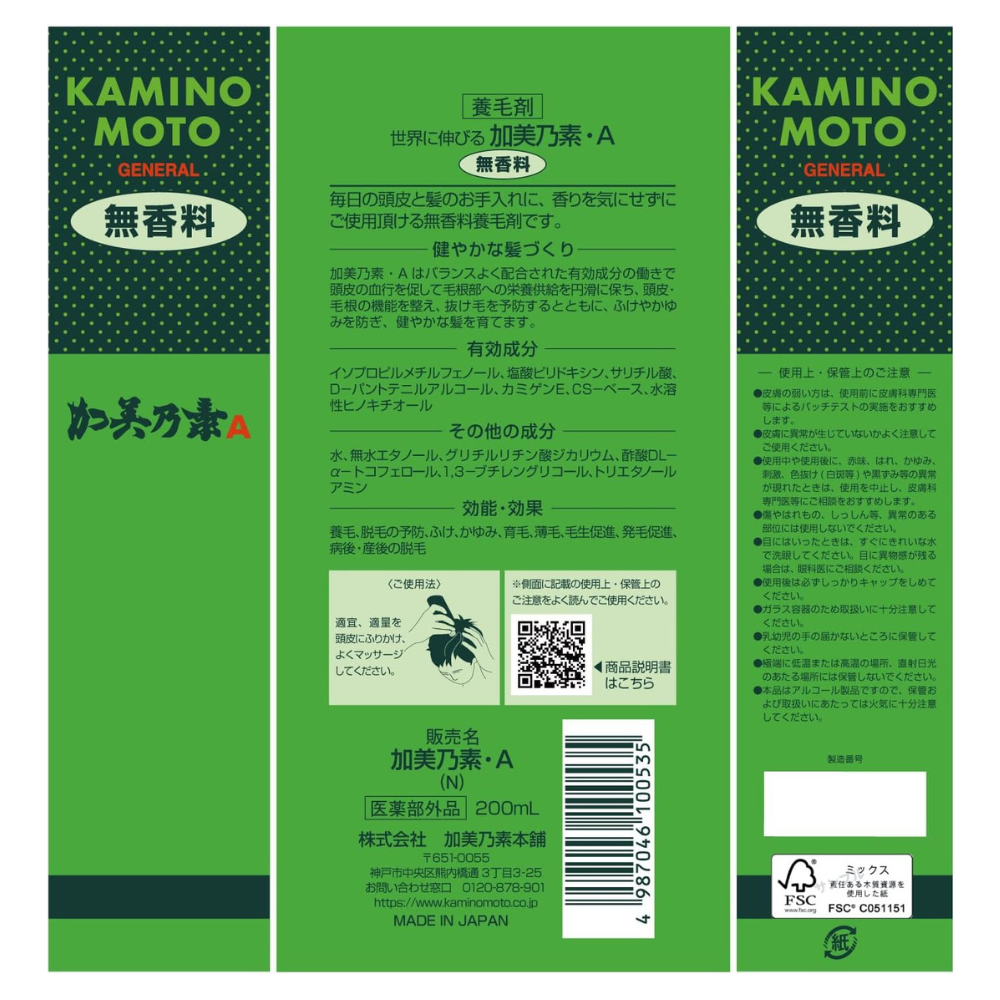
| JAN code | 4987046100535 |
| Regulatory status | Quasi-drug (iyakubugaihin) in Japan |
Who Is This For?
- Anyone starting scalp care who wants the approved-active route without a hormone in the bottle
- People whose main complaint is dandruff, itching or a scalp that feels tight rather than visible thinning
- Scent-sensitive users, and anyone who shares a bathroom with someone who is
- Users who want a maintenance tonic to keep a currently healthy scalp in condition
- Not for: children and adolescents, and not a substitute for seeing a dermatologist about sudden or patchy hair loss
How to Use
- Wash and towel-dry the hair so the scalp is damp, not dripping.
- Part the hair in rows and apply the tonic to the scalp skin, not to the lengths.
- Work across the areas that concern you — crown, parting, temples — a few millilitres in total.
- Massage with the pads of the fingers for one to two minutes.
- Leave on. Do not rinse. Style as usual.
Frequency: Once or twice a day, on a clean scalp
Full Ingredients
Approved actives: isopropyl methylphenol; pyridoxine hydrochloride (vitamin B6); salicylic acid; D-panthenyl alcohol (provitamin B5); Kamigen E; CS-Base; water-soluble hinokitiol.
Kamigen E and CS-Base are Kaminomoto's own designations for, respectively, a vitamin-E-type component and an organic-acid complex; the company uses them as approved active names rather than publishing an INCI breakdown for each. Contains ethanol.
Not present: ethinylestradiol. That is worth stating explicitly, because three of its stablemates contain it.
The manufacturer publishes the actives and the headline ingredients but not the complete INCI list online. What is shown above is what is disclosed; the full list is printed on the package you receive.
Cautions
- Contains ethanol and salicylic acid: expect a brief sting, and stop if the scalp stays red or flaky.
- For scalp use only. Do not apply to the face or to broken, sunburned or freshly shaved skin.
- Not for children or adolescents.
- If hair loss is sudden, patchy, or comes with scaling or pain, see a dermatologist rather than working through a bottle of tonic.
- Keep out of reach of children. Store away from direct sunlight and open flame.
Package Contents
1 × bottle, 200 ml. Japanese domestic packaging with Japanese-language labelling.
Shipping & Store Notes
- Ships directly from Japan
- Processing time: 2–6 business days
- Tracking number provided after dispatch
- Import duties and taxes may apply depending on destination country
- Opened cosmetics cannot be returned for hygiene and safety reasons
Authenticity Guarantee
Every product at Tsujimoto Market is sourced directly from Japan and verified for authenticity. We never sell fakes or grey-market goods. Each order is carefully packed in Kobe, Japan and dispatched with full tracking.
FAQ
When in the day should a scalp tonic go on, and does it matter?
It matters more than the brand does. A tonic is meant for a clean scalp with the hair towel-dried, not soaking: on wet hair the liquid runs off before it can sit on the skin, and on a day-old scalp it has sebum to get through first. Part the hair in rows and put it on the skin, not the lengths — the lengths are dead keratin and cannot use it. Then massage for a minute; the massage is doing at least as much as anything in the bottle. Most people find evening after washing the easiest slot to keep to, and keeping to it is the part that decides whether you ever find out if it works.
Will this regrow hair I have already lost?
No, and any page that says otherwise is selling you something. A Japanese scalp essence in this category is approved to support the hair you still have — reducing itch and flaking, keeping the scalp comfortable, and helping existing growth stay in place. It does not restore follicles that have closed, and it does not treat androgenetic hair loss, for which there are actual medicines. If your parting is widening or you are shedding in clumps, see a dermatologist rather than working through bottles of essence.
What does "quasi-drug" mean on a Japanese label?
Quasi-drug (iyakubugaihin) is a Japanese regulatory category that sits between cosmetics and medicines. A product enters it by naming specific active ingredients at approved concentrations, and it may then state the effect those actives were approved for. It is not a medicine and it is not a promise of a result on your skin. Outside Japan the same product is normally imported and sold as an ordinary cosmetic.
The packaging is in Japanese — how do I know what I am using?
The carton and bottle carry Japanese-language labelling, because this is stock made for the Japanese domestic market. Where an ingredient list appears on this page, it is translated from that labelling or from the manufacturer's own published data; where the manufacturer does not publish one, the ingredients section says so rather than filling the gap. Either way, send us a photo of anything unclear on the box after delivery and we will translate it, and ask us before ordering if you need the full label list first.
Will I pay customs duty or import VAT?
That depends on your country and on the declared value of the parcel, not on us. We ship from Japan with a correct customs declaration and full tracking; any duty or import VAT your country charges is collected by your local carrier or customs office on delivery. Check your national de-minimis threshold before ordering if you want to avoid a surprise.