
Tsujimoto Market: Our Guarantees
Description
Grace of Maca and Zinc — Japanese Maca and Zinc Supplement, 30-Day Supply
Overview
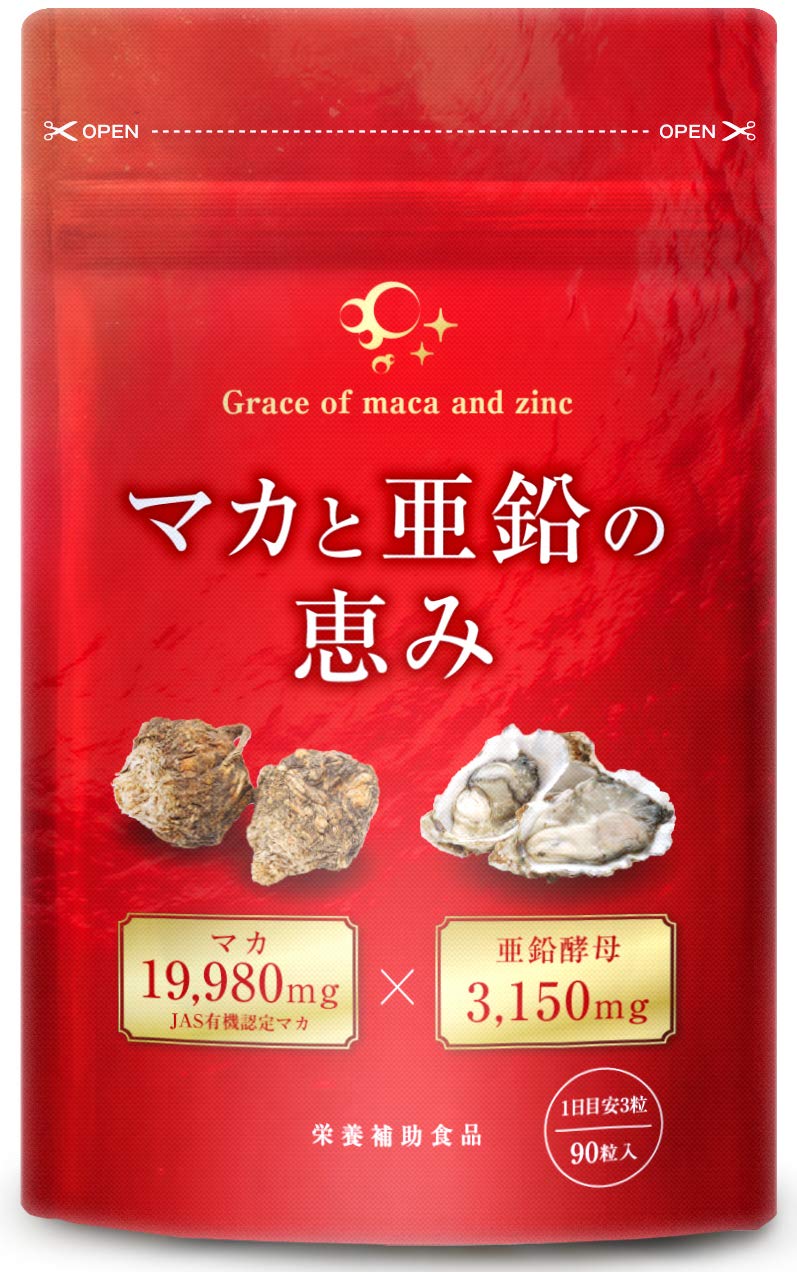
A Japanese-made supplement combining maca root and zinc, packed for a thirty-day course. Maca is a Peruvian root vegetable eaten as a food in the Andes and used in Japan as a daily supplement ingredient; zinc is an essential trace mineral that a lot of people run short of without knowing it.
We have to start with what this page does not tell you. We have not been able to source an ingredient panel, a capsule count, or per-serving amounts of maca or zinc for this particular product from the manufacturer or from any reference we can cite. Rather than publish figures copied from a similar-looking product — and there are many nearly identical maca-and-zinc packs on the Japanese market — this page says so and spends its length on what is true of maca and zinc regardless. Browse our Japanese vitamins and supplements.
Note also that this page makes no claim about sexual function, testosterone or fertility, whatever the product name may suggest. A food may not make those claims in Japan or in any market we ship to, and we are not going to make them.
Key Benefits
- ✓ Maca and zinc in one daily supplement, made in Japan and packed for a thirty-day course
- ✓ Zinc is an essential trace mineral. Japan's nutrient-function food framework permits the statement that zinc is a nutrient involved in maintaining normal taste function, in the health of skin and mucous membranes, and in antioxidant enzyme activity
- ✓ Maca is a food, not a drug extract — a Peruvian root vegetable, dried and powdered, eaten in the Andes as an ordinary crop
- ✓ Convenient daily format — a thirty-day pack is easy to trial without committing to a large tub
- ✓ Honest about the limits of the evidence — maca's marketed effects are not well supported, and this page says so rather than implying otherwise
- ✓ Tells you where the zinc ceiling is — 40–45 mg a day for adult men in Japan, above which zinc interferes with copper
- ✓ States what we could not source rather than filling the ingredient panel with a plausible guess
Product Details
| Brand | Grace of Maca and Zinc |
|---|---|
| Classification | Food (dietary supplement) — not a medicine |
| Key ingredients | Maca root (Lepidium meyenii) and zinc |
| Pack duration | 30 days |
| Format | Not recorded on our side |
| Units per pack | Not recorded on our side |
| Maca per serving | Not published by the maker — we have not estimated it |
| Zinc per serving | Not published by the maker — we have not estimated it |
| Country of origin | Japan |
| JAN code | Not recorded — we have not invented one |
Who Is This For?
- Adults who want to try maca and zinc together without buying two separate products or a large tub of either
- People whose diet is light on zinc-rich foods — oysters, red meat, liver, pumpkin seeds and hard cheese are the usual sources, and a diet without much of any of them runs low
- People who prefer a short pack to see how they get on before committing
- Not for anyone already taking a zinc supplement or a multivitamin containing zinc without adding the amounts up first — the ceiling is easy to cross by accident
- Not for anyone with thyroid disease without medical advice (maca is a brassica), anyone pregnant or breastfeeding, or children
How to Use
- Follow the dosage printed on the pack you receive. We do not publish a serving size here because the maker does not publish one we can cite, and inventing one for a zinc product would be the wrong kind of helpful.
- Take it with food. Zinc on an empty stomach causes nausea in a lot of people, and it is the single most common reason somebody abandons a zinc supplement.
- Add up your total zinc across everything you take. A multivitamin plus a dedicated zinc supplement plus this one can reach the ceiling without any single product looking high.
- Separate it from calcium or iron supplements by a couple of hours if you take those — they compete for absorption.
- Take it daily across the thirty days rather than sporadically. Zinc status responds to consistent intake, not to occasional large doses.
Frequency: Daily, with food, for the thirty-day course. Dose per the pack.
Full Ingredients
Maca root (Lepidium meyenii) and zinc are the two named ingredients. Beyond that, we do not have a panel.
We do not publish a full ingredient declaration for this product, because the manufacturer does not publish it either and we have not been able to read it from a source we can cite. Rather than fill the gap with a plausible guess, this page says so. The declaration printed on the pack is the authority — write to us and we will read it off the box before we dispatch.
What is worth knowing about the two named ingredients, independent of this product's amounts: zinc is a cofactor for a large number of enzymes, and Japan's nutrient-function food wording permits saying that it is involved in maintaining normal taste function, in the health of skin and mucous membranes, and in the function of antioxidant enzymes. Maca is the dried root of a Peruvian brassica, eaten as a staple crop in the high Andes; the effects it is commonly marketed for are not well supported by evidence, and we would rather say so than imply otherwise.
Cautions
- This is a food, not a medicine. It does not diagnose, treat, cure or prevent any disease. If you have a medical condition, are pregnant or breastfeeding, or take prescription medication, ask your doctor before starting any supplement
- Zinc has an upper limit. Japan's tolerable upper intake for adult men is about 40–45 mg a day. Sustained intake above that interferes with copper absorption and can cause copper deficiency
- Add up every source. Multivitamins, other supplements and fortified foods all contribute; the ceiling is easy to cross without any single product looking high
- Zinc taken on an empty stomach commonly causes nausea — take it with food
- Zinc can reduce absorption of some antibiotics and of copper, iron and calcium supplements; separate them by a couple of hours and ask a pharmacist if you take prescription medication
- Maca is a brassica, like cabbage and mustard. If you have thyroid disease, ask your doctor before taking it
- Not for children, and not during pregnancy or breastfeeding without medical advice
- A supplement does not replace a varied diet; do not exceed the stated daily amount
- Stop taking it and consult a doctor if you feel unwell after starting
- Keep out of reach of children
Package Contents
One pack, sold as a thirty-day supply. We have not recorded the format or the unit count on our side, and we have not guessed at them — the pack you receive states both. If you would like us to read them off the box before we dispatch, write to us and we will.
Shipping & Store Notes
- Ships directly from Japan
- Processing time: 2–6 business days
- Tracking number provided after dispatch
- Import duties and taxes may apply depending on destination country
- Opened supplements cannot be returned for hygiene and safety reasons
Authenticity Guarantee
Every product at Tsujimoto Market is sourced directly from Japan and verified for authenticity. We never sell fakes or grey-market goods. Each order is carefully packed in Kobe, Japan and dispatched with full tracking.
FAQ
Why does this page not list the ingredients or the dose?
Because we could not source them. There is no maker page we can cite, no JAN on our record, and no ingredient panel. Japanese maca-and-zinc supplements are a crowded own-brand category where several products look nearly identical, so copying a plausible panel from one of them would mean printing a label for a product people swallow. We would rather have a page that admits the gap. Read the panel on the pack you receive, and write to us if you want us to read it first.
The title mentions male vitality. What does the product actually do?
This page makes no claim about sexual function, testosterone or fertility, and it will not — a food may not make those claims in Japan or in any market we ship to. What can be said is the permitted Japanese nutrient-function wording for zinc: that zinc is a nutrient involved in maintaining normal taste function, in skin and mucous membrane health, and in antioxidant enzyme activity.
How much zinc is too much?
Japan's tolerable upper intake for adult men is about 40–45 mg a day. Above that, sustained, zinc interferes with copper absorption and can cause copper deficiency. The practical risk is not this product on its own — it is this product plus a multivitamin plus another supplement, none of which looks high individually.
Should I take it with food?
Yes. Zinc on an empty stomach makes a lot of people nauseous, and that is the usual reason somebody gives up on a zinc supplement in the first week. Taking it with a meal fixes it.
Is maca safe for everyone?
It is a root vegetable eaten as a staple in the Andes, so it is a food rather than a potent extract. The one group who should check first is anyone with thyroid disease: maca is a brassica, the same family as cabbage and mustard, and high intakes of raw brassicas are goitrogenic. Pregnancy, breastfeeding and children are also reasons to ask a doctor rather than self-prescribe.