

Tsujimoto Market: Our Guarantees
Shipping
International shipping not available
Japanese OTC eye drops cannot be shipped outside Japan due to regulations. See these alternatives with worldwide delivery:
Description
Sante Beauteye — Five Maximum-Concentration Actives, 12 mL
Overview
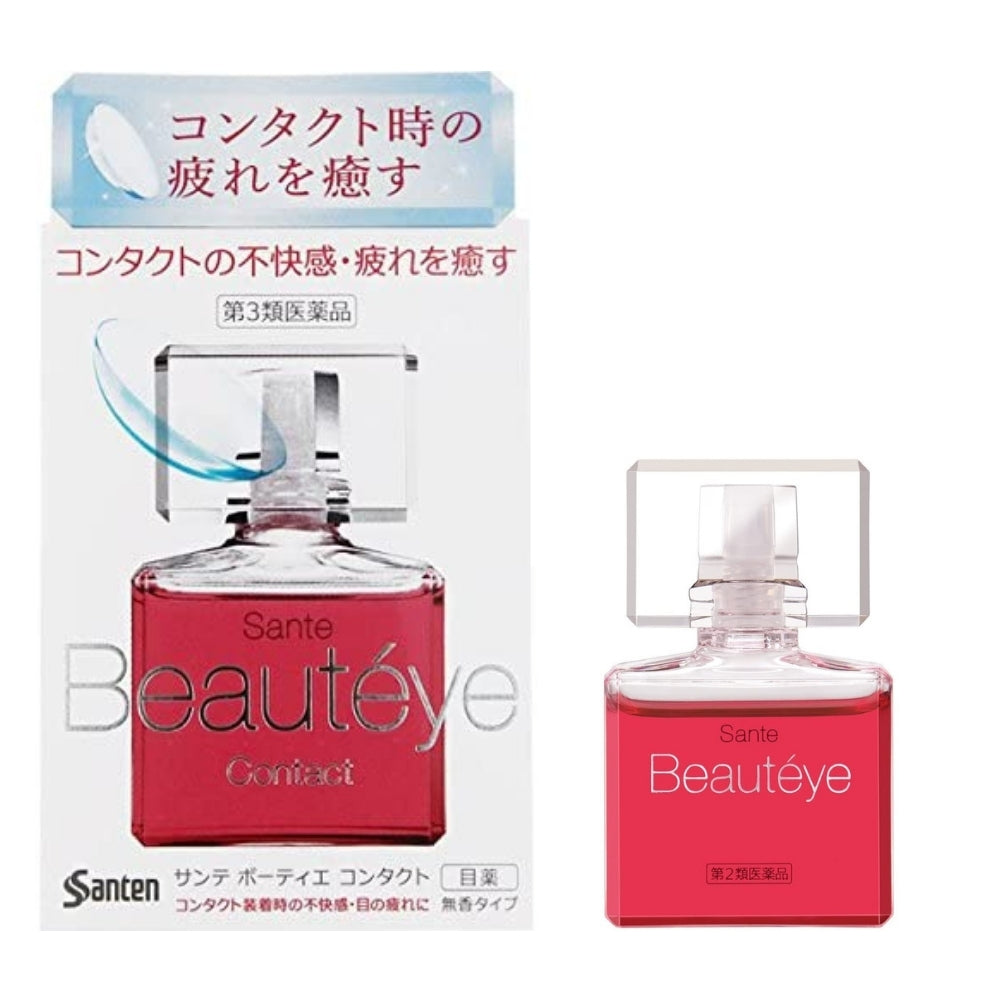
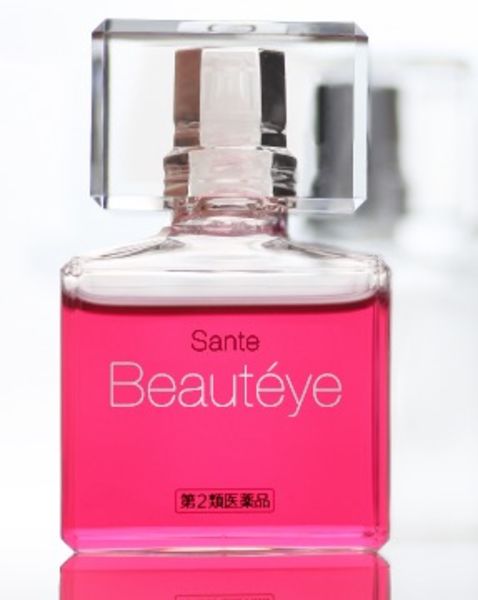
Beauteye is the bottle Santen designed to be left out on a dressing table rather than hidden in a drawer — the flacon deliberately echoes a perfume bottle. Behind the styling is a conventional Japanese eye medicine with five actives, all five dosed at the maximum concentration the approval standard permits: taurine for tissue metabolism, vitamin B12 for the ciliary muscle, sodium chondroitin sulfate to hold moisture on the cornea, tetrahydrozoline to reduce redness in the white of the eye, and chlorpheniramine against itching. It is a shorter list than Sante Medical 12, but nothing on it is present at a token level.
This is a licensed Japanese over-the-counter medicine, not a cosmetic eye product. Everything the manufacturer is allowed to say about it — the indications, the dose, the active ingredients and their percentages — is fixed by the Japanese approval and reproduced here as published. We do not add claims of our own.
Approved indications in Japan: eye fatigue; conjunctival congestion; blurring of vision (as when there is excessive eye mucus); itching of the eyes; prevention of eye disease (after swimming, or when dust or sweat enters the eye); blepharitis (inflamed eyelid rims); ophthalmia caused by ultraviolet or other light (such as snow blindness); discomfort when wearing hard contact lenses.
See the rest of our Japanese eye drops, or the eye-health supplements we ship alongside them.
Key Benefits
- All five actives dosed at the maximum concentration Japan's OTC ophthalmic standard allows
- Taurine at 1.0% — twice the level found in Sante Medical 12
- Sodium chondroitin sulfate at 0.5% for corneal protection and slower tear evaporation
- Tetrahydrozoline works on visible redness in the white of the eye, which matters when you are photographed or on camera
- Compact perfume-style flacon that survives a handbag better than a standard eye-drop carton
- Class 2 OTC medicine with published indications, not a cosmetic eye serum
Product Details
| Brand | Santen (参天製薬) |
|---|---|
| Country of origin | Japan |
| Product type | Eye drops (ophthalmic solution) |
| Regulatory class (Japan) | Class 2 OTC medicine (第2類医薬品) — a licensed non-prescription medicine, not a cosmetic |
| Volume | 12 mL |
| Format | Multi-dose plastic dropper bottle in a printed carton with the Japanese package insert |
| Contact lenses | Hard lenses only |
| JAN code | 4987084410979 |
| Sold by | Tsujimoto Market, Kobe, Japan |
Who Is This For?
- People who want the redness-reducing action rather than only the fatigue actives
- Anyone who keeps drops in a handbag and wants a bottle that does not look clinical
- Hard contact lens wearers
- Anyone comparing Santen's range and wondering what the shorter Beauteye list gives up — the answer is breadth, not dose
- Not for you if you wear soft lenses, have glaucoma, or want a drop with no vasoconstrictor in it
How to Use
- Wash your hands and remove soft contact lenses; hard lenses may stay in.
- Tilt your head back and draw the lower lid down with a clean fingertip.
- Squeeze one to three drops into the pocket of the lower lid, keeping the nozzle clear of lid, lash and eyeball.
- Close the eye for about thirty seconds; press gently at the inner corner instead of blinking.
- Wipe away any overflow and re-cap the bottle immediately.
Frequency: One to three drops, five to six times a day, as stated in the Japanese approval.
Full Ingredients
Active ingredients
- Taurine 1.0% — activates tissue metabolism in the eye
- Vitamin B12 (cyanocobalamin) 0.02% — acts on the ciliary muscle to relieve eye fatigue
- Sodium chondroitin sulfate 0.5% — protects and moisturises the cornea, slowing tear evaporation
- Tetrahydrozoline hydrochloride 0.05% — reduces congestion in the conjunctiva
- Chlorpheniramine maleate 0.03% — antihistamine, for inflammation and itching
Excipients
The full excipient list is printed on the Japanese carton; Santen's published product data names the five actives above and states that the formula is a preserved multi-dose ophthalmic solution. Ask us for a photo of the carton panel before ordering if you need the complete excipient list — we will not guess at it here.
Ingredient list as declared by the manufacturer. Formulations are occasionally revised, so always read the list printed on the package you receive.
Cautions
- This is a medicine, not a cosmetic. Personal import of over-the-counter medicines is restricted or prohibited in some countries, and several actives used in Japanese eye drops are prescription-only elsewhere. Check your national rules before ordering — customs may hold or destroy a parcel we cannot get back.
- The Japanese approval covers use with hard contact lenses only. Do not use while wearing soft lenses — the benzalkonium chloride preservative is absorbed by soft lens material.
- Read the Japanese package insert supplied with the product. If you cannot read it, ask us for a translation before you use the drops.
- Consult a doctor or pharmacist before use if you are under medical treatment, are pregnant or breastfeeding, have ever had an allergic reaction to a medicine, or have glaucoma.
- Stop using the drops and see a doctor if redness, itching, swelling, pain or blurred vision appear or get worse, or if symptoms have not improved after about two weeks of use.
- Do not use the product after the expiry date printed on the carton, and discard it within the period the insert states after opening.
- Do not let the dropper tip touch the eye, eyelid or lashes, and do not share the bottle with anyone else.
- Keep out of reach of children. Store away from direct sunlight and high temperatures.
Package Contents
One bottle of 12 mL ophthalmic solution in its Japanese retail carton, with the manufacturer's package insert in Japanese. Nothing is repackaged or decanted.
Shipping & Store Notes
- Ships directly from Japan
- Processing time: 2–6 business days
- Tracking number provided after dispatch
- Import duties and taxes may apply depending on destination country
- Opened cosmetics cannot be returned for hygiene and safety reasons
Authenticity Guarantee
Every product at Tsujimoto Market is sourced directly from Japan and verified for authenticity. We never sell fakes or grey-market goods. Each order is carefully packed in Kobe, Japan and dispatched with full tracking.
FAQ
How many drops should I use, and how often?
The Japanese approval for this product says: one to three drops, five to six times a day. More is not better — an eye can only hold about one drop, so the rest runs down your cheek and the extra dose is wasted. If you find yourself reaching for the bottle more often than the insert allows, that is a reason to see an eye doctor rather than to increase the dose.
Is this a medicine or a cosmetic?
A medicine. Japanese eye drops of this type are licensed under the Pharmaceuticals and Medical Devices Act and sold in pharmacies, not as cosmetics. That is why this page lists active ingredients with percentages and an approved indication list rather than beauty claims — and why you should check whether your country allows you to import an over-the-counter medicine before you order.
Does the redness ingredient cause rebound redness?
Tetrahydrozoline is a vasoconstrictor: it narrows the small vessels in the white of the eye, which is why redness fades within minutes. Used daily over long stretches, decongestant drops of this class are associated with the eye looking redder once the effect wears off, so ophthalmologists generally advise keeping them for occasional use rather than as a routine. If your eyes are red most days, the useful step is finding out why, not using more drops.
Is this product halal or suitable for vegans?
The formula contains sodium chondroitin sulfate, which is manufactured from animal cartilage — commonly shark or bovine. It is therefore not suitable for vegans, and buyers who observe halal rules should treat the source as unverified: the manufacturer does not publish it and the product carries no halal certification. Everything else in the formula is synthetic or mineral.
How long does a bottle last once opened?
Japanese eye-drop inserts generally tell you to finish the bottle within about three months of opening and to discard whatever is left after that, because the preservative system is only validated for that period. Write the date you opened it on the carton. An unopened bottle keeps until the expiry date printed on the box, which is typically two to three years from manufacture.