
Tsujimoto Market: Our Guarantees
Description
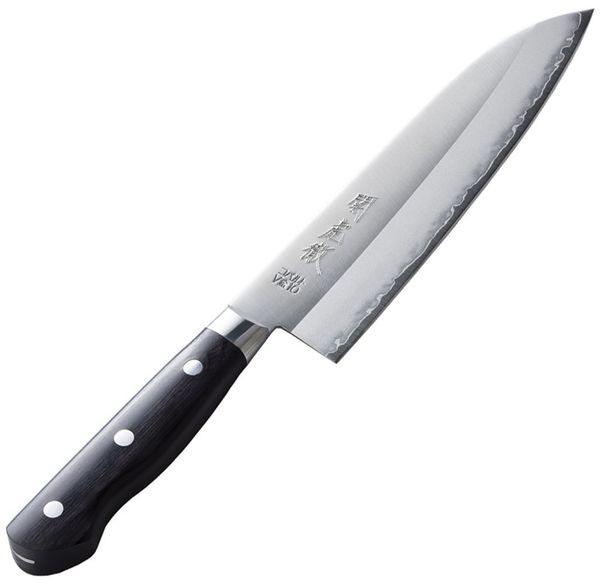
Seki Kotetsu VG-10 Santoku 180 mm — Clad Japanese Kitchen Knife (YG300)
Overview
Two things a kitchen knife page has to say before anything else: what shape it is, and what steel it is made of. This is a santoku — 三徳, "three virtues", the Japanese all-purpose shape that handles fish, meat and vegetables on one blade — with a 180 mm edge. The steel is V金10号 (VG-10), a stainless blade steel with cobalt and a high chromium content, forged here as 割込み: a hard VG-10 core clad between softer stainless outer layers, so the edge is hard where it cuts and the body of the blade is not brittle.
It is made by Yasuda Hamono in Seki, Gifu — the town that forged swords from the Kamakura period and now ships more blades than anywhere else in Japan — and sold there under the name 関虎徹, Seki Kotetsu. Total length 305 mm, blade height 45 mm, handle of 積層強化木, laminated compressed hardwood.
See also: Japanese kitchen goods, household goods from Japan.
Key Benefits
- ✓ Santoku shape: one blade for fish, meat and vegetables, 180 mm of edge
- ✓ VG-10 core — a cobalt-bearing, high-chromium stainless blade steel
- ✓ Clad construction: hard core, softer stainless flanks, so the edge is hard without the blade being brittle
- ✓ Stainless enough to wipe dry and put away, unlike a carbon-steel Japanese knife
- ✓ Laminated compressed hardwood handle, which does not swell or split the way plain wood does
- ✓ 158 g and 305 mm overall — light in the hand for a knife with this much edge
- ✓ Made in Seki, Gifu, and certified under the prefecture's Hida-Mino Suguremono scheme
- ✓ Bought in Japan, packed in Kobe and sent with tracking
Product Details
| Brand | Seki Kotetsu (関虎徹), by Yasuda Hamono Co., Ltd. |
|---|---|
| Model | YG300 |
| Country of origin | Japan — Seki, Gifu Prefecture |
| Knife type | Santoku (三徳), Japanese all-purpose |
| Blade length | 180 mm |
| Overall length | 305 mm |
| Blade height | 45 mm |
| Weight | 158 g |
| Blade steel | V金10号 (VG-10) core, 割込み clad between stainless outer layers |
| Handle | 積層強化木 — laminated compressed hardwood |
| Edge | Double bevel, ground for right or left hand alike |
| Certification | Hida-Mino Suguremono, Gifu Prefecture |
Who Is This For?
- Anyone who wants one Japanese knife rather than three, and cooks a mix of fish, meat and vegetables
- Cooks moving up from a supermarket knife who want a real blade steel without the upkeep of carbon steel
- Anyone with a smaller kitchen: 180 mm is the length that still fits a normal board
- Left-handed cooks — this is a double-bevel blade, not a single-bevel one
- Not for cutting bone, frozen food or anything you would twist or pry with. A hard core chips
How to Use
- Cut on wood or plastic. Glass, stone and ceramic boards take the edge off in a single meal.
- Let the length of the blade do the work — draw it through rather than pressing straight down.
- Wash by hand in warm water with a little detergent immediately after use, especially after anything salty or acidic.
- Dry it at once and put it away dry. Stainless means slow to rust, not unable to.
- Store it so the edge touches nothing: a block, a magnetic bar, a sheath or an edge guard.
- Sharpen on a whetstone. Pull-through sharpeners with carbide wheels tear metal out of an edge like this instead of grinding it.
Frequency: Daily use; hand-wash and dry after every use
Materials and Construction
Blade. V金10号 (VG-10) core, forged 割込み — clad, with the hard core sandwiched between softer stainless outer layers. VG-10 is a stainless blade steel to which cobalt and a high proportion of chromium are added; the cobalt is what lets it be taken to a hardness that holds an edge, the chromium is what keeps it from rusting while it does.
Why the clad construction matters. A blade made entirely of steel that hard would be brittle across its whole width. Cladding puts the hardness only where the cutting happens and leaves the rest tough, which is why the knife can be thin at the edge without being fragile in the hand.
Handle. 積層強化木 — hardwood veneers laminated and compressed under resin. It behaves in a wet kitchen the way plain wood does not: no swelling at the bolster, no splitting along the grain.
Where it is made. Seki, Gifu Prefecture. Seki has forged blades since the Kamakura period and remains Japan's largest blade-producing town by shipment value. This model is certified under the prefecture's Hida-Mino Suguremono scheme.
Composition and specification as declared by Yasuda Hamono Co., Ltd. on its official product page.
Cautions
- This knife is sharp in a way supermarket knives are not. Treat a moment of inattention as a cut.
- Adults only. Several countries set a minimum age for buying a kitchen knife; it is your local rule, not ours, and it applies at the border as well as the till.
- Not for bone, frozen food, pumpkin skin, or anything that makes you twist or lever the blade. The hard core chips rather than bends.
- Not dishwasher safe. The detergent is abrasive and alkaline, the rack knocks the edge, and the heat dries out the handle.
- Stainless is slow to rust, not unable to. Salt, citrus and a night in the sink will all mark it.
- Never try to catch a falling knife. Step back and let it land.
- Keep it out of reach of children and out of a loose drawer where a hand goes in blind.
- Sharpen on a whetstone, not a carbide pull-through. If you have never used a stone, a cheap one and a video is a better first purchase than a gadget.
Package Contents
One santoku knife. No sheath, edge guard, whetstone or case is included — if you do not already have somewhere safe to keep it, order an edge guard at the same time.
Shipping & Store Notes
- Ships directly from Japan
- Processing time: 2–6 business days
- Tracking number provided after dispatch
- Import duties and taxes may apply depending on destination country
- Kitchen knives are restricted or prohibited in the post to some destinations, and several countries set a minimum age for buying one. We cannot clear a parcel through a rule that forbids it, so please check your own country's position before ordering
- Returns are accepted only on an unused knife in its original packaging, for safety reasons
Authenticity Guarantee
Every product at Tsujimoto Market is sourced directly from Japan and verified for authenticity. We never sell fakes or grey-market goods. Each order is carefully packed in Kobe, Japan and dispatched with full tracking.
FAQ
What kind of knife is this, and what steel is it?
A santoku — the Japanese all-purpose shape, 180 mm of double-bevelled edge, equally at home on fish, meat and vegetables. The steel is VG-10, a cobalt-bearing high-chromium stainless blade steel, clad between softer stainless outer layers. Those are the two facts to compare it on; discussion of molybdenum and vanadium in the abstract tells you nothing about which knife you are holding.
Santoku or gyuto — which should I buy?
A santoku has a shorter, flatter, taller blade and a rounded tip; a gyuto is longer with a pointed tip and more curve for rocking. If your board is normal-sized, you chop more than you rock, and you want one knife rather than several, the santoku is the easier answer. If you break down large cuts of meat regularly, a gyuto earns its length.
Can it go in the dishwasher?
No, and this is the single most common way a knife like this is ruined. Dishwasher detergent is abrasive and alkaline, the rack lets the edge knock against other items, and the drying cycle dries the handle out. Thirty seconds by hand and a towel is the whole of the maintenance.
How do I sharpen it, and how often?
On a whetstone — a 1000-grit stone for sharpening and a 3000 or higher for finishing covers everything a home cook needs. Do it when the knife stops going through a tomato skin under its own weight, not on a schedule. Avoid pull-through sharpeners with carbide wheels: they tear metal out of a hard clad edge rather than grinding it.
Is the blade rustproof?
Stainless, which means slow to rust rather than unable to. Salt, acid and standing water will all mark it if left. Wash and dry it after use and it will stay clean indefinitely; leave it wet in the sink overnight with lemon on it and it will spot.