

Tsujimoto Market: Our Guarantees
Description
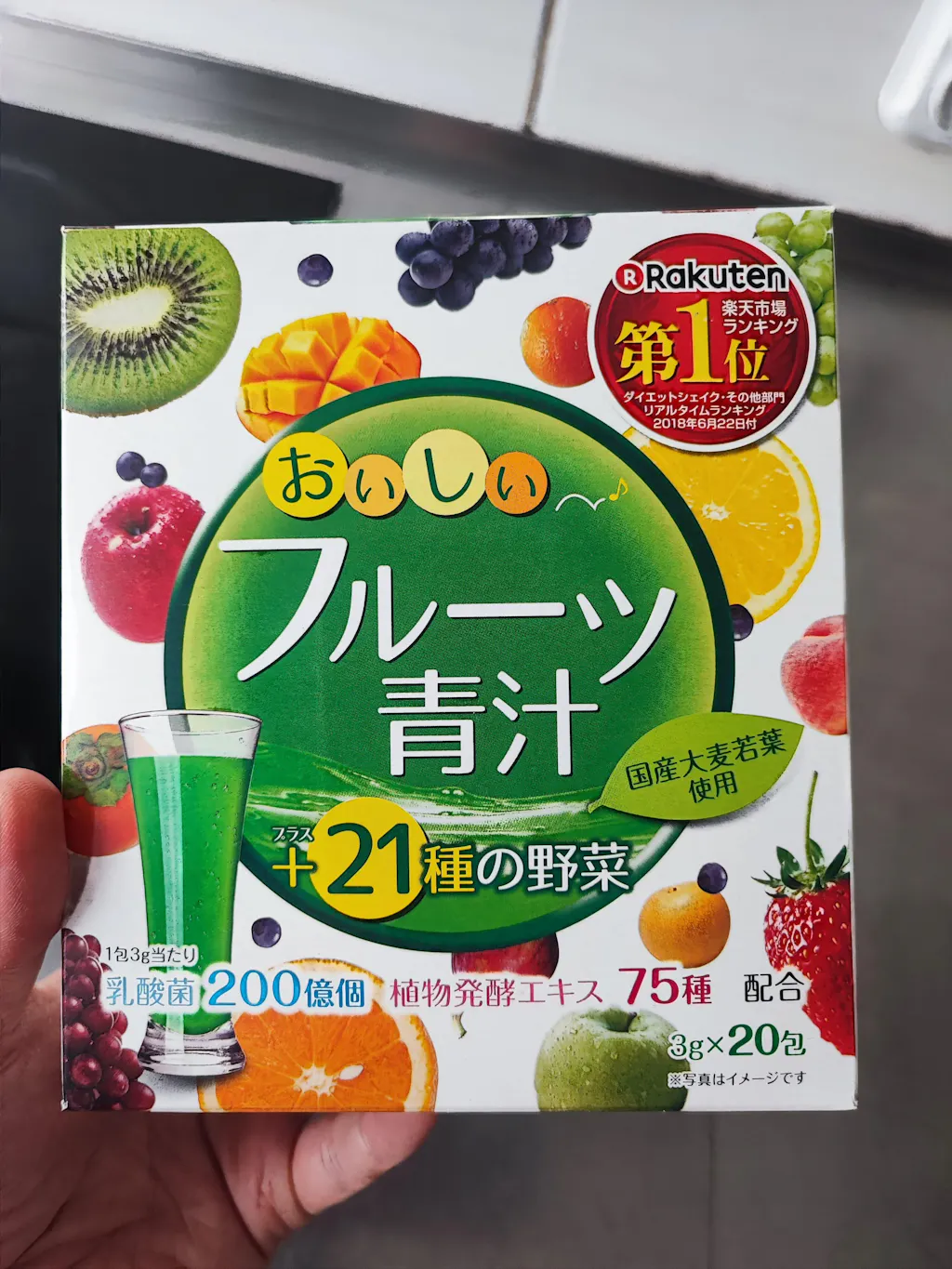
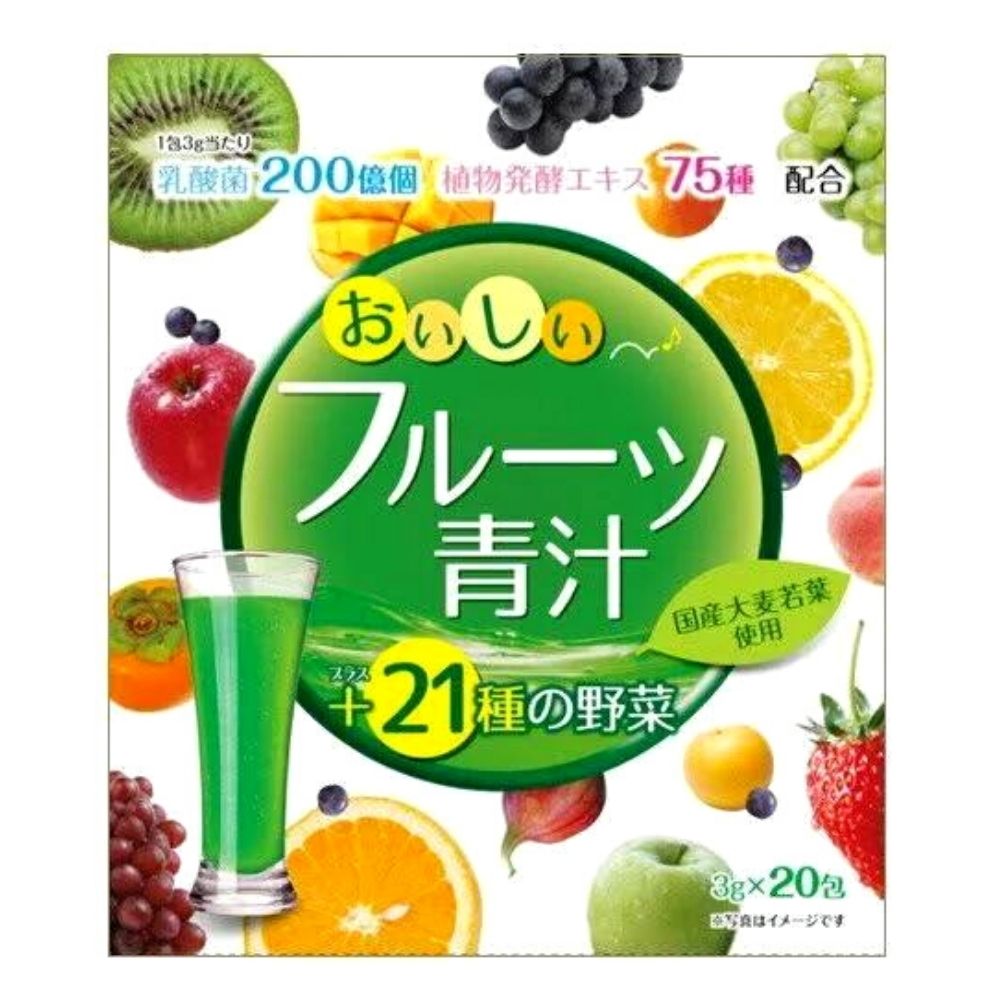
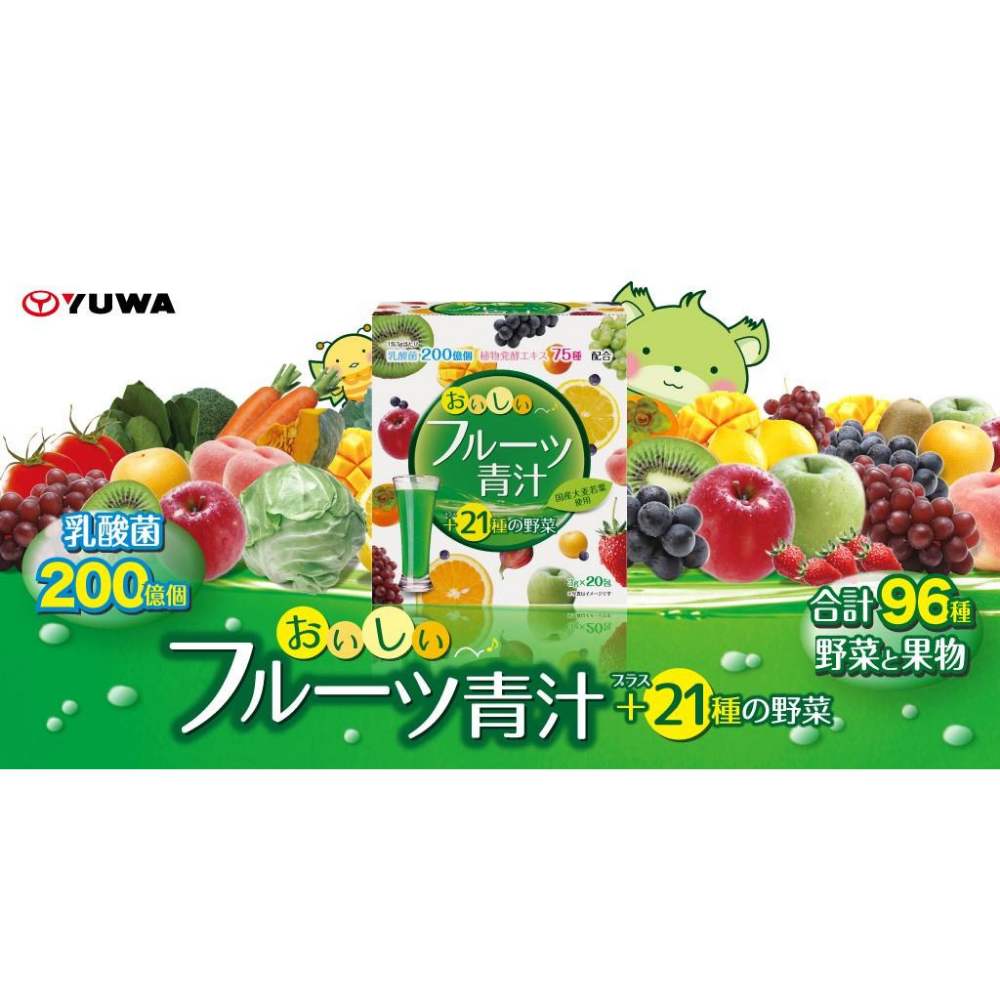
Yuwa Fruit Aojiru — 3 g × 20 Sachets
Overview
Yuwa's fruit aojiru is the version of the drink made for people who did not get on with the plain one. Barley grass is still the first ingredient, but it is cut with dried vegetable powder, a fermented plant extract and a fruit-flavoured base, so the result tastes closer to a mild squash than to grass. Each box holds 20 single-serve sachets of 3 g.
It is worth knowing what is in it before you buy: the resistant dextrin is declared as containing wheat, and the sweetener is aspartame. Both are listed in full below. Yuwa is a Tokyo maker working out of an ISO 22000 certified plant, and this is their own declaration, not ours.
See also: Japanese aojiru supplements · Japanese supplements
Aojiru (青汁) is the Japanese name for a powdered green drink, usually made from young barley grass or kale, that is stirred into water or milk and drunk once a day. It is sold in Japan as an ordinary food, not as a medicine: the point is to add vegetable material and dietary fibre to a diet that is short of both, in a format that takes fifteen seconds. Nothing on this page should be read as a treatment for any condition.
Key Benefits
- ✓ Barley grass is the first ingredient, followed by 21 dried vegetables including kale, broccoli, spinach and bitter melon
- ✓ 10.95 kcal per sachet, so it fits a diet without arithmetic
- ✓ 20 billion sterilised lactic acid bacteria and 20 mg of fermented plant extract per 3 g, both figures published by the maker
- ✓ Fruit-flavoured rather than grassy — the reason this version exists
- ✓ 20 pre-measured sachets: nothing to weigh, nothing to scoop
- ✓ Full ingredient declaration reproduced below, including the wheat and aspartame the maker declares
- ✓ Made by Yuwa in an ISO 22000 certified plant in Tokyo
Product Details
| Brand | Yuwa |
|---|---|
| Made by | Yuwa Co., Ltd. (株式会社ユーワ), Musashimurayama, Tokyo — ISO 22000 certified plant |
| Japanese product name | おいしいフルーツ青汁 20包 |
| Product type | Food (powdered drink mix) |
| Format | Individually sealed sachets |
| Flavour | Fruit |
| Serving size | 3 g (one sachet) |
| Servings per box | 20 — 20 days at one a day |
| Net contents | 60 g (3 g × 20) |
| Country of origin | Japan |
| JAN code | 4960867005494 |
| Regulatory status in Japan | Ordinary food (一般食品). No notified health claim; not a quasi-drug (医薬部外品) |
| Declared allergens | Wheat (declared by the maker in the resistant dextrin). Also contains aspartame, a source of phenylalanine |
Who Is This For?
- Anyone who bought a plain barley-grass aojiru, could not finish the box, and wants the same idea in a drinkable form
- People whose vegetable intake collapses on weekdays and who want a fifteen-second floor under it
- Someone introducing a household to aojiru who expects resistance to the taste
- Not for you if you have a wheat allergy, or phenylketonuria, or you avoid artificial sweeteners — this one contains wheat and aspartame, and the plain barley-grass aojiru does not
How to Use
- Tear open one sachet.
- Pour 80–100 ml of cold or room-temperature water into a glass or shaker.
- Add the powder and stir or shake until no lumps remain. A shaker gives the cleanest result; barley-grass powder resists a spoon.
- Drink it straight away — the powder settles within a minute or two.
- Milk, soy milk, apple juice or unsweetened yoghurt all work in place of water and blunt the grassy note; they also add their own calories, which plain water does not.
Frequency: One sachet a day. It is a food, so there is no course to complete and no loading period.
Ingredients & Nutrition
Ingredients, in the maker's declared order (source: Yuwa product page):
Barley grass powder (produced in Japan), maltodextrin, resistant dextrin (contains wheat), dried vegetable powder [barley grass, kale, broccoli, cabbage, daikon leaf, pumpkin, purple sweet potato, bok choy, parsley, carrot, celery, bitter melon, spinach, mulberry leaf, molokhia, mugwort, napa cabbage, asparagus, tomato, nozawana, lotus root — 21 vegetables], fermented plant extract powder [maltodextrin plus a plant fermentate the maker describes as 75-plant, built on brown sugar, cabbage, strawberry, apple, daikon, tomato, yuzu, persimmon, kiwi, cucumber, aubergine, spinach, komatsuna, green pepper, celery, bitter melon, shiso, carrot, prune, mugwort, soya, oligosaccharide, grape, peach, mandarin, pumpkin, lychee, hyuganatsu, kale, barley grass, molokhia, kombu, brown rice, sweetcorn, kumquat, shiitake, rice bran, lemon, cocoa, wood ear, wakame, bladderwrack, kombu root, blueberry, akebia, bayberry, mallotus, plantain, kumazasa, horsetail, loquat leaf, maitake, hijiki, pear, bok choy, ume, lotus root, turmeric, iyokan, vitamin greens, fig, crimson glory vine, burdock, broccoli, ginger, quince, parsley, asparagus, Japanese parsley, raspberry, mitsuba, myoga, silverberry, blackberry, winter strawberry], lactic acid bacteria (sterilised) / citric acid, flavouring, sweetener (aspartame, L-phenylalanine compound).
Nutrition, per 3 g sachet (source: Yuwa product page): energy 10.95 kcal · protein 0.23 g · fat 0.04 g · carbohydrate 2.42 g · salt equivalent 0.003 g · lactic acid bacteria 20 billion · fermented plant extract powder 20 mg.
Two notes on what is not here. The lactic acid bacteria are declared sterilised, so they are not live cultures and we do not call them probiotics. And Yuwa declares only "lactic acid bacteria" — the strain designation that appears on some retail copy of this product is not in the maker's declaration, so it is not on this page.
Cautions
- This is a food, not a medicine. It is not intended to diagnose, treat, cure or prevent any disease
- If you are pregnant, breastfeeding, taking prescription medication or under medical supervision, ask your doctor before starting any supplement
- Stop taking it and consult a doctor if it disagrees with you
- Never swallow the powder dry — always dissolve it in liquid first, or it can catch in the throat
- Keep out of the reach of small children
- Store away from direct sunlight, heat and damp; finish an opened sachet the same day
- Contains wheat: the resistant dextrin is declared 小麦を含む by the maker. Avoid if you have a wheat allergy
- Contains aspartame — a source of phenylalanine. Not suitable for people with phenylketonuria (PKU)
Package Contents
- 1 × retail box, factory-sealed
- 20 × 3 g single-serve sachets (60 g net)
- No scoop, shaker or measuring spoon is included — the sachets are pre-measured
Shipping & Store Notes
- Ships directly from Japan
- Processing time: 2–6 business days
- Tracking number provided after dispatch
- Import duties and taxes may apply depending on destination country
- Opened cosmetics and supplements cannot be returned for hygiene and safety reasons
- Powdered supplements are shipped in the maker's sealed retail box; we do not repack or decant
Authenticity Guarantee
Every product at Tsujimoto Market is sourced directly from Japan and verified for authenticity. We never sell fakes or grey-market goods. Each order is carefully packed in Kobe, Japan and dispatched with full tracking.
FAQ
Does it actually taste of fruit, or is that marketing?
It is a fruit-flavoured powder, not fruit juice. Yuwa builds it on a flavouring plus an aspartame sweetener, and the grassy note is muted rather than gone. If you want the greens without the sweetener, Yuwa's plain barley-grass aojiru is the other product.
It contains wheat and aspartame — is that on the box?
Yes. The maker declares the resistant dextrin as containing wheat, and the sweetener as aspartame and L-phenylalanine compound. Both are reproduced in the ingredient section above. We list them because you cannot plan a diet around a product whose allergens and sweetener are not printed where you can see them.
Are the lactic acid bacteria live?
No. They are declared sterilised, which is why the maker can put a fixed count of 20 billion on the box — a live count would drift over shelf life. Sterilised bacterial bodies are a normal Japanese supplement ingredient; they are simply not probiotics, and we do not describe them as such.
How long does one box last?
At the maker's dose of one sachet a day, 20 days. Net weight is 60 g.
What is the barcode, and can I check it?
JAN 4960867005494. It passes its EAN-13 check digit. If you want to confirm you are getting the same box, that is the number on the back.