
Tsujimoto Market: Our Guarantees
Description
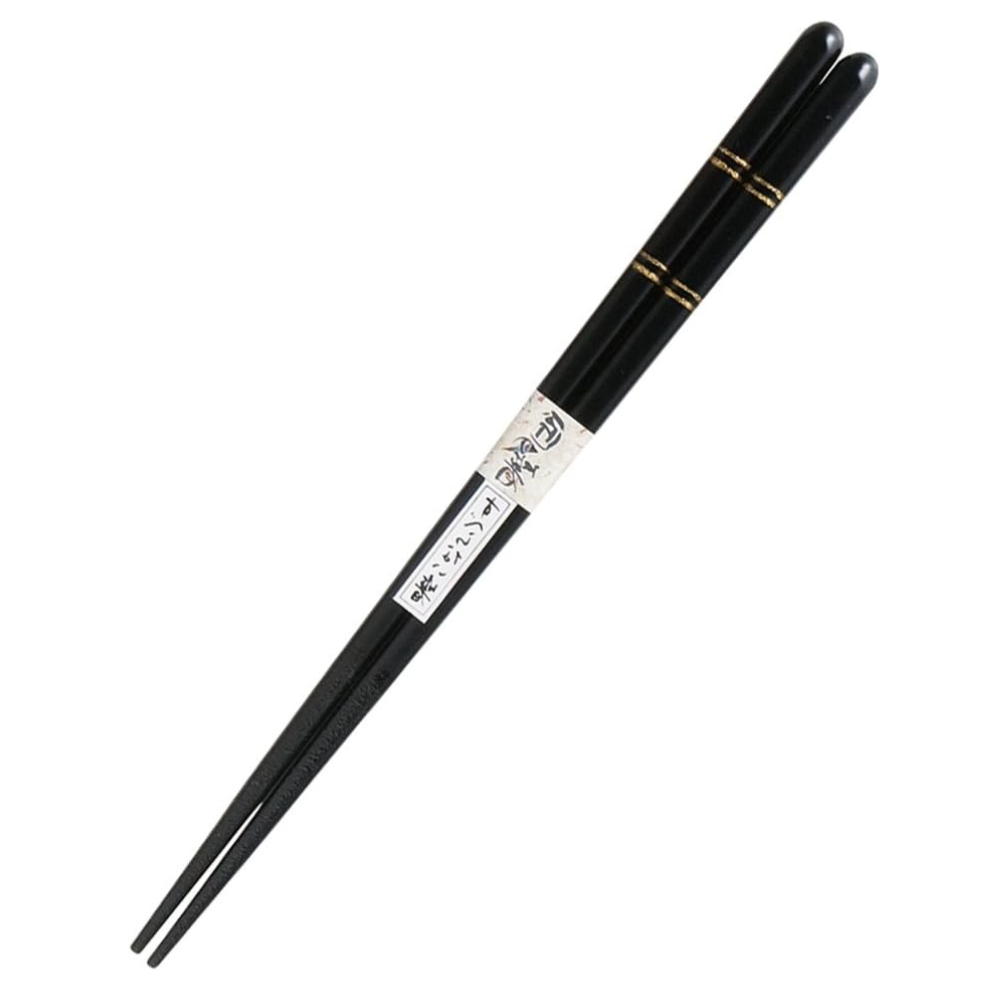
Tanaka Hashiten Wakasa-Nuri Chopsticks — Black with Gold Double Band, 23 cm
Overview
A black lacquered pair with two thin gold bands near the top, 23 cm, from Tanaka Hashiten in Fukui. The Japanese name for the pattern is 金二重 — kin-nijū, "gold double" — and it is one of the quiet formal patterns rather than a decorative one: it reads correctly at a guest table and does not look out of place at breakfast.
Two practical things separate it from an ordinary lacquered pair. The tips carry a non-slip treatment (スベリ止め加工), which is the difference between picking up a cube of silken tofu and chasing it round the bowl. And the finish is specified by the maker as dishwasher-compatible (洗浄機対応), which most lacquered chopsticks are not. For a five-colour family set instead, see the Ohashi Koujou five-pair set; for an everyday wooden pair, the MUJI octagonal cherry pair.
Choosing a length. The Japanese rule of thumb is issoku-hitomata: hold your hand with thumb and index finger at a right angle, measure between the two tips, and multiply by 1.5. For most adults that lands between 21 and 24 cm. 21 cm suits smaller hands, 23 cm is the general adult size, and if you are between the two, go longer — chopsticks that are slightly long are usable, chopsticks that are too short are not.
Key Benefits
- ✓ 金二重 kin-nijū pattern — black body, two gold bands, formal without being ornamental
- ✓ Non-slip treatment on the tips (スベリ止め加工): tofu, beans, mushrooms and noodles stop being a fight
- ✓ Dishwasher-compatible finish (洗浄機対応), which most lacquered chopsticks are not
- ✓ 23 cm, approx. 20 g — enough weight to feel deliberate in the hand, not enough to tire it
- ✓ Made in Fukui, the prefecture that produces the large majority of Japan's lacquered chopsticks
- ✓ Bought in Japan and shipped from Kobe with tracking
Product Details
| Brand | Tanaka Hashiten (田中箸店), Fukui |
|---|---|
| Japanese product name | 高級国産若狭塗箸 洗浄機対応箸 スベリ止め加工付 金二重 黒 |
| Pattern | 金二重 kin-nijū — "gold double" |
| Length | 23 cm (230 mm) |
| Weight | Approx. 20 g per pair |
| Material | Wood with lacquer finish |
| Tip treatment | Non-slip (スベリ止め加工) |
| Dishwasher | Yes — maker-specified as 洗浄機対応 |
| Microwave | No |
| Contents | 1 pair |
| Country of origin | Japan (Fukui) |
| Maker item no. | 27063 |
Who Is This For?
- Anyone who wants one good pair rather than a drawer of adequate ones
- Households that run a dishwasher and have given up on lacquered chopsticks because of it
- People who struggle with slippery food — the non-slip tips are the reason to choose this over a plain lacquered pair
- Gift buyers: black-and-gold is the safe formal register in Japan and reads as a considered present rather than a souvenir
- 23 cm is the general adult length. If your hand is small, 21 cm will suit you better — see the length note below
How to Use
- Rinse before first use and wipe dry.
- Use for anything you would use chopsticks for; the non-slip tips make small and slippery items easier.
- Wash in the dishwasher, laid flat in the cutlery basket, or by hand in warm water with mild detergent.
- Do not leave soaking, and do not run a high-temperature pot cycle.
- Dry fully and store flat, away from metal cutlery that can chip the lacquer.
Frequency: After every meal
Materials & Construction
Body: wood with a lacquer finish, black, with two gold bands applied near the grip end. Tips: non-slip treatment (スベリ止め加工). Finish specification: maker-rated 洗浄機対応 — dishwasher-compatible.
A word on what "Wakasa-nuri" means here. Wakasa-nuri (若狭塗) is a lacquer craft from the Wakasa region of Fukui, designated a traditional Japanese craft, and the historic technique layers lacquer over shell and eggshell and then polishes back through the layers. Fukui produces the large majority of Japan's lacquered chopsticks, and "Wakasa-nuri" is used across that output — from hand-finished togidashi work down to production pairs like this one, which are lacquered and coated for machine washing rather than built up from inlay. This is an honest production pair from that tradition, not a hand-inlaid art piece, and the price reflects that.
Cautions
- Not a toy. Keep away from children under three — chopsticks are a puncture hazard and a choking hazard.
- Never use in a microwave and never use to stir something on the heat.
- Do not leave soaking. Water sitting in the grain or under a lacquer edge is what lifts a finish.
- Dry before storing. Stored damp, wood chopsticks develop mould at the tip where you cannot see it.
- Stop using a pair once the coating chips or cracks — the exposed edge harbours food residue and can splinter.
- Keep away from direct sunlight, radiators and high humidity.
Package Contents
- 1 × pair of Tanaka Hashiten kin-nijū chopsticks, 23 cm
- Japanese retail sleeve with care and dishwasher information
- No chopstick rest and no case are included
Shipping & Store Notes
- Ships directly from Japan
- Processing time: 2–6 business days
- Tracking number provided after dispatch
- Import duties and taxes may apply depending on destination country
- Unused chopsticks in unopened packaging can be returned; a pair that has been eaten with cannot, for hygiene reasons
- Lacquered and wooden items travel well but are not indestructible — tell us within 48 hours if yours arrives chipped and we will replace it
Authenticity Guarantee
Every product at Tsujimoto Market is bought in Japan on the domestic market and packed in Kobe. We do not sell replicas or grey-market goods, and we do not relabel. Chopsticks are one of the categories where imitation is common outside Japan, so this matters more here than it does on a bottle of shampoo.
FAQ
Can these really go in the dishwasher?
Yes — the maker rates this model (item 27063) 洗浄機対応, dishwasher-compatible, and the finish is formulated for it. Two caveats that apply to any dishwasher-safe lacquerware: lay them flat in the cutlery basket rather than wedging them upright where the spray arm can hit an edge repeatedly, and do not run them on a high-temperature pot cycle. Most lacquered chopsticks are not dishwasher-safe at all, so do not generalise from this pair to the next one you buy.
Is this hand-inlaid Wakasa-nuri?
No, and we would rather say so. Historic Wakasa-nuri builds a surface from lacquer layered over shell and eggshell, then polishes back through it. This is a production pair from the same region and tradition, lacquered and coated for machine washing. It is a good, honest object at its price; it is not a craft piece, and any page telling you otherwise at this price is selling you a story.
What does 金二重 mean?
"Gold double" — kin-nijū, after the two gold bands. You will see the pattern romanised various ways by resellers; kin-nijū is the reading of 金二重.
Will the gold bands wear off?
They are under the lacquer, not printed on top, so normal use and dishwashing will not take them off. What does damage a pair is impact — a drop onto a tiled floor, or being knocked about loose in a drawer with metal cutlery. Store them apart from knives and forks.
Which pair should I buy for a family?
Not this one — buy the five-pair Ohashi Koujou set, which gives everyone their own colour. This pair is for one person or for a gift. The rest of the shelf is in Japanese Kitchen Products.