

Tsujimoto Market: Our Guarantees
Description
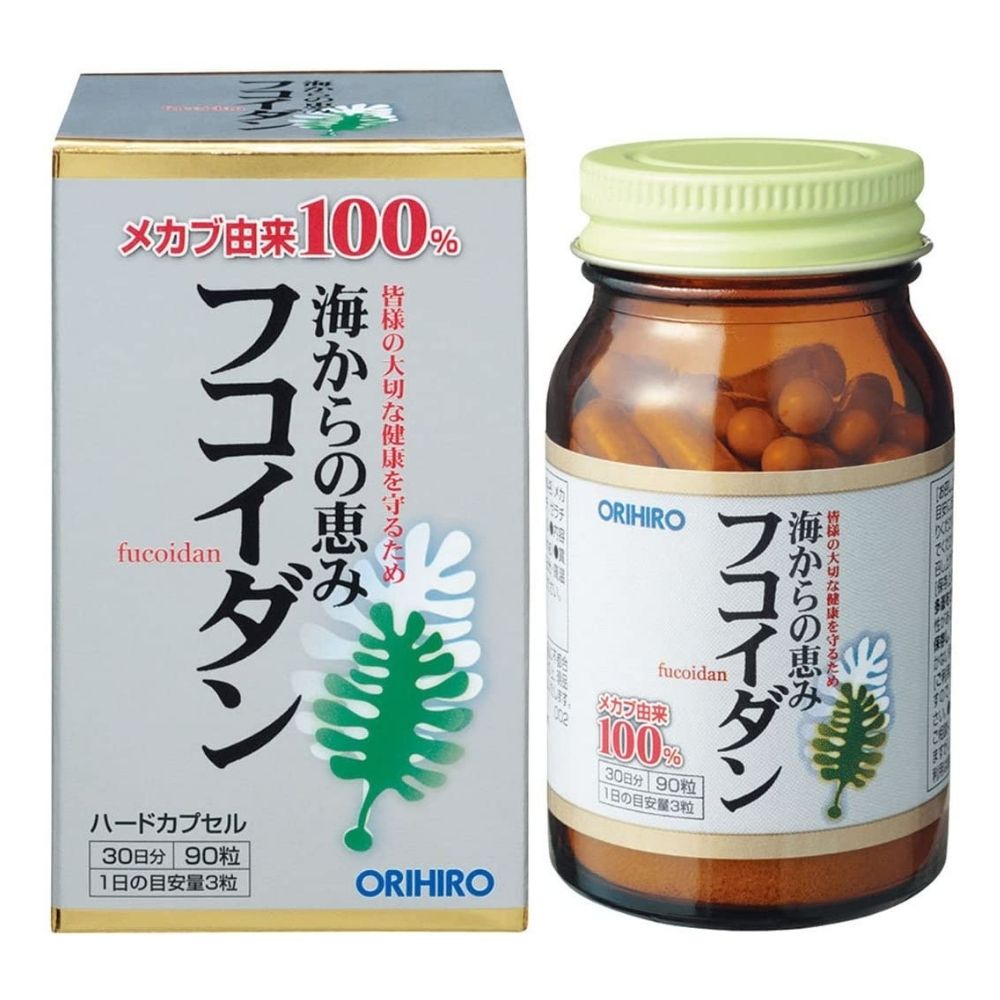
Orihiro Fucoidan — Mekabu Extract Hard Capsules, 90 Capsules / 30 Days
Overview
Orihiro sells this in Japan as フコイダン, JAN 4971493105915, and describes it as mekabu extracted and purified from the wakame plant and packed into a hard capsule. Orihiro also answers, on its own FAQ, the question most fucoidan pages avoid: it uses high-molecular-weight fucoidan.
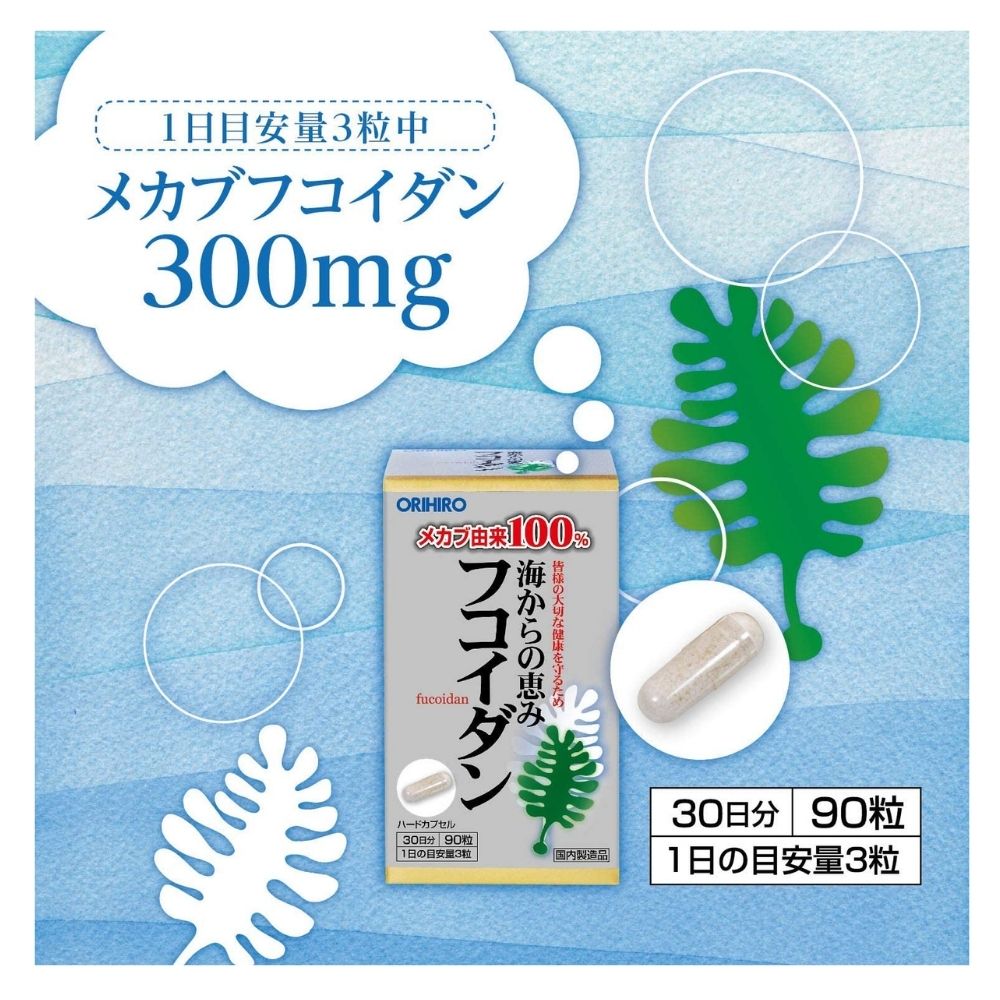
The 300 mg figure is the daily amount, not the capsule. Orihiro declares 300 mg of mekabu extract per three capsules — the stated daily serving — which is 100 mg in each. Until today this page said each tablet delivered 300 mg, which is three times the truth, and they are capsules rather than tablets. Everything below is Orihiro's own. See the rest of our Japanese supplements, or DHC's fucoidan tablet, which reaches the same 300 mg a day in two tablets instead of three capsules.
Key Benefits
- ✓ 300 mg of mekabu extract per daily three capsules — the extract declared at 80% fucoidan
- ✓ Orihiro states it uses high-molecular-weight fucoidan, a distinction most listings leave unanswered
- ✓ Ninety capsules per bottle: thirty days at Orihiro's stated three a day, with no rationing
- ✓ Mekabu extract produced in Japan; Orihiro's full ingredient list and panel are printed below
- ✓ A short declaration — five ingredients, of which gelatin is the only listed allergen
- ✓ Japanese-market bottle (JAN 4971493105915), dispatched from our Kobe warehouse with tracking
Product Details
| Brand | Orihiro (オリヒロ株式会社) |
|---|---|
| Product name (Japan) | フコイダン |
| Product type | Food supplement (健康食品). Not a medicine and not a quasi-drug |
| Format | Hard capsule — gelatin shell |
| Net content | 90 capsules — 323 mg each, of which 260 mg contents |
| Daily amount (Orihiro) | 3 capsules — one bottle is 30 days |
| Key component | Mekabu extract 300 mg per 3 capsules, declared at 80% fucoidan |
| Fucoidan type | High-molecular-weight, per Orihiro's own FAQ |
| Country of origin | Japan; mekabu extract produced domestically |
| Declared allergen | Gelatin (the only entry marked on Orihiro's 28-item table) |
| JAN | 4971493105915 |
Who Is This For?
- Someone who already knows the fucoidan figure they want and is comparing carriers rather than claims
- People who eat little or no seaweed and would rather take a tasteless capsule than change what they cook
- Anyone who specifically wants high-molecular-weight fucoidan, which Orihiro states and most sellers do not
- Buyers who prefer a short ingredient list — this one has five entries and no added flavour or colour
- Not for you if: you avoid gelatin for dietary or religious reasons, are vegetarian or vegan, are allergic to seaweed or iodine, manage a thyroid condition without medical advice, or take blood-thinning medication without speaking to your doctor
How to Use
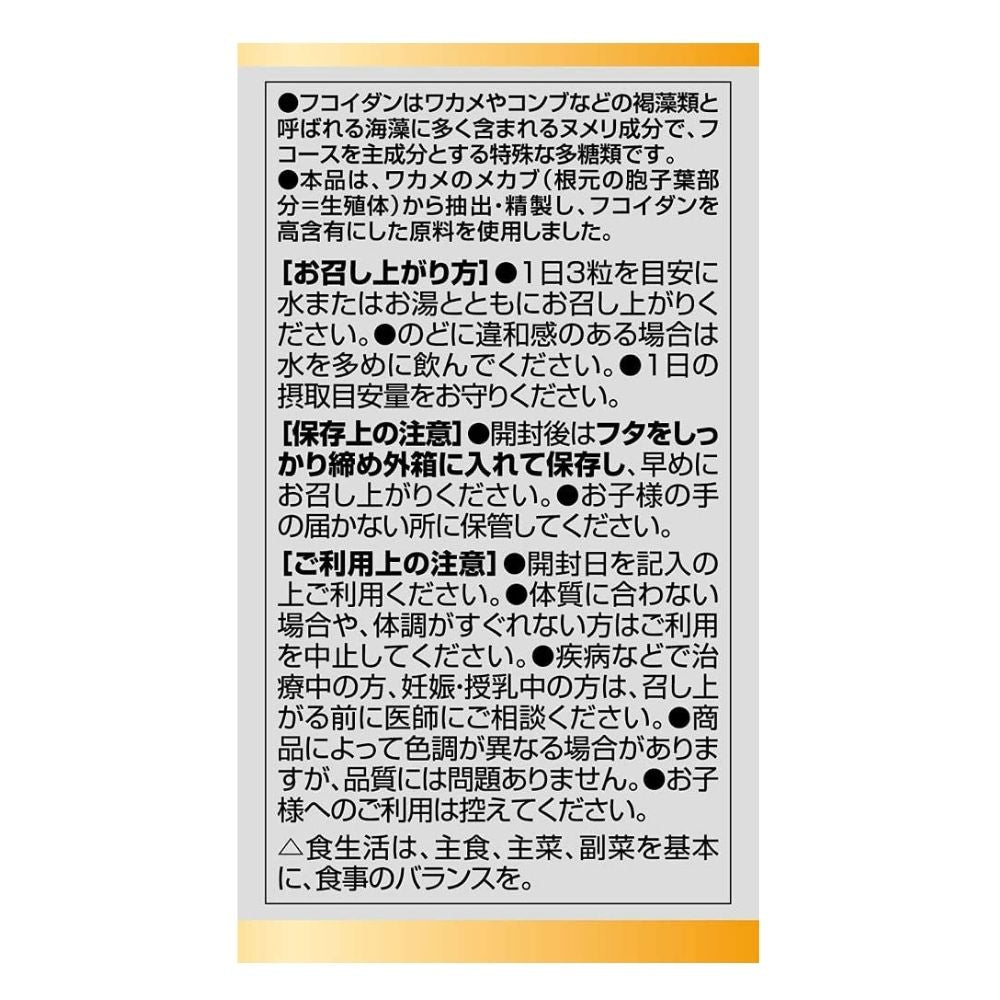
- Take three capsules a day. That is Orihiro's stated daily amount and the basis of the 90-capsule bottle.
- Swallow them with water or hot water.
- If a capsule feels uncomfortable going down, drink more water with it — this is Orihiro's own instruction.
- Keep to three a day. Orihiro's third instruction is to observe the stated daily amount.
- Close the bottle after each use and store it cool, dry and out of direct sunlight.
Frequency: Three capsules daily. One 90-capsule bottle is a 30-day course at that amount.
Ingredients and Nutrition Panel
Ingredients, in Orihiro's declared order: mekabu extract (produced in Japan), reduced maltose syrup, dextrin / gelatin, calcium stearate, silicon dioxide.
Five entries, and gelatin is the capsule shell. On Orihiro's 28-item allergen table it is the only line marked present — every other entry, including soy, wheat, milk, egg, crab and shrimp, is marked absent. Orihiro does not publish the animal source of the gelatin.
Panel, per 3 capsules (969 mg including the shell) — Orihiro's figures:
| Mekabu extract | 300 mg (declared at 80% fucoidan) |
|---|---|
| Energy | 3 kcal |
| Protein | 0.19 g |
| Fat | 0.03 g |
| Carbohydrate | 0.61 g |
| Salt equivalent | 0–0.03 g |
Cautions
- This is a food supplement, not a medicine. It is not intended to diagnose, treat, cure or prevent any disease.
- Keep to the stated daily amount of three capsules — Orihiro's own instruction.
- The capsule shell is gelatin of undeclared animal origin. It is not vegetarian, not vegan, and its halal status cannot be confirmed.
- If a capsule is uncomfortable to swallow, take it with more water, as Orihiro advises.
- Mekabu is seaweed and therefore a source of iodine. Speak to your doctor first if you have a thyroid condition or are watching iodine intake; do not use it if you are allergic to seaweed or iodine.
- Fucoidan is a sulfated polysaccharide. Ask your doctor before use if you take anticoagulant or antiplatelet medication.
- Consult a doctor before use if you are pregnant, breastfeeding, under medical care, or taking any medication.
- This is an adult food supplement. We do not recommend it for children without a paediatrician's advice.
- Stop taking it and speak to a healthcare professional if you notice any unusual reaction.
- Store cool and dry, away from direct sunlight and heat, and keep out of reach of children.
Package Contents
- 1 × Orihiro Fucoidan — 90 hard capsules
- Japanese-market bottle with the maker's printed panel, allergen table and cautions
- A 30-day course at Orihiro's stated three capsules a day
- Orihiro notes the cap colour may vary between batches
Shipping & Store Notes
- Ships directly from Japan
- Processing time: 2–6 business days
- Tracking number provided after dispatch
- Import duties and taxes may apply depending on destination country
- Opened supplements cannot be returned for hygiene and safety reasons
Authenticity Guarantee
Every product at Tsujimoto Market is sourced directly from Japan and verified for authenticity. We never sell fakes or grey-market goods. Each order is carefully packed in Kobe, Japan and dispatched with full tracking.
FAQ
Is it 300 mg per capsule or per day?
Per day. Orihiro publishes 300 mg of mekabu extract per three capsules, and three capsules is the stated daily amount, so each capsule holds about 100 mg. This page previously said each tablet delivered 300 mg — a threefold overstatement, and in the same body as a bullet that said 300 mg per serving. Both are now replaced by Orihiro's figure.
Capsule or tablet?
A hard capsule. Orihiro's description is explicit: the purified mekabu extract is packed into a hard capsule, the shell is gelatin, and the pack is 90 capsules of 323 mg each holding 260 mg of contents. The live page called it a tablet throughout, including in the title.
What is high-molecular-weight fucoidan, and why does Orihiro mention it?
Fucoidan extracts are sold in high- and low-molecular-weight forms, and sellers usually do not say which they have. Orihiro answers it directly in its own FAQ: it uses the high-molecular-weight form. We are reporting that because it is a published specification a buyer can compare, not because we are claiming one form works better than the other.
Is it halal, vegetarian or vegan?
Not vegetarian and not vegan: the capsule shell is gelatin. Orihiro does not publish the animal the gelatin comes from, so halal status cannot be confirmed and we will not state one. If that matters to you, DHC's fucoidan uses a shellac-coated tablet instead — insect-derived rather than animal-derived, which is a different question but still not a plain yes.
How does it compare with DHC's fucoidan?
On extract, identically: both deliver 300 mg of mekabu extract a day, both declare 80% fucoidan. Orihiro is three gelatin capsules a day, 90 to a bottle, and states high-molecular-weight. DHC is two shellac-coated tablets a day, 60 to a pack. The real differences are the capsule material, the number you swallow, and the price.