
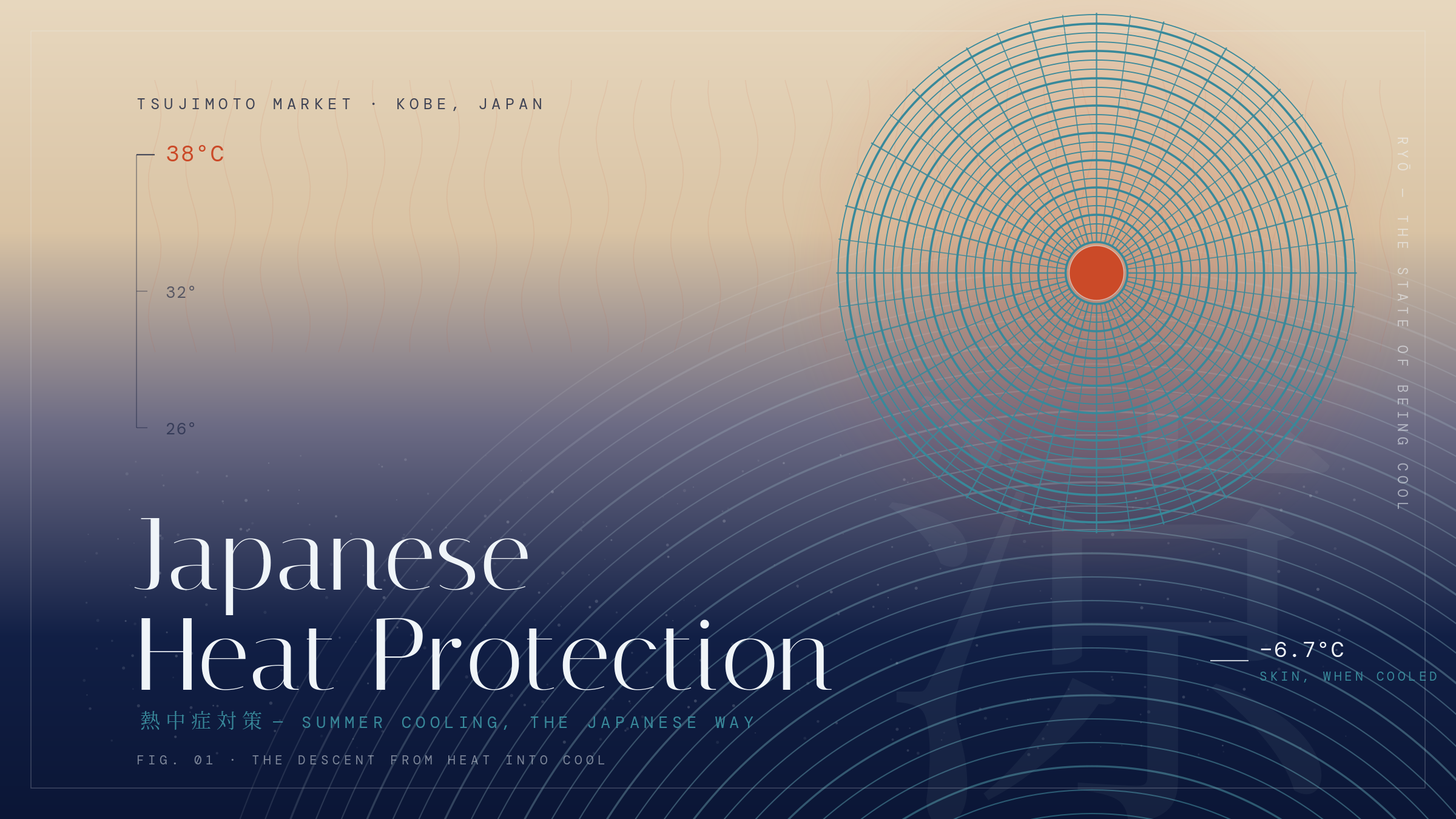
If you have never spent a summer in Japan, it is hard to describe what the humidity does to you. I have lived in Japan since 2002, and here in Kobe, July and August are not just hot — they are heavy. The air sits on your skin, a ten-minute walk to the station leaves your shirt damp, and the heat lingers well past sunset. Japan takes this seriously enough that there is a whole everyday vocabulary around it — necchūshō taisaku (熱中症対策), meaning "heat countermeasures" — and every convenience store, pharmacy and supermarket fills its shelves with practical tools to get through the season.
Over the years I have watched these products become as ordinary here as an umbrella. This is the toolkit Japanese households actually reach for — nothing exotic, just clever, tested little things that make a brutal afternoon bearable. Below I have pulled together the ones I stock and use myself, grouped by the job they do: cooling your skin, cooling your body directly, and replacing what you lose through sweat.
What makes Japanese heat protection different
It is built around a humid summer, not a dry one
Western "keep cool" advice often assumes dry heat, where evaporation does most of the work. Japanese summers are humid, so sweat does not evaporate efficiently and you feel sticky rather than cooled. That is why so many Japanese products focus on two things Western ranges rarely combine: wiping away sweat and sebum, and delivering an active cold sensation on the skin, usually through menthol. The goal is not just to mask the heat but to reset that clammy feeling in seconds.
It is a layered approach, not a single fix
Ask anyone here and they will not point to one magic item. They cool the skin with sheets or a mist, cool the body with something worn on the neck, and — crucially — drink and salt up before they feel unwell. Japan's climate makes fluid and electrolyte loss a daily reality in summer, so hydration is treated as part of staying cool, not an afterthought. The products below are meant to be used together.
It is practical and honest
What I appreciate about this category is how unglamorous it is. These are drugstore staples judged on whether they work on a packed commuter train, not on marketing. Where a product is a simple confectionery or a sports drink, the Japanese packaging says so plainly — and I will keep the same honesty here.
Step 1: Cool your skin
Biore Cooling Body Sheets — the everyday reset
If I had to name the single most-used summer product in Japan, it would be cooling body sheets. Kao's Biore Cooling Body Sheets in Refresh Floral are thick, tear-resistant wipes soaked in cooling water and menthol. You wipe your neck, arms and back, and skin temperature drops the instant you do — the packaging describes it as up to a 3°C drop. They also lift away the sweat and sebum that cause odour, and the version I linked leaves a light floral scent. The formula includes sodium hyaluronate, so your skin does not feel stripped afterward.

If you are sensitive to fragrance, or you wear perfume and do not want it to clash, I keep the Biore Cooling Body Sheets Fragrance-Free version too. It is the same menthol-cooling, sweat-wiping idea with sodium hyaluronate for moisture, just with no added scent — the one I recommend for anyone with reactive skin or a no-fragrance preference. Both packs hold 20 large sheets, which is enough to keep some at home, some in your bag, and some at your desk. A quick note: these are for cooling and wiping intact skin, not antiperspirants, so treat them as a refresh rather than sweat prevention.
Seabreeze Deo & Water — cooling mist that doubles as deodorant
When you want something faster than a wipe, a trigger mist is the answer. Seabreeze Deo & Water in Frozen Mint is a deodorant and cooling body mist built on what the brand calls its "Double Smooth" formula — a plant-based powder plus a "Smooth Essence" that neutralises odour and takes away stickiness in seconds, for that just-showered feeling. Frozen Mint is one of the strongest cooling scents in the range. A nice detail: scent capsules are designed to activate with perspiration, so the fragrance holds through the day, and the "Powder Cut" formula is made to avoid white marks.
If mint is too sharp for you, the Citrus Sherbet variant uses the same cooling-deodorant technology with a brighter, juicier scent — a good pick for students, long walks and anyone who prefers something fruity over minty. Seabreeze does not publish a full ingredient list for these on our storefront, so I will not pretend to detail every component; what the brand states is the plant-based powder, Smooth Essence and scent capsules. One practical rule from the packaging: spray on skin, not on clothing, since the powder can mark fabric.
Step 2: Cool your body directly
Gogit Iceneck — a reusable neck ring that just works
The neck is one of the best places to cool because major blood vessels run close to the surface. The Gogit Iceneck cooling ring collar uses PCM — Phase Change Material — that freezes at 28°C. As it slowly changes phase it absorbs heat and holds a steady, gentle cool rather than the shock of ice, so it does not over-chill your skin. You freeze it in about 15–20 minutes (freezer, fridge, or a bowl of ice water), loop it around your neck, and it stays cool for up to about three hours in the heat, or roughly 60–120 minutes when you are active outdoors at 25–40°C.

It is reusable with no batteries and nothing to charge, fragrance-free, and made in Japan for the Japanese market — which is exactly why it is built to survive a real summer. The wide version I stock fits necks of about 32–40 cm, so check the measurement rather than assuming one size fits all. The brand positions it around outdoor activity — golf, cycling, hiking, fishing — and everyday commuting. I would treat it as comfort gear that genuinely helps you feel cooler; in extreme heat it belongs alongside shade, rest and water, not as a replacement for them.
Seabreeze Cool Towel — the low-tech neck companion
A cooling towel does much the same job as the ring, without freezing anything first. The Seabreeze Cool Towel is a reusable towel from the same Seabreeze summer line — you wet it, wring out the excess and snap it in the air, and it cools to about -6.7°C against the skin, with 93%+ UV cut. All it needs is water, so you can re-wet it all day. I think of the ring and the towel as a pair: the ring for hands-free hours, the towel for a quick reset and for wiping away sweat.
JisuLife Handheld Fan 10 S — moving air on a still day
When the air is heavy and still, moving it helps more than almost anything. The JisuLife Handheld Fan 10 S is a compact portable fan with a 5000mAh battery for up to 28 hours of cooling, a brushless motor and 9-blade turbine for strong, far-reaching airflow, and five speed levels from a gentle breeze to full power. It charges over USB-C and has a fold-out stand, so it works handheld on the platform and as a desk fan once you are at work.
UNIQLO UV Cut Compact Umbrella — the Japanese parasol
You cannot talk about a Japanese summer without the parasol. Carrying an umbrella against the sun is completely normal here for men and women alike, because a patch of shade you bring with you is one of the most effective ways to stay cooler outdoors. The UNIQLO UV Cut Compact Umbrella Heat Shield blocks about 99% of UV rays (UPF50+, certified to JIS L 1925:2019) and adds a 遮熱 heat-shield coating that reduces the heat building up under the canopy, so it genuinely feels cooler beneath it. Folded down to 28.5 cm it slips into any bag, and it doubles as a rain umbrella when the tsuyu showers arrive.

Step 3: Replace what you sweat out
This is the step people outside Japan skip, and it is the one that matters most on the worst days. When you sweat heavily you lose not just water but sodium, potassium and other minerals — and drinking plain water alone does not fully restore the balance. Japanese summers made electrolyte replacement a normal daily habit, and it comes in two convenient forms: powders you mix into water, and salt tablets you carry in your pocket.
Pocari Sweat Powder — the classic ion-supply drink
Pocari Sweat is an institution in Japan, and the Otsuka Pocari Sweat Powder lets you make it fresh at home. It is an "ion-supply" drink with an electrolyte balance designed to resemble your body fluids, which is why it absorbs quickly and sits gently on the stomach — it replenishes the water and ions (sodium, potassium, calcium, magnesium) you lose through sweat. Each sachet makes one litre, and the pack I stock holds five, so it is easy to keep a supply for hot days, sport, or your emergency kit.

A note on how the Japanese packaging frames it: Pocari is popular here for gentle rehydration when you have been sweating, but it is a drink, not a medicine — for genuine medical dehydration, follow your doctor's advice. It also contains sugar and glucose for absorption, so it is not a zero-calorie drink.
Aquarius Powder — a sports-drink mix with amino acids
The other name you will see everywhere is Aquarius. The Aquarius Powder Sports Drink Mix is a just-add-water sports drink that restores minerals and amino acids lost through sweat — it includes arginine along with sodium, potassium, magnesium and calcium salts, plus vitamin C. It leans slightly more toward the "sports" end than Pocari, and it is handy for training days, gym bags and family stock-ups. Each 48g sachet makes one litre, and the pack contains five sachets. Like Pocari, it contains sugars, so it is a sports drink rather than a diet one.
Kabaya Salt Charge Tablets — electrolytes you can pocket
Sometimes you cannot stop to mix a drink, and that is where salt tablets earn their place. Kabaya Salt Charge Tablets in Salt Lemon are candy-style tablets that replenish the salt and electrolytes you lose through sweat — each tablet supplies sodium, potassium and citric acid, and the tart lemon flavour is genuinely pleasant in the heat. The bag holds about 26 individually wrapped tablets, so they travel well in a pocket or bag for outdoor work, sport or a long day in the sun.
Kabaya is refreshingly clear on the packaging that these are a confectionery for salt replenishment, not a medicine — and that you should still drink water and rest in extreme heat rather than relying on tablets alone. That honesty is exactly why I like carrying them: they solve the specific problem of salt loss without overpromising.
Practical tips for a Japanese-style hot day
- Cool the pulse points. The neck, inner wrists and temples respond fastest. A neck ring or a menthol wipe there does more than the same effort elsewhere.
- Salt before you feel unwell, not after. On heavy-sweat days, small regular top-ups of electrolytes — a tablet or a glass of ion drink — work better than waiting until you feel drained.
- Keep sheets sealed and mists on skin. Reseal cooling-sheet packs so they do not dry out, and spray body mists on skin rather than clothes to avoid marks.
- Carry shade and airflow. A UV parasol and a pocket fan sound simple, but on a still, glaring day they do more than anything you apply to the skin.
- Mind sensitive skin. Menthol and alcohol-based products can be intense; if your skin is reactive, start with the fragrance-free options and patch test first.
Frequently asked questions
Do cooling body sheets actually lower your temperature?
They cool the surface of the skin quickly — the Biore packaging describes an instant drop of up to about 3°C where you wipe — thanks to menthol and the evaporating cooling water. Think of them as a fast, refreshing reset for sticky skin rather than a way to lower your core body temperature.
What is the difference between Pocari Sweat and Aquarius?
Both are Japanese electrolyte drinks you mix from powder. Pocari Sweat is an "ion-supply" drink balanced to resemble body fluids, which many people find gentle and easy to absorb. Aquarius leans a little more sporty and includes amino acids such as arginine. Either works for hot-weather hydration; the choice mostly comes down to taste.
Are salt tablets or ion drinks better?
They do slightly different jobs. Salt tablets like Kabaya's are pocketable and give you sodium and potassium without needing water on hand, while ion drinks rehydrate and replace electrolytes at the same time. On a hot day I carry both — tablets for when I am moving, a drink for when I can sit down.
How does a PCM neck ring stay cool without ice?
The Gogit Iceneck is filled with a Phase Change Material that solidifies at 28°C. As it slowly melts it absorbs heat from your skin and holds a steady cool — no dripping, no batteries, and no over-chilling. Re-freeze it in 15–20 minutes and it is ready again.
Are these products safe for sensitive skin?
Many are gentle, but menthol and alcohol can feel strong, and some products carry fragrance. If your skin is reactive, choose the fragrance-free Biore sheets, patch test new products, and stop if you notice irritation. The neck ring, which touches skin through a smooth plastic surface, is the mildest option for very sensitive skin.
Staying cool, the Japanese way
The reason I put this collection together is simple: after more than two decades of Japanese summers, I have learned that no single product does the job — it is the combination that works. Reset your skin with a cooling sheet or mist, cool your neck with a PCM ring or towel, carry a fan and a UV parasol for the long stretches outdoors, and replace what you sweat out with an ion drink or a salt tablet before you feel it. None of it is complicated, and none of it is expensive; it is just the quiet, practical wisdom of a country that has been managing hot, humid summers for a very long time.
You can find everything mentioned here, along with the rest of my summer picks, in the Summer Cooling collection. Everything is sourced directly from Japan and shipped from Kobe with tracking. If a heatwave is heading your way, this is the toolkit I would want in your bag.
— Natalia Tsujimoto, in Japan since 2002, based in Kobe. I choose every product personally from Japanese pharmacies, stores and makers. Questions? Write to me at support@tsujimotomarket.com.